

Storm
STORM is an AI research assistant that generates comprehensive, Wikipedia-style articles with citations, designed to streamline the initial research and drafting process.
Excellent for generating foundational research articles, weaker for nuanced or highly specialized content.
Analysis based on product data, pricing structure, traffic signals, and public user sentiment.
Who Should Use Storm?
Typical users
Students, academics, researchers, and content creators who need to quickly gather and synthesize information on a topic. It's particularly useful for those who need a structured starting point for articles or reports.
Maturity fit
beginner to scaling
Choose this if…
- You need to quickly generate a comprehensive overview of a topic.
- You want a structured draft with citations to build upon.
- Your primary goal is to save time on initial research and outlining.
- You are comfortable with editing and refining AI-generated content.
Skip this if…
- You require highly specialized or in-depth analysis without human editing.
- Your workflow depends on real-time data or highly dynamic information.
- You need to generate content that is publication-ready without any revisions.
- You are looking for a tool to replace critical thinking and original research.
About Storm
STORM is an open-source AI research tool developed by Stanford University. It synthesizes information from the web to create detailed, Wikipedia-style articles complete with citations. Its purpose is to automate the initial stages of research and knowledge curation, providing a structured foundation for users.
What it actually does
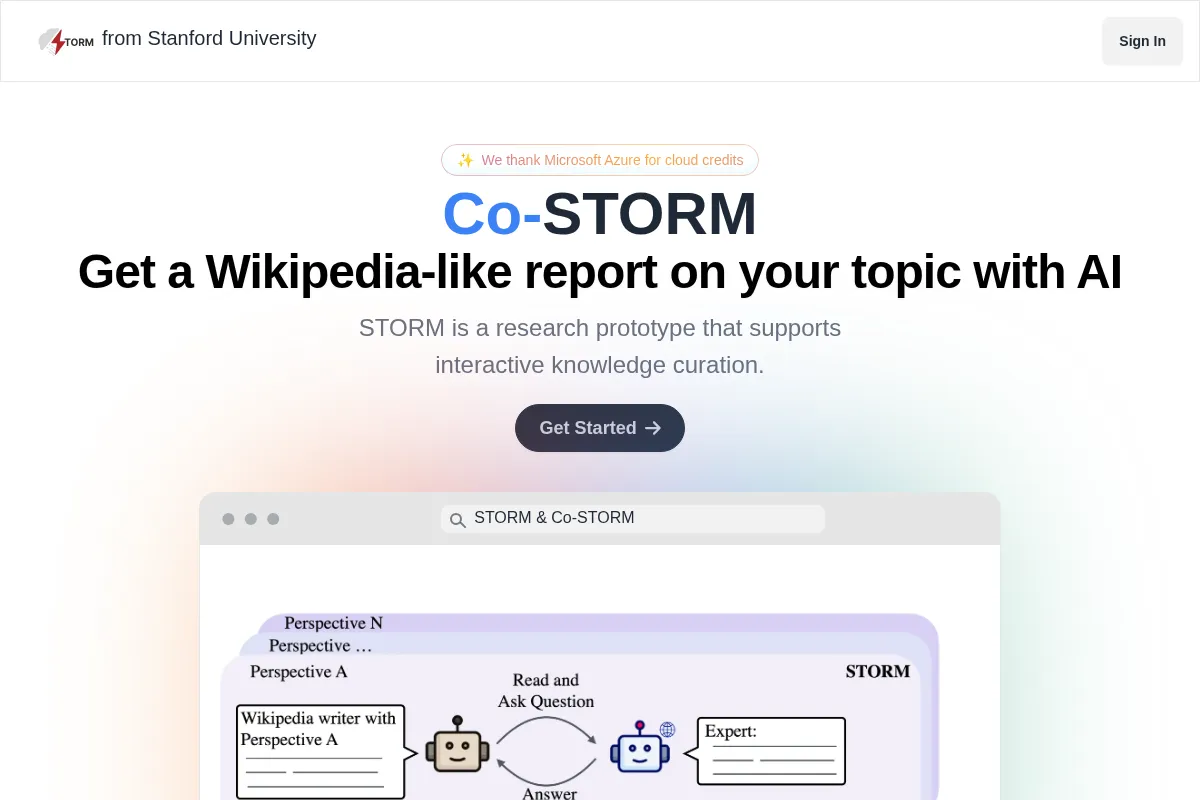
STORM researches a given topic online, identifies multiple perspectives, and generates a comprehensive, well-organized article with citations. It acts as a research assistant, providing a detailed draft that users can then edit and refine.
What makes it different
STORM differentiates itself through its multi-stage research process, which includes perspective-guided question asking and simulated conversations between AI agents to ensure a comprehensive and nuanced understanding of a topic. It focuses on generating structured, citation-backed articles, aiming for a higher degree of factual accuracy and organization than general-purpose chatbots.
Key Features
Synthesis of Topic Outlines through Retrieval and Multi-perspective Question Asking (STORM)
The core methodology involving AI agents simulating conversations to gather diverse information and perspectives.
Wikipedia-style Article Generation
Creates comprehensive, structured articles that mimic the format and depth of Wikipedia entries.
Automated Citations
Provides citations for the information presented, allowing users to verify sources and enhancing credibility.
Pre-writing Stage Automation
Focuses on research, outlining, and information gathering, significantly reducing the time spent on initial drafting.
Co-STORM Collaboration
An extension that allows for human-AI collaboration in the knowledge curation process.
Local Hosting Option
Enables users to run STORM on their own machines for privacy and customization.
Discover Tab
Allows users to explore articles generated by others, providing inspiration and examples.
Pricing
Free
- AI-powered research
- Wikipedia-style article generation
- Automated citation sourcing
- Topic outlining
- Multi-perspective analysis
- PDF export
- Local hosting option
Pricing checked 6 months ago
Pricing guidance
- Not applicable, as the tool is free and open-source.
- Potential for service availability issues due to high demand.
- Generated content is public by default when using the web interface (local hosting mitigates this).
- May require API keys for certain functionalities or local setups.
Completely free and open-source, positioning it as an accessible research aid for everyone.
Pros & Cons
Strengths
-
Efficient Research and Drafting
STORM significantly reduces the time required for initial research and article drafting by automating information gathering and structuring. This is invaluable for users facing tight deadlines.
-
Structured Output with Citations
The tool generates well-organized articles with citations, providing a solid, verifiable foundation for further work. This aids in academic integrity and content credibility.
-
Free and Open-Source
As an open-source project, STORM is freely accessible, making advanced AI research capabilities available to a wide range of users without cost barriers.
-
Multi-Perspective Approach
Its unique method of simulating conversations between AI agents helps in exploring various viewpoints on a topic, leading to more comprehensive initial drafts.
Weaknesses
-
Requires Human Editing
The generated articles are drafts and often require significant editing for readability, nuance, and publication-ready quality. It's not a 'write-and-publish' solution.
Affects: Users expecting polished, final content without revision.
-
Potential for Oversimplification
While comprehensive, the articles can sometimes oversimplify complex topics or lack the specific detail needed for highly specialized research.
Affects: Researchers needing deep, niche expertise or highly nuanced analysis.
-
Inconsistent Service Availability
Some users have reported issues with server availability and processing getting stuck, indicating potential instability in the service.
Affects: Users who rely on consistent, immediate access to the tool.
-
Strict Prompt Limitations
There can be limitations on prompt length or specificity, which may hinder the generation of highly targeted or complex content.
Affects: Users needing to generate very specific or intricate research papers.
Real User Sentiment
Users generally find STORM impressive for its ability to generate comprehensive, cited articles quickly, though they note it requires significant editing and can be inconsistent.
Users tend to like
- Speed of article generation
- Comprehensive nature of generated content
- Inclusion of citations
- Free and open-source accessibility
- Structured output for research foundation
Users commonly complain about
- Requires substantial editing for publication quality
- Inconsistent service availability and processing issues
- Potential for oversimplification or lack of depth on niche topics
- Strict prompt limitations
- Clunky interface or setup difficulties for local hosting
Recurring tradeoffs
- Speed and comprehensiveness vs. publication-ready quality
- Free accessibility vs. potential service instability
- Automated research vs. need for human critical evaluation
Happiest users
Students and researchers who need a strong starting point for articles and are comfortable with editing AI-generated content.
Often frustrated
Users expecting a fully automated, publication-ready content creation tool without the need for significant human input or revision.
Use Cases
Academic research paper drafting
Generating initial drafts with citations for essays, theses, and dissertations.
Content creation for blogs and websites
Quickly producing foundational articles on various topics for content marketers.
Literature review assistance
Summarizing existing research and identifying key sources on a subject.
Knowledge curation for educators
Creating educational materials and overviews on complex subjects.
Personal learning and exploration
Quickly understanding new topics by generating detailed, cited reports.
Frequently Asked Questions
What is STORM AI?
STORM (Synthesis of Topic Outlines through Retrieval and Multi-perspective Question Asking) is an AI research tool developed by Stanford University. It researches a given topic online and generates comprehensive, Wikipedia-style articles with citations. It's designed to streamline the research and writing process by providing a structured draft that users can then edit and refine.
How does STORM compare to ChatGPT or Perplexity?
STORM is more specialized than general-purpose AI chatbots like ChatGPT. While ChatGPT can write on a wide range of topics, STORM is specifically designed for in-depth research and generating structured, citation-backed articles, similar to Wikipedia entries. It often outperforms tools like Perplexity in generating detailed, comprehensive reports with citations, though it requires more editing than a direct answer from Perplexity. STORM's strength lies in its research methodology, using AI agents to simulate conversations and gather diverse perspectives, which is more advanced than Perplexity's direct search summarization.
Is STORM free to use?
Yes, STORM is a free and open-source AI research tool developed by Stanford University. Users can access it via their website or even host it locally. There are no apparent usage limits for the web version, making it highly accessible for students, researchers, and content creators.
What are the limitations of STORM?
STORM's primary limitation is that its output is a draft and requires significant human editing for publication-ready quality. It can sometimes oversimplify complex topics or lack the depth needed for highly specialized research. Users have also reported inconsistent service availability and strict prompt limitations. It's a tool to assist research, not replace critical thinking or final writing.
Can STORM be used for academic papers?
STORM can be a valuable tool for the initial stages of academic paper writing, such as generating outlines, gathering background information, and creating a first draft with citations. However, it is crucial to remember that the output needs thorough review, fact-checking, and editing by the user to ensure accuracy, depth, and adherence to academic standards. It should be used as a research assistant, not a substitute for original work.
Does STORM have integrations?
STORM is an open-source project, and while it supports local hosting and can be integrated with various language models (like OpenAI's GPT, Claude, Gemini, Mistral) and retrieval services (like Tavily, You.com, Bing Search) through API keys, it does not offer direct, out-of-the-box integrations with other third-party applications in the way a commercial SaaS product might. Users looking for deeper integrations would likely need to leverage its open-source nature for custom development.
How accurate is the information generated by STORM?
STORM aims for high accuracy by citing its sources, with reported citation recall and precision rates around 84-85%. However, like all AI-generated content, it is not infallible. Human verification of the generated information and sources is strongly recommended to ensure factual accuracy and prevent the propagation of misinformation. The tool is best used as a starting point for research that is then critically evaluated by the user.
Why trust this page?
This evaluation combines product positioning, pricing analysis, traffic and market signals, and public user sentiment into a single decision-support page. Content is generated editorially — not copied from the vendor's website.
Company
Founded
—
Stage
—
HQ
Stanford, California
Storm is a research project from Stanford University's Open Virtual Assistant Lab, not a venture-backed company. It is available for free and the code is open-source, meaning its longevity is tied to academic research grants and community interest rather than commercial funding.
Market Signals & Traffic
Estimated visits, global rank, geography, traffic sources, monthly visit trends, and organic search keywords (Similarweb)—on a dedicated page built for depth and search.
- Estimated visits
- 0
- Global rank
- —
- Snapshot
- May 2026
- Traffic trend
- —
Estimated monthly visits
Alternatives to Storm
View all alternativesscite
AI Assistant, Productivity

Discover and evaluate scientific research through smart citation context.
Jasper
Content Creation, AI Assistant

AI-powered content creation platform for marketing and business teams.
Similar Tools
SlidesAI
Content Creation, Productivity, AI Assistant

AI-powered tool that transforms any text into professional presentation slides.
Hemingway Editor
Content Creation, Productivity, AI Assistant

Writing tool that improves clarity by highlighting complex sentences.
Banana
Developer Tools, Automation

Serverless GPU infrastructure for deploying and scaling machine learning models.
crewAI
Automation & Agents, Developer Tools

Framework for orchestrating collaborative autonomous agents for complex workflows.
Colossyan
Video Creation, Content Creation, Training & Onboarding

AI video generation platform with realistic avatars for training and communication.
Ollama
Developer Tools, Privacy & Compliance

Run large language models locally on your machine.