

Auctor
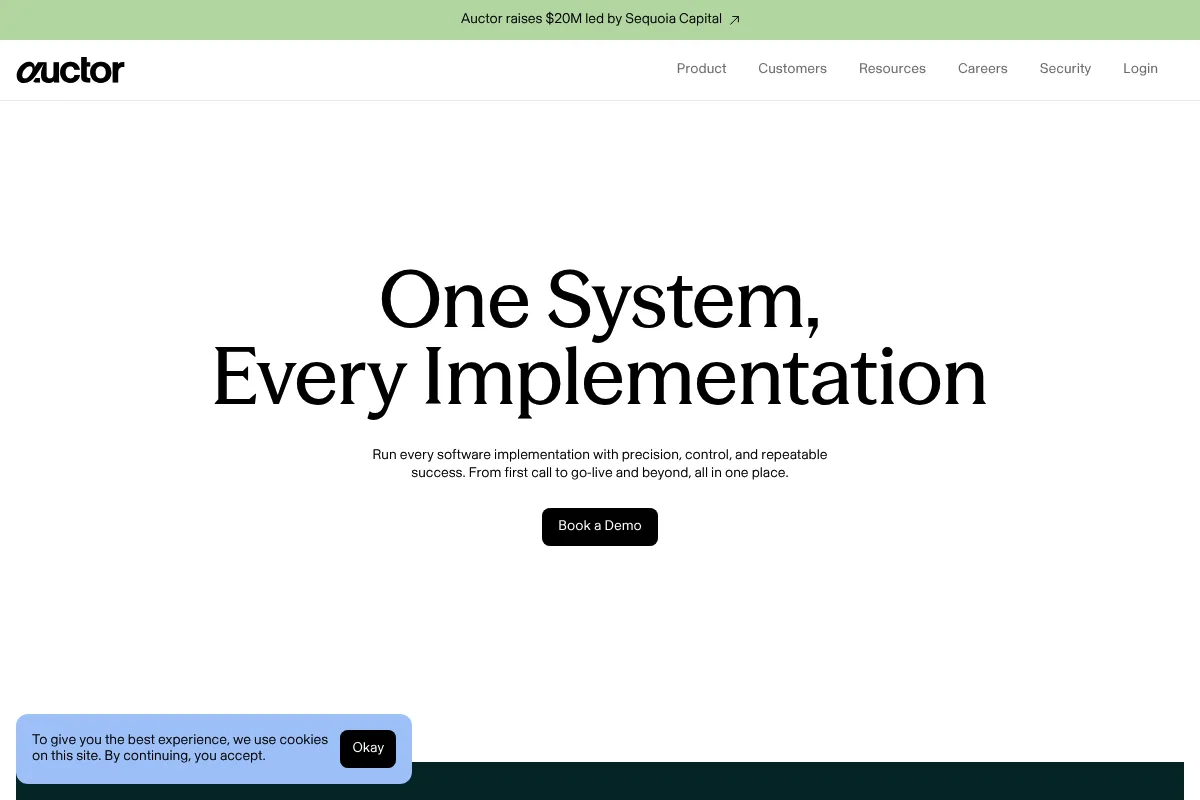
Auctor is an AI-native system of action for pre-sales and implementation teams that automates the transition from discovery calls to project artifacts like SOWs and BRDs.
Excellent for automating the discovery-to-proposal workflow in complex enterprise sales, but not a tool for cold lead scraping or mass outbound.
Analysis based on product data, pricing structure, traffic signals, and public user sentiment.
Who Should Use Auctor?
Typical users
Sales Engineers, Solutions Architects, and Professional Services leads at enterprise software companies or System Integrators (SIs).
Maturity fit
scaling to advanced
Choose this if…
- Your sales process involves complex discovery calls that take days to turn into SOWs
- You struggle with 'documentation drift' between what sales promised and what delivery builds
- You want to automate the creation of Business Requirements Documents (BRDs) and user stories directly from meeting transcripts
Skip this if…
- You need a cold email prospecting tool to find new leads (use Apollo or Clay instead)
- Your sales cycle is short and doesn't require custom statements of work or technical scoping
- You don't use a call recording platform like Gong or Chorus to capture discovery data
About Auctor
Auctor is a specialized AI agent platform designed to bridge the gap between sales discovery and project execution. It targets the 'messy middle' of enterprise software sales where technical requirements often get lost in translation between pre-sales and delivery teams.
Official profiles
What it actually does
The platform joins discovery calls to capture requirements in real-time and automatically generates execution-ready documents such as SOWs, proposals, and system diagrams. It maintains a traceable audit trail from the initial customer request to the final project deliverable.
What makes it different
Unlike general AI note-takers, Auctor is purpose-built for the implementation lifecycle. It doesn't just summarize meetings; it structures data into specific industry-standard artifacts like BRDs and Epics, ensuring that every requirement is linked back to its source transcript.
Ratings across the web
Ratings aggregated from independent review platforms.
Key Features
Meeting Copilot
Surfaces critical technical questions in real-time during discovery to ensure no requirement is missed.
Auto-Aligned Artifacts
Generates first drafts of SOWs and design docs that stay in sync as requirements change during the sales cycle.
Traceable Requirements
Links every line in a project plan back to the specific moment in a call where the customer requested it.
Gong/Chorus Integration
Imports transcripts directly to extract technical constraints and business goals without manual data entry.
CRM Sync
Automatically updates Salesforce or HubSpot with technical discovery notes and project status.
Workflow Standardization
Codifies your team's best practices into reusable templates for every new implementation.
Pricing
Contact Sales
- Full AI Agent access
- Unlimited artifact generation
- CRM & Gong integrations
- Priority support
- Custom implementation templates
Pricing checked 4 months ago
Pricing guidance
- When discovery-to-proposal time exceeds 48 hours
- When project rework due to misaligned requirements hits a critical threshold
- When you need to scale your SI partner ecosystem
- Pricing is likely based on the number of 'Agents' or seats
- Heavy reliance on third-party call recording APIs
Premium enterprise positioning backed by recent $20M Series A funding from Sequoia.
Pros & Cons
Strengths
-
Drastic reduction in 'Admin Time'
Turns weeks of manual documentation work into minutes by drafting SOWs and BRDs automatically from call context.
-
Eliminates requirement gaps
The traceability feature ensures that delivery teams know exactly why a feature was scoped, reducing costly change orders later.
-
High-fidelity pre-sales handoffs
Provides a 'living record' of decisions, making the transition from the sales engineer to the delivery lead much cleaner.
Weaknesses
-
Garbage in, garbage out
The AI's output is only as good as the discovery call; if the rep doesn't ask the right questions, the generated SOW will be generic.
Affects: Teams with junior or unguided sales reps
-
Narrow use case
This is not a general-purpose sales tool. If you aren't doing complex implementations, the overhead of the platform isn't worth it.
Affects: High-velocity, low-ACV SaaS teams
-
Requires specific tech stack
To get the most value, you need to be using Gong, Chorus, or similar tools for the AI to ingest data.
Affects: Teams without established call-recording infrastructure
Real User Sentiment
Early adopters are highly positive about the time saved on documentation, though the tool is still in the 'early-access' phase for many.
Users tend to like
- Speed of generating SOWs
- Accuracy of requirement extraction
- Integration with Gong
Users commonly complain about
- Steep learning curve for prompt tuning
- Lack of public pricing transparency
Recurring tradeoffs
- You trade manual control over every word in a document for massive speed gains and standardized formatting.
Happiest users
Solutions Architects at Series C+ startups who spend 10+ hours a week writing technical documentation.
Often frustrated
Solo founders looking for a simple cold email tool who find the implementation focus too complex.
Use Cases
Sales Discovery
Converting a 60-minute technical call into a structured Business Requirements Document.
SOW Automation
Generating a legally-ready Statement of Work within minutes of a deal closing.
Implementation Handoff
Providing delivery teams with a traceable record of every customer promise made during the sales cycle.
SI Enablement
Helping System Integrators standardize their delivery playbooks across hundreds of projects.
Requirement Traceability
Auditing project failures by tracing requirements back to the original discovery call transcripts.
Frequently Asked Questions
Is Auctor a lead generation tool like Apollo?
No. While it is used by sales teams, it does not find new leads or scrape emails. It automates the work that happens *after* you have a lead on a call, specifically the discovery and scoping phases.
Does Auctor have a free trial?
There is no public self-serve free trial. You must book a demo with their team to get access, as the tool requires configuration with your existing CRM and call recording stack.
Which CRMs does it integrate with?
Auctor currently supports deep integrations with Salesforce and HubSpot, as well as project management tools like Jira and Notion.
How does it compare to general AI note-takers like Otter or Fireflies?
Otter and Fireflies provide summaries and transcripts. Auctor goes further by using that data to generate specific business artifacts like SOWs, BRDs, and Epics that are formatted for professional services teams.
Is it safe for enterprise data?
Yes, Auctor emphasizes enterprise-grade security and requirement traceability, which is why they have secured backing from investors like Sequoia and HubSpot Ventures.
Can it generate system architecture diagrams?
Yes, one of its specialized capabilities is turning verbal descriptions of technical requirements into structured system configuration diagrams and process flows.
Why trust this page?
This evaluation combines product positioning, pricing analysis, traffic and market signals, and public user sentiment into a single decision-support page. Content is generated editorially — not copied from the vendor's website.
Funding & Company
Founded
2025
Stage
Series a
Total Raised
$20M
Latest Round
Series A (Apr 2026)
Notable Investors
Auctor emerged from stealth in April 2026, announcing $20 million in total funding, including a Series A round led by top-tier firm Sequoia Capital. [3, 4, 8] This significant early-stage investment from a syndicate of strategic and venture investors provides substantial runway to tackle the enterprise software implementation market.
Market Signals & Traffic
Estimated visits, global rank, geography, traffic sources, monthly visit trends, and organic search keywords (Similarweb)—on a dedicated page built for depth and search.
- Estimated visits
- 0
- Global rank
- —
- Snapshot
- May 2026
- Traffic trend
- —
Alternatives to Auctor
View all alternativesSalesloft
Automation & Agents, Communication, Productivity

Revenue orchestration platform for sales engagement and pipeline management.
Instantly
Email Marketing, Marketing Automation, Automation

Cold email outreach platform for scaling sales and lead generation.
Snov.io
Email Marketing, Marketing Automation, Automation

Sales automation platform for lead generation and email outreach
Similar Tools
Ranked AI
AI Assistant, Content Creation

A fully managed, AI-powered SEO and PPC service for businesses and agencies.
Coframe
Marketing Automation, Developer Tools

Continuously optimizes website copy and images through autonomous A/B testing.
Navattic
Training & Onboarding, Marketing Automation, Automation & Agents

Create interactive, self-guided product demos for sales and marketing.
Outlit
Automation, Productivity, Workflow

Automated contract review and negotiation platform for legal teams
Lumio
Research, Productivity, Workflow

Centralize customer feedback to drive informed product discovery decisions.
Clay
Marketing Automation, Automation, Data Extraction

Scale personalized outbound sales and lead enrichment with automated workflows.