

Omi (Based Hardware)
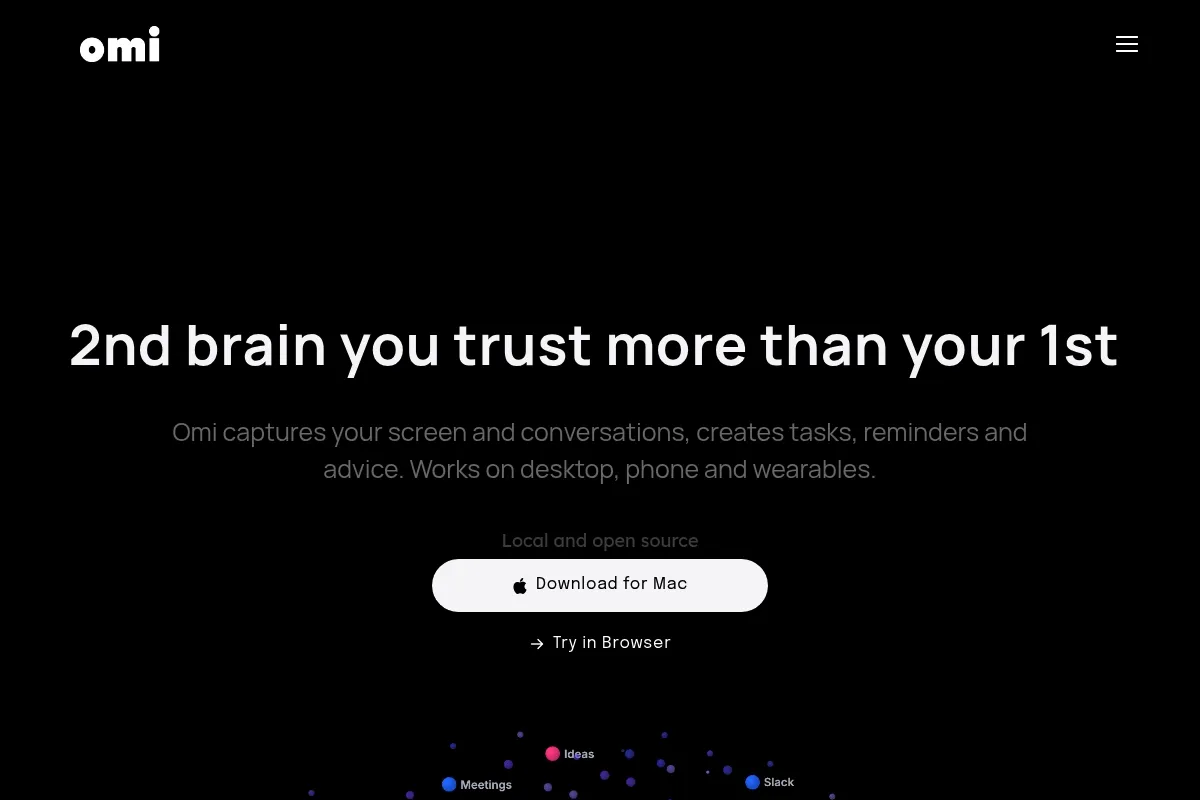
An open-source AI wearable that captures and summarizes ambient conversations, offering a hackable alternative to proprietary memory assistants.
Excellent for developers and privacy-first users, weaker for professionals requiring high-fidelity speaker identification.
Analysis based on product data, pricing structure, traffic signals, and public user sentiment.
Who Should Use Omi (Based Hardware)?
Typical users
Software engineers, early adopters of ambient computing, and students who need automated lecture notes without a high monthly cost.
Maturity fit
beginner to scaling
Choose this if…
- You want an ambient recorder without a mandatory monthly subscription.
- Your priority is data ownership and the ability to self-host your backend.
- You want to customize your AI assistant with community-built plugins.
Skip this if…
- You need to record phone calls, which the hardware cannot capture.
- Your workflow requires 100% accurate speaker diarization for large meetings.
- You want a device with multi-day battery life.
About Omi (Based Hardware)
Omi is an open-source hardware and software ecosystem designed for continuous ambient audio capture. It functions as a wearable second brain that transcribes daily interactions and organizes them into searchable memories and tasks.
What it actually does
The device records audio via a wearable pendant and syncs it to a mobile app for transcription and summarization. It uses Large Language Models to extract action items, identify recurring themes, and allow users to query their past conversations via a chat interface.
What makes it different
Unlike proprietary competitors, Omi is fully open-source, allowing users to flash custom firmware or self-host the backend. It features a community-driven app store where developers can build modular plugins to process conversation data for specific platforms like Notion or Slack.
Key Features
Open-Source Firmware
Allows developers to modify how the device handles audio and data processing.
1,200 Free Minutes
Provides a generous monthly transcription allowance without requiring a subscription.
Omi App Store
Offers modular plugins for Notion, Google Drive, and custom AI mentors.
Haptic Button Interface
Uses physical clicks for recording control and interaction rather than touch sensors.
Self-Hostable Backend
Enables privacy-conscious users to run the processing on their own servers.
Magnetic Charging Dock
Simplifies daily charging with a snap-on USB-C base.
Pricing
Omi Device
- Omi CV1 Hardware
- Magnetic Charging Dock
- Necklace/Clip accessories
- 1,200 transcription mins/mo
Pro Subscription
- Unlimited transcription
- Advanced AI models
- Priority processing
- Cloud backup
Pricing checked 5 months ago
Pricing guidance
- When you exceed 20 hours of recording per month
- When you want to use more advanced LLMs for summaries
- When you need unlimited cloud storage for audio backups
- Transcription accuracy depends on phone connectivity
- Third-party plugins may require their own API keys
- Free tier minutes do not roll over
Aggressively affordable hardware with a developer-friendly freemium software model.
Pros & Cons
Strengths
-
Ownership of data
The open-source nature and self-hosting options ensure your private conversations aren't locked in a proprietary cloud.
-
Extensible ecosystem
The plugin architecture allows the device to grow with new features built by the community rather than just the vendor.
-
Low entry cost
At $89 with a large free transcription tier, it is one of the most affordable ways to enter the ambient AI market.
-
Lightweight form factor
The small, coin-sized design is less intrusive than larger wearables or phone-based recording setups.
Weaknesses
-
Accidental triggers
The entire front face is a physical button, leading to frequent accidental power-offs or recording starts when worn under clothing.
Affects: Active users and those wearing it as a necklace.
-
No phone call recording
Lacks the induction sensors required to capture audio from phone calls, limiting its use for remote sales or support work.
Affects: Sales professionals and remote workers.
-
Battery life limitations
With 10-14 hours of use, it requires daily charging, which can lead to gaps in data if forgotten overnight.
Affects: Users wanting 24/7 life-logging.
-
App stability issues
As an open-source project, the mobile app can be buggy, with occasional sync failures or UI clutter.
Affects: Non-technical users seeking a polished consumer experience.
Real User Sentiment
Users appreciate the transparency and price but find the hardware reliability and app UX to be prototypical.
Users tend to like
- Open-source transparency
- Affordable hardware
- Notion integration
- Active developer community
Users commonly complain about
- Accidental button presses
- Lack of transcript editing
- Short battery life
- Occasional sync lag
Recurring tradeoffs
- Lower price vs. lower hardware polish
- Open ecosystem vs. potential privacy risks from third-party plugins
Happiest users
Developers and tech-savvy early adopters who enjoy tinkering with their tools.
Often frustrated
Corporate professionals expecting a seamless, enterprise-grade meeting recorder.
Use Cases
Student Lectures
Automatically transcribing and summarizing university classes for easier review.
Personal Journaling
Capturing fleeting thoughts and daily reflections without typing.
Developer Debugging
Recording standups and technical discussions to track decisions and action items.
Memory Augmentation
Helping users with ADHD or memory issues recall specific details from past conversations.
Content Creation
Capturing raw ideas and dialogue for writers and podcasters on the go.
Frequently Asked Questions
Does Omi require a monthly subscription?
No, the hardware is a one-time purchase of $89, and the app includes 1,200 minutes of free transcription per month. You only need a subscription if you want unlimited minutes or access to premium AI models.
How does Omi compare to the Limitless Pendant?
Omi is open-source and significantly cheaper ($89 vs $199), but Limitless offers better speaker diarization and deeper integration with meeting software like Zoom. Omi is better for hackers, while Limitless is better for corporate executives.
Can Omi record phone calls?
No. Omi uses a standard microphone to capture ambient sound. It does not have the vibration sensors found in devices like the Plaud Note, which are necessary to record audio directly from a phone's chassis.
Is my data private on Omi?
Omi offers more privacy controls than most competitors because it is open-source. You can choose to store data locally on your phone or even self-host the entire backend, though the default setting uses Omi's secure cloud.
What is the battery life of the Omi wearable?
The latest Omi hardware typically lasts between 10 and 14 hours on a single charge. This is enough for a full workday, but it requires charging every night via its magnetic dock.
What integrations does Omi support?
Omi has a community-driven app store with plugins for Notion, Google Drive, ChatGPT, and Slack. Because it is open-source, developers can also build custom integrations using the Omi SDK.
Why trust this page?
This evaluation combines product positioning, pricing analysis, traffic and market signals, and public user sentiment into a single decision-support page. Content is generated editorially — not copied from the vendor's website.
Funding & Company
Founded
2024
Stage
Seed
Total Raised
$2M
Latest Round
Seed (Jan 2025)
Notable Investors
Based Hardware Inc., the company behind the Omi AI wearable, has raised a single $2 million Seed round in early 2025. This initial capital is being used to expand its engineering team and accelerate the development of its next-generation hardware and a brain-computer interface (BCI) developer kit.
Market Signals & Traffic
Estimated visits, global rank, geography, traffic sources, monthly visit trends, and organic search keywords (Similarweb)—on a dedicated page built for depth and search.
- Estimated visits
- 336,768
- Global rank
- #114,380
- Snapshot
- Apr 2026
- Traffic trend
- Surging
Estimated monthly visits
Alternatives to Omi (Based Hardware)
View all alternativesPlaud NotePin
AI Assistant, Productivity, Documentation

Voice recorder for transcribing and summarizing meetings and calls.
Otter.ai
AI Assistant, Productivity, Documentation
AI-powered transcription and meeting assistant for accurate notes and summaries.
Similar Tools
Adam.ai
AI Assistant, Productivity, Communication
Comprehensive platform for managing meeting agendas, notes, and action items.
Krisp
AI Assistant, Productivity, Communication

AI-powered noise cancellation and meeting assistant for clear communication.
Hugo
AI Assistant, Productivity, Communication

Centralized workspace for agencies to manage email, tasks, and calendars.
Aymo AI
AI Assistant, Productivity, Communication

Personal assistant for managing tasks and information via WhatsApp.
Noty
AI Assistant, Productivity, Communication

Meeting assistant for automated transcription, summaries, and action items.
Kyutai
Research, Developer Tools
Open-science research lab developing multimodal generative models.