

A financial management platform that provides legal and banking infrastructure for un-incorporated groups—best for open-source projects and grassroots collectives, less suitable for traditional private companies.
Excellent for groups needing a bank account and legal status without forming a company, weaker for private entities requiring financial privacy.
Analysis based on product data, pricing structure, traffic signals, and public user sentiment.
Who Should Use Open Collective?
Typical users
Open-source maintainers, community organizers, and activist groups that lack a formal legal entity.
Maturity fit
beginner to scaling
Choose this if…
- You want to accept donations without forming a 501(c)(3) or LLC
- Your priority is radical financial transparency for your contributors
- You need a platform to handle tax forms (W-9/W-8BEN) for global payouts
- You want to manage a shared budget across a decentralized team
Skip this if…
- You require private financial records or non-public ledgers
- You are a standard for-profit company looking for a simple payment processor
- Your project is small enough that the 5-10% total fee outweighs the administrative burden
About Open Collective
Open Collective provides the software and legal framework for groups to manage money collectively. It operates on a 'fiscal hosting' model where established non-profits act as a legal umbrella for smaller projects, removing the need for individual groups to incorporate or manage their own bank accounts.
Official profiles
What it actually does
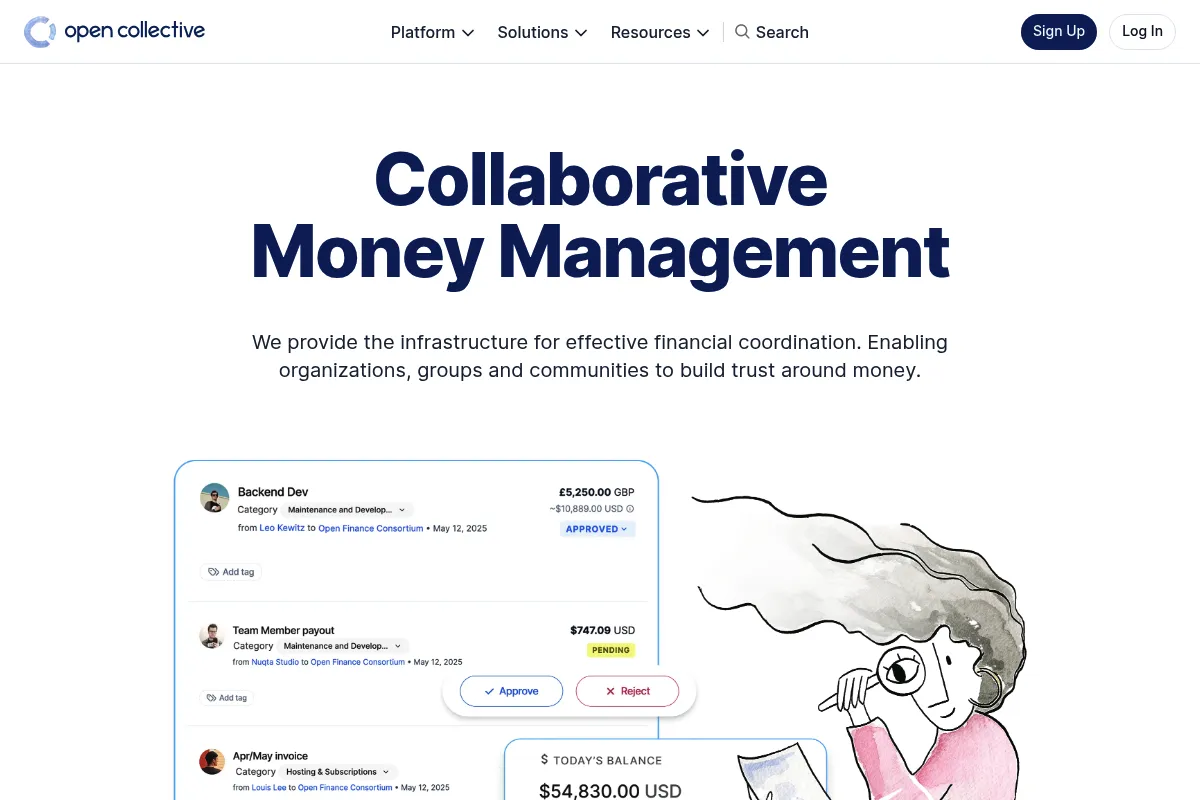
The platform allows groups to create a 'Collective' to accept donations, manage expenses, and pay contributors. It automates the public ledger, ensuring every transaction is visible to donors while handling the back-office complexity of tax reporting and fund disbursements.
What makes it different
Unlike Patreon or GitHub Sponsors which focus solely on fundraising, Open Collective provides the actual legal and banking infrastructure. Through its network of Fiscal Hosts, it solves the 'who owns the bank account' problem for decentralized or community-led projects.
Ratings across the web

Ratings aggregated from independent review platforms.
Key Features
Fiscal Hosting
Provides legal status and banking without the need for incorporation.
Transparent Ledger
Every dollar in and out is automatically logged and visible to the public.
Expense Management
Contributors submit receipts for approval and automated payout via PayPal or Wise.
Virtual Cards
Allows trusted members to spend collective funds directly at point-of-sale.
Contribution Tiers
Customizable recurring donation levels for individual and corporate supporters.
Organization Profiles
Enables companies to manage their open-source giving budget from a single dashboard.
Pricing
Self-Hosted
- Use your own legal entity
- Use your own bank account
- Full access to software features
- Public ledger
Fiscally Hosted
- No legal entity required
- Access to Host bank account
- Host handles tax reporting
- Host handles payouts
- Platform + Host fees combined
Pricing checked 6 months ago
Pricing guidance
- When you decide to incorporate your own 501(c)(3) and move to self-hosting
- When your volume justifies the administrative cost of managing your own bank account
- Host fees vary by host (e.g., Open Source Collective is 10%, others may differ)
- Payment processor fees (Stripe/PayPal) are charged on top of platform/host fees
- Some hosts have minimum balance requirements
Premium pricing justified by the significant reduction in legal and administrative labor.
Pros & Cons
Strengths
-
Eliminates legal overhead
By using a Fiscal Host, projects avoid the costs and paperwork of forming a non-profit or corporation.
-
Built-in trust and transparency
The public ledger proves to donors exactly how their money is being spent, which often increases donation conversion.
-
Global payout handling
The platform manages the complexity of paying contributors in different countries, including necessary tax documentation.
-
Corporate-friendly
Provides the invoices and tax receipts that large companies require to sponsor open-source projects.
Weaknesses
-
High cumulative fees
Between the platform fee, the fiscal host fee, and payment processing, you can lose 10-15% of every donation.
Affects: Small projects with tight margins
-
Mandatory public data
There is no option for private accounting; if you need to hide specific expenses or donor names (in some cases), this isn't the tool.
Affects: Groups requiring financial privacy
-
Complex host relationships
Users must apply to and be accepted by a Fiscal Host, which adds a layer of approval and potential bureaucracy.
Affects: New projects wanting immediate setup
Real User Sentiment
Highly positive among developers and community leaders who value transparency and hate paperwork.
Users tend to like
- Ease of paying international contributors
- Automatic generation of tax receipts
- The 'set it and forget it' nature of legal compliance
- Public ledger builds immediate credibility with donors
Users commonly complain about
- The UI can be confusing when navigating between the Collective and the Host
- Total fees feel high compared to simple payment processors
- The approval process for some hosts can be slow
Recurring tradeoffs
- You trade 10% of your revenue for the ability to avoid thousands of dollars in legal and accounting fees.
Happiest users
Maintainers of popular open-source libraries who want to accept corporate sponsorships without starting a business.
Often frustrated
Small local groups who find the percentage-based fees too high for their low-volume fundraising.
Use Cases
Open Source Project
Accepting funds from companies to pay for hosting and contributor bounties.
Grassroots Activism
Raising money for community supplies without a single person taking the tax hit.
Meetup Groups
Managing ticket sales and venue costs transparently.
Mutual Aid Funds
Distributing small grants to community members with a public audit trail.
Corporate Giving
Companies like Airbnb or Google using the platform to distribute funds to their dependencies.
Frequently Asked Questions
Do I need a bank account to use Open Collective?
No. If you join a Fiscal Host, you use their bank account. You only need a way to receive payouts (like PayPal or Wise) when you want to withdraw funds or reimburse expenses.
How does this compare to GitHub Sponsors?
GitHub Sponsors is for individuals or organizations with their own bank accounts. Open Collective provides the legal entity and bank account for you. Many projects use both: GitHub Sponsors for the 'Donate' button and Open Collective as the 'Fiscal Host' to receive those funds.
What are the total fees?
It depends on the host. Typically, it is a 10% host fee + 0% platform fee (for many non-profit hosts) + Stripe/PayPal fees (approx 2.9% + $0.30). Expect to lose about 13-15% total.
Is my data private?
No. Open Collective is 'transparent by default.' All contributions and expenses are listed on your public page. You can hide donor names in some cases, but the financial totals and expense descriptions remain public.
Can I pay people in other countries?
Yes. Open Collective integrates with Wise and PayPal to handle international payouts and automatically collects the required tax forms (W-8BEN) for the US-based hosts.
What is a Fiscal Host?
A Fiscal Host is a legal entity (usually a non-profit) that holds funds on behalf of Collectives. They provide the bank account, handle the taxes, and ensure the money is spent according to the law.
Why trust this page?
This evaluation combines product positioning, pricing analysis, traffic and market signals, and public user sentiment into a single decision-support page. Content is generated editorially — not copied from the vendor's website.
Funding & Company
Founded
2015
Stage
Seed
Total Raised
$2.82M
Latest Round
Seed (Jun 2017)
Notable Investors
Open Collective was initially backed by nearly $3M in seed funding between 2015 and 2017 from investors focused on social good. [2, 4] In 2024, the original platform transitioned from a venture-backed company to stewardship by a community-governed non-profit, ensuring its long-term stability is tied to its mission rather than investor returns. [5, 8]
Market Signals & Traffic
Estimated visits, global rank, geography, traffic sources, monthly visit trends, and organic search keywords (Similarweb)—on a dedicated page built for depth and search.
- Estimated visits
- 0
- Global rank
- —
- Snapshot
- May 2026
- Traffic trend
- Falling
Estimated monthly visits
Alternatives to Open Collective
View all alternatives
Similar Tools
Mastra
Developer Tools, Automation & Agents, Workflow

TypeScript framework for building and deploying production-ready agents.
Podium
Communication, Marketing Automation, E-commerce

Customer communication and lead conversion platform for local businesses.
Noty
AI Assistant, Productivity, Communication

Meeting assistant for automated transcription, summaries, and action items.
Shotcut
Video Creation, Content Creation

Open-source, cross-platform video editor for high-quality video production
Adam.ai
AI Assistant, Productivity, Communication

Comprehensive platform for managing meeting agendas, notes, and action items.
All Hands AI
Developer Tools, Automation & Agents

Open-source platform for autonomous software engineering agents.