

A dedicated handheld AI assistant that attempts to replace app-based navigation with voice-driven actions, currently functioning more as an experimental prototype than a reliable daily tool.
Excellent for tech enthusiasts wanting to test the limits of Large Action Models, weaker for anyone needing a dependable replacement for smartphone workflows.
Analysis based on product data, pricing structure, traffic signals, and public user sentiment.
Who Should Use Rabbit?
Typical users
Early adopters, gadget collectors, and AI researchers who prioritize experimenting with new interaction models over reliability.
Maturity fit
beginner
Choose this if…
- You want a dedicated, distraction-free device for voice-to-action tasks
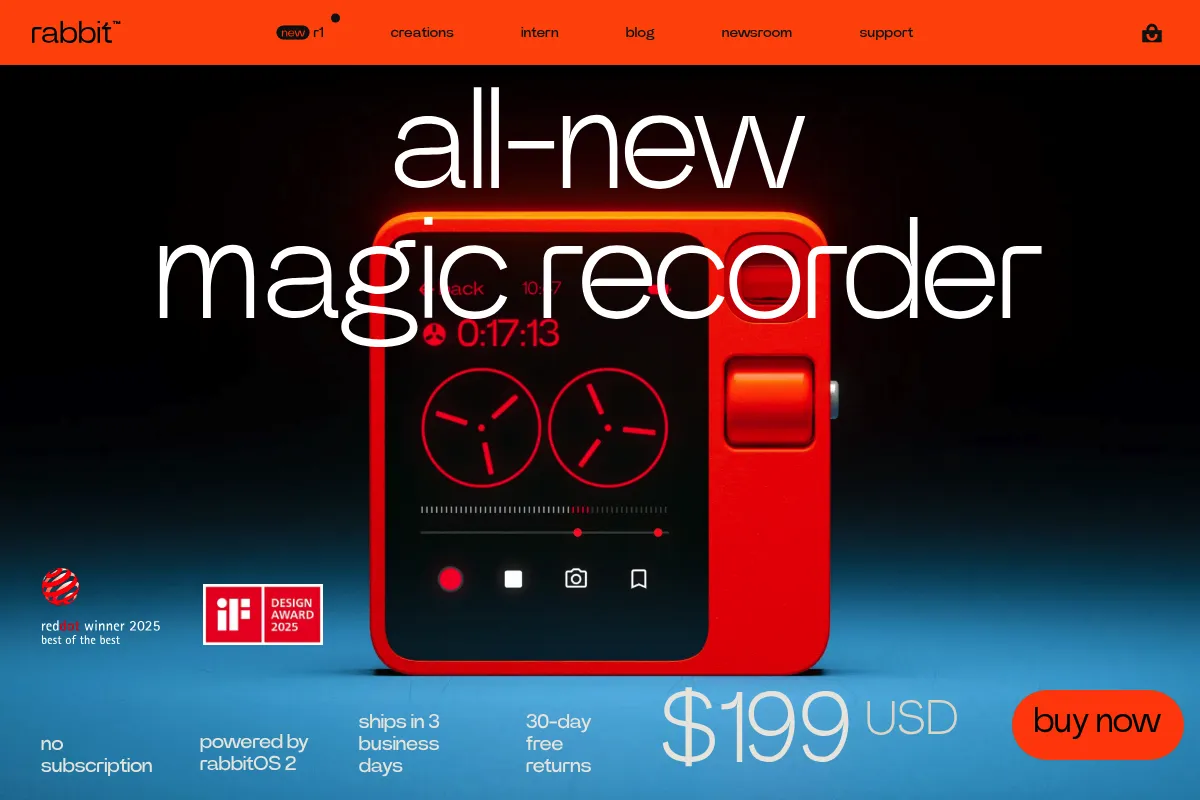
- You value the Teenage Engineering hardware aesthetic and physical controls
- Your priority is testing 'Teach Mode' and agentic AI capabilities early
Skip this if…
- You need a device that reliably lasts a full day on a single charge
- You require a broad ecosystem of supported apps beyond the core four (Spotify, Uber, DoorDash, Midjourney)
- You are frustrated by 5-10 second latencies for simple queries
About Rabbit
Rabbit is a standalone hardware device designed to bypass traditional smartphone interfaces using a Large Action Model (LAM). It aims to execute digital tasks—like booking rides or playing music—through a unified natural language interface rather than individual apps.
Official profiles
What it actually does
The device listens to voice commands and interacts with web-based versions of popular apps to perform actions on the user's behalf. Users connect their accounts via a 'Rabbit Hole' cloud portal, allowing the device to execute tasks like ordering food or generating AI images without manual screen navigation.
What makes it different
Unlike standard LLMs that only process text or images, Rabbit's LAM is specifically trained to navigate and interact with user interfaces. It prioritizes a push-to-talk physical interaction and a rotating 'Rabbit Eye' camera over the always-on, screen-heavy experience of a smartphone.
Ratings across the web

Ratings aggregated from independent review platforms.
Key Features
Large Action Model (LAM)
Navigates app interfaces to execute tasks without manual tapping.
Rabbit Hole
A secure web portal for connecting third-party services and reviewing history.
Rabbit Eye
A 360-degree rotating camera used for vision-based queries and environment sensing.
Push-to-Talk
A physical side button that ensures the device only listens when intended.
Teach Mode
An experimental feature allowing users to record and automate custom web workflows.
Perplexity Integration
Provides live, sourced answers to general knowledge questions.
Analog Scroll Wheel
Provides tactile navigation for settings and history logs.
Pricing
Rabbit R1
- Rabbit R1 Hardware
- Lifetime access to Rabbit OS
- Perplexity Pro (limited time offer)
- Rabbit Hole portal access
- USB-C charging cable
Pricing checked 5 months ago
Pricing guidance
- N/A - Single tier hardware
- Requires a separate SIM card and data plan for mobile use
- No built-in support for standard SMS or phone calls
- Limited to 2.4GHz/5GHz Wi-Fi
Aggressively priced as a loss-leader to build an early user base for their LAM ecosystem.
Pros & Cons
Strengths
-
Low entry price
At $199 with no recurring subscription, it is significantly more accessible than competitors like the Humane AI Pin.
-
Privacy-first hardware
The physical push-to-talk button and the ability to physically rotate the camera into the housing provide clear privacy indicators.
-
Compact, high-quality design
The Teenage Engineering collaboration results in a unique, pocketable form factor that stands out from generic smartphones.
-
Fast vision processing
The device is surprisingly quick at identifying objects or summarizing text viewed through the camera lens.
Weaknesses
-
Severe battery limitations
The device often struggles to survive a full day of moderate use, requiring frequent recharging.
Affects: Mobile users and travelers
-
High execution latency
The round-trip time from voice command to action completion is often slower than just opening an app on a phone.
Affects: Efficiency-focused users
-
Limited app support
The 'Large Action Model' currently only supports a very small number of services reliably, limiting its utility.
Affects: Power users
-
Redundant functionality
Most core features—translation, search, and music control—are already handled more reliably by modern smartphones.
Affects: Practical-minded buyers
Real User Sentiment
Polarized; users praise the hardware aesthetics and vision features but are frustrated by the slow, unreliable app execution.
Users tend to like
- Tactile scroll wheel and button feel
- Vibrant orange industrial design
- Accurate real-time translation
- Integration with Perplexity for search
Users commonly complain about
- Frequent 'hallucinations' where the device claims to do something it hasn't
- Poor battery life in standby mode
- Difficulty connecting to enterprise Wi-Fi
- Limited utility compared to a smartphone
Recurring tradeoffs
- Portability vs. Capability: You gain a small device but lose the reliability of a full mobile OS.
Happiest users
Tech hobbyists who enjoy being part of a 'beta' hardware launch.
Often frustrated
Mainstream consumers who expected a polished, faster alternative to their iPhone or Android.
Use Cases
International Travel
Using the push-to-talk feature for quick, two-way language translation.
Hands-free Commuting
Ordering a ride-share via voice while walking or carrying bags.
Visual Identification
Using the camera to identify plants, animals, or parts of a machine.
AI Image Generation
Prompting Midjourney via voice to create concepts while away from a desk.
Quick Fact-Checking
Using the Perplexity integration to get sourced answers without screen distractions.
Frequently Asked Questions
Does the Rabbit R1 require a monthly subscription?
No, the Rabbit R1 costs a flat $199. There are currently no monthly fees for the Rabbit OS or the basic AI services it provides, though you will need your own SIM card and data plan for mobile connectivity.
Can the Rabbit R1 replace my smartphone?
No. It lacks essential smartphone features like a traditional dialer for phone calls, a standard messaging app for SMS, and a full app store. It is designed to be a companion device, not a replacement.
How does Rabbit R1 compare to the Humane AI Pin?
The Rabbit R1 is significantly cheaper ($199 vs $699) and includes a screen and scroll wheel, whereas the Humane Pin is a screenless wearable. Rabbit uses a 'Large Action Model' to control apps, while Humane relies more on a proprietary 'AI Mic' and laser projection interface.
Which apps are currently supported on Rabbit R1?
As of now, the 'Rabbit Hole' officially supports Spotify, Uber, DoorDash, and Midjourney. Other capabilities like search and translation are built-in, but the list of third-party apps it can actually 'act' within remains very small.
Is the Rabbit R1 just an Android app in a box?
While the device runs on an AOSP (Android Open Source Project) base, the core value proposition is the 'Large Action Model' (LAM) running in the cloud. However, technical teardowns have shown that much of the interface functions similarly to a specialized Android application.
How long does the battery actually last?
In real-world testing, the battery typically lasts between 4 to 7 hours of active use. While software updates have improved standby time, it still requires daily charging and may not last through a full day of heavy interaction.
Why trust this page?
This evaluation combines product positioning, pricing analysis, traffic and market signals, and public user sentiment into a single decision-support page. Content is generated editorially — not copied from the vendor's website.
Funding & Company
Founded
2020
Stage
Series b
Total Raised
$64.7M
Latest Round
Series B (Mar 2024)
Notable Investors
Rabbit has raised a total of $64.7 million, primarily to develop and launch its r1 AI hardware device. The funding is heavily backed by top-tier venture firm Khosla Ventures, which has led multiple rounds, signaling strong investor confidence in the company's vision to create a new category of consumer AI hardware.
Market Signals & Traffic
Estimated visits, global rank, geography, traffic sources, monthly visit trends, and organic search keywords (Similarweb)—on a dedicated page built for depth and search.
- Estimated visits
- 158,418
- Global rank
- #253,120
- Snapshot
- Apr 2026
- Traffic trend
- Falling
Estimated monthly visits
Alternatives to Rabbit
View all alternativesAi Pin
AI Assistant, Communication, Productivity

Wearable screenless device for voice and gesture-based digital interaction.
Gemini
AI Assistant, Content Creation

An experimental AI-powered conversational chatbot from Google.
Copilot
AI Assistant, Content Creation

AI-powered assistant for productivity, creativity, and collaboration.
Similar Tools
MultiOn
AI Assistant, Automation, Productivity

AI agents that autonomously perform tasks and workflows on the web.
Genspark
AI Assistant, Automation, Productivity

All-in-one AI workspace for research, content creation, and task automation.
Lindy
AI Assistant, Automation, Productivity

No-code AI agent builder for automating business workflows.
Reclaim AI
AI Assistant, Automation, Productivity

AI-powered calendar assistant that automatically schedules tasks, habits, and focus time.
Obviously AI
Automation, Developer Tools, Research

No-code platform for building and deploying predictive machine learning models.
rasa.io
Email Marketing, Marketing Automation, Content Creation

Automated personalized newsletters tailored to every individual subscriber.