

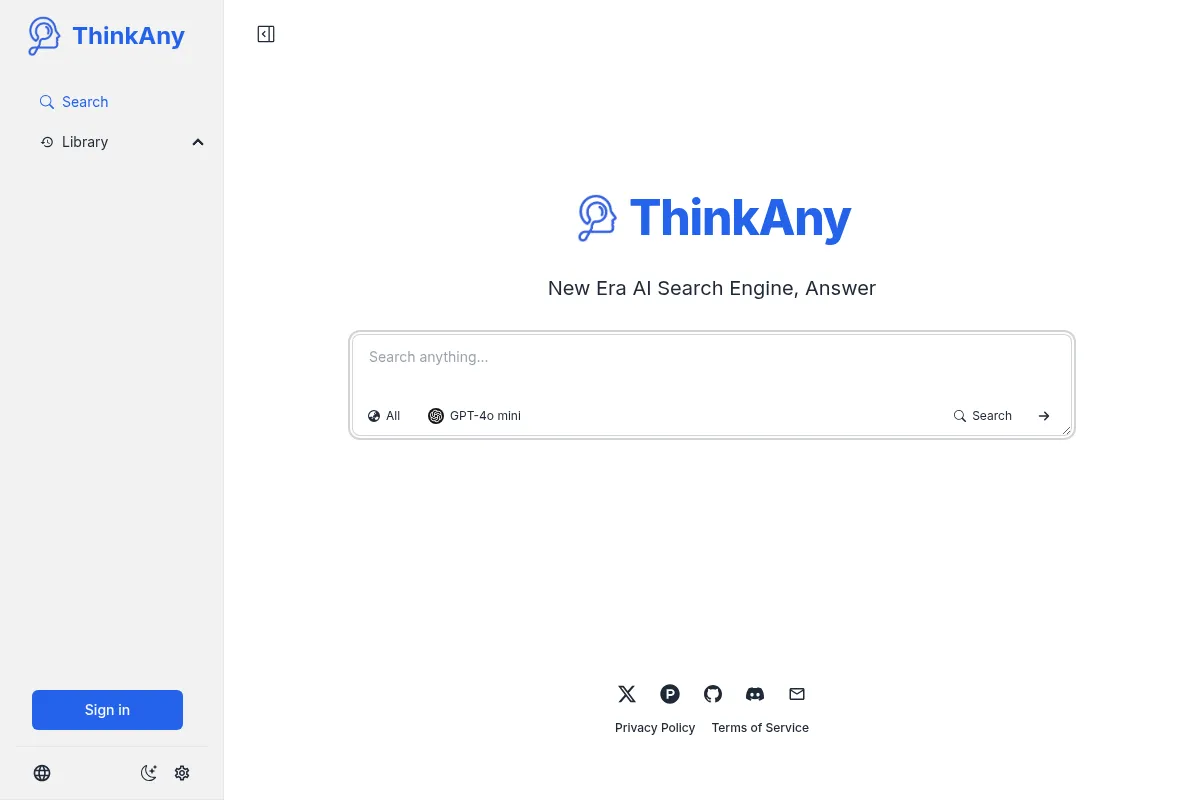
ThinkAny is an AI search engine that synthesizes web information into direct, sourced answers, with integrated productivity tools for research structuring.
Best for researchers and professionals needing synthesized information, weaker for users requiring deep customization of AI models.
Analysis based on product data, pricing structure, traffic signals, and public user sentiment.
Who Should Use ThinkAny?
Typical users
Researchers, students, content creators, and professionals who frequently need to gather and synthesize information from the web. Ideal for individuals or small teams looking to streamline research and knowledge organization.
Maturity fit
beginner to scaling
Choose this if…
- You need direct, synthesized answers instead of a list of links.
- You value integrated tools for creating mind maps and outlines from search results.
- Your research workflow benefits from clear sourcing and aggregation of information.
- You prefer a clean, intuitive interface for AI-powered search.
Skip this if…
- You require the ability to select from multiple underlying AI models.
- Your workflow depends on advanced automation or complex integrations.
- You need highly specialized AI functionalities beyond information synthesis and structuring.
- You are looking for a long-established tool with extensive user reviews and brand recognition.
About ThinkAny
ThinkAny is an AI-powered search engine that uses Retrieval-Augmented Generation (RAG) to provide direct, synthesized, and sourced answers. It aims to move beyond traditional search results by aggregating web content into coherent responses. The tool also includes productivity features like mind maps and outlines to aid in research and knowledge organization.
Official profiles
What it actually does
ThinkAny functions as an AI search engine that retrieves information from the web and synthesizes it into direct answers. It offers different modes, including search, chat, and summarization, and provides tools like mind maps and outlines to help users structure and understand the information they find.
What makes it different
ThinkAny differentiates itself by focusing on the synthesis of information and offering integrated productivity tools like mind maps and outlines directly within the search experience. Unlike some competitors that offer more raw AI model customization, ThinkAny prioritizes a structured and visually organized output for research.
Ratings across the web

Ratings aggregated from independent review platforms.
Key Features
Search Mode
Provides direct, factual, and sourced answers for specific queries.
Chat Mode
Allows for conversational follow-ups and deeper exploration of topics.
Summarize Mode
Condenses long articles, papers, or web pages into key bullet points.
Mind Map & Outline Tools
Transforms research into structured, visual knowledge for better understanding and organization.
RAG Technology
Ensures answers are up-to-date and verifiable by retrieving live data from the web.
Content Aggregation
Gathers information from multiple high-quality sources into a single, synthesized response.
Pricing
Free
- Basic search
- Basic chat capabilities
Pro
- Advanced experience
- Multi-Usage-Mode (Search/Chat/Summarize)
- Enhanced productivity tools (Mind Map, Outline)
Pricing checked 6 months ago
Pricing guidance
- When you need to use the Summarize mode for long documents.
- When you want to leverage the Mind Map and Outline features for research structuring.
- When you require more advanced chat capabilities or search modes.
- The free plan has limited usage times and basic chat models.
- Specific query depth and filtering options may be limited on the free tier.
Affordable freemium model with a straightforward paid tier for enhanced features.
Pros & Cons
Strengths
-
Integrated Productivity Tools
The inclusion of mind map and outline generation directly from search results transforms research from passive consumption to active understanding, a significant advantage for students and professionals.
-
Clear Sourcing and Synthesis
ThinkAny excels at aggregating information from multiple sources and presenting it as a synthesized answer with clear citations, reducing the need for users to cross-reference numerous links.
-
Intuitive Interface
The platform offers a clean, minimalist, and user-friendly interface that makes it easy to navigate and utilize its AI search and productivity features.
-
Up-to-date Information
By leveraging RAG technology, ThinkAny provides current information, overcoming the knowledge cutoff limitations of traditional AI models.
Weaknesses
-
Limited AI Model Choice
Unlike some competitors, ThinkAny does not currently offer users the ability to select from a variety of underlying AI models, which may limit customization for advanced users.
Affects: Advanced users seeking model flexibility
-
Newer Market Player
As a relatively new entrant, ThinkAny has less brand recognition and fewer user reviews compared to more established AI search engines.
Affects: Users prioritizing established tools and extensive social proof
-
Potential for Hallucination
While RAG mitigates some AI hallucination, like any AI tool, ThinkAny may occasionally provide inaccurate or irrelevant sources.
Affects: Users who require absolute factual accuracy without verification
Real User Sentiment
Generally positive, with users appreciating its unique features and synthesized answers, though some note its newness and limitations compared to more established competitors.
Users tend to like
- Integrated mind map and outline tools for research structuring.
- Direct, synthesized, and sourced answers.
- Clean and intuitive user interface.
- Up-to-date information due to RAG technology.
Users commonly complain about
- Lack of choice in underlying AI models.
- Newer player with less brand recognition and fewer reviews.
- Occasional inaccuracies or irrelevant sources (hallucinations).
Recurring tradeoffs
- Ease of use and structured output vs. advanced AI model customization.
- Novelty and unique features vs. established market presence and user base.
Happiest users
Researchers, students, and professionals who value structured knowledge organization and direct, synthesized answers.
Often frustrated
Advanced users who require granular control over AI models or extensive integration capabilities.
Use Cases
Academic Research
Synthesizing information from multiple sources for papers and projects.
Content Creation
Gathering background information and structuring ideas for articles or blog posts.
Market Analysis
Aggregating data and trends for business insights.
Learning and Development
Understanding complex topics through direct answers and visual outlines.
Personal Knowledge Management
Organizing information found online into structured formats.
Competitive Research
Quickly gathering and comparing information on competitors.
Frequently Asked Questions
What is ThinkAny and how does it differ from traditional search engines?
ThinkAny is an AI-powered search engine that uses Retrieval-Augmented Generation (RAG) technology to provide direct, synthesized, and sourced answers, rather than just a list of links. It aims to go beyond traditional search by aggregating and summarizing information from the web. Key differentiators include its integrated productivity tools like mind maps and outlines, which help users structure and visualize research findings, offering a more active approach to information consumption compared to passive link lists.
What is RAG technology and why is it important for ThinkAny?
RAG stands for Retrieval-Augmented Generation. It's a technology that allows AI models to access and process real-time information from the web before generating an answer. This is crucial because it ensures that ThinkAny's responses are up-to-date and grounded in verifiable sources, mitigating the 'knowledge cutoff' and 'hallucination' issues common in older AI models. It enables ThinkAny to provide accurate and current information by retrieving live data and then synthesizing it.
What are the pricing plans for ThinkAny, and is there a free version?
ThinkAny operates on a freemium model. There is a Free plan that offers basic search and chat capabilities. For enhanced features, including multi-usage modes (search, chat, summarize) and productivity tools like mind maps and outlines, users can upgrade to the Pro plan for $20 per month. The Pro plan is highlighted as the most popular and offers an advanced experience.
How does ThinkAny compare to Perplexity AI?
ThinkAny and Perplexity AI are both AI-powered search engines that provide synthesized answers with citations. ThinkAny's key differentiator is its integrated productivity tools like mind maps and outlines, which are excellent for structuring research. Perplexity, on the other hand, is often praised for its powerful 'Focus' feature, choice of AI models, and more extensive customization options for advanced users. The choice between them often depends on whether you prioritize structured knowledge organization (ThinkAny) or AI model flexibility and raw power (Perplexity).
What are the limitations of ThinkAny?
One significant limitation is the lack of choice in underlying AI models; users cannot select different LLMs as they can with some competitors. As a newer player, it also has less brand recognition and fewer user reviews. While RAG technology helps, like any AI, there's still a possibility of occasional inaccuracies or irrelevant sources (hallucinations) that users should verify. The free tier also has usage limitations.
Does ThinkAny offer integrations with other tools?
Information regarding specific third-party integrations is not extensively detailed in the available resources. However, ThinkAny does mention a RAG Search API, suggesting potential for developer integration in the future. For users seeking extensive workflow integrations, this may be a consideration.
Who are the typical users of ThinkAny?
ThinkAny is ideal for researchers, students, content creators, and professionals who need to quickly gather, synthesize, and organize information. Its focus on direct answers and structured output makes it particularly useful for those who need to understand complex topics or prepare reports and presentations.
Can developers use ThinkAny?
Yes, ThinkAny appears to be developer-friendly. The company maintains an open-source presence on GitHub and has mentioned a RAG Search API, indicating a strategy that could allow developers to build upon their technology.
Why trust this page?
This evaluation combines product positioning, pricing analysis, traffic and market signals, and public user sentiment into a single decision-support page. Content is generated editorially — not copied from the vendor's website.
Funding & Company
Founded
2020
Stage
Series a
Total Raised
$74.6M
Latest Round
Series A (Jun 2024)
Notable Investors
HeyGen, the parent company of ThinkAny, has secured approximately $74.6 million in funding, highlighted by a substantial $60 million Series A in June 2024 led by top-tier firm Benchmark. This significant capital provides a long runway for product development and market expansion for its core AI video generation platform.
Market Signals & Traffic
Estimated visits, global rank, geography, traffic sources, monthly visit trends, and organic search keywords (Similarweb)—on a dedicated page built for depth and search.
- Estimated visits
- 0
- Global rank
- —
- Snapshot
- May 2026
- Traffic trend
- Surging
Estimated monthly visits
Alternatives to ThinkAny
View all alternativesPerplexity
AI Assistant, Content Creation

AI-powered conversational search engine providing cited, comprehensive answers.
Gemini
AI Assistant, Content Creation

An experimental AI-powered conversational chatbot from Google.
ChatGPT
AI Assistant, Content Creation

AI-powered conversational chatbot for generating text and assisting with various tasks.
Similar Tools
Mistral / Le Chat
AI Assistant, Productivity, Content Creation

A versatile AI assistant for work and life, offering fast responses and advanced features.
iAsk.Ai
AI Assistant, Productivity, Content Creation

Search engine for instant, factual answers and document analysis.
HubSpot
Marketing Automation, Automation & Agents, Website Builder
Customer platform for marketing, sales, and service automation.
Shopify
Website Builder, Marketing Automation, Automation

Comprehensive platform for building and managing online retail stores.
Pieces
Developer Tools, Productivity, AI Assistant

Workflow copilot for capturing and managing developer context and snippets.
n8n
Automation, Automation & Agents, Developer Tools

Workflow automation platform for connecting apps and building complex sequences.