

An enterprise-grade computer vision engine that automates visual damage appraisal for auto and property insurance—best for high-volume carriers looking to remove human adjusters from simple claims.
Excellent for accelerating touchless claims and triage, but weaker for complex structural repairs that require physical teardowns.
Analysis based on product data, pricing structure, traffic signals, and public user sentiment.
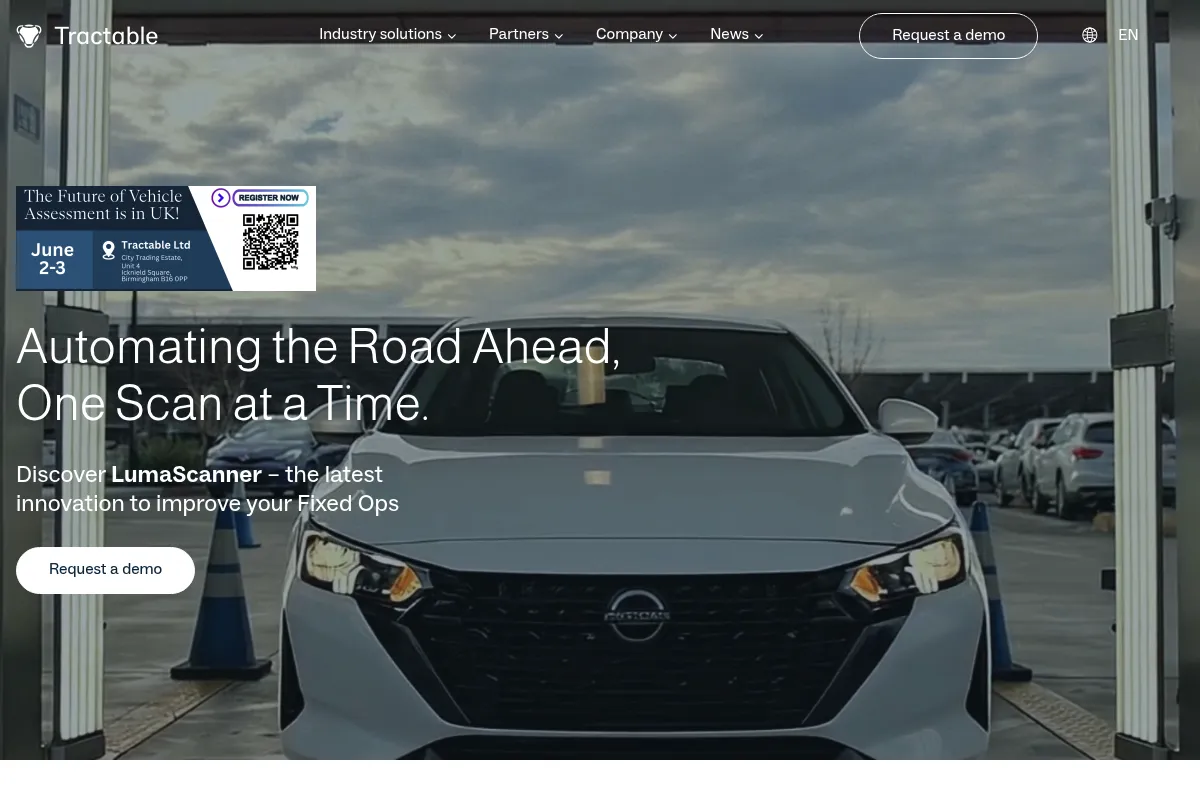
Who Should Use Tractable?
Typical users
Claims managers at Tier-1 insurance carriers, large-scale fleet operators, and automotive recyclers.
Maturity fit
advanced
Choose this if…
- You process over 10,000 claims monthly and need to reduce cycle times.
- Your priority is standardizing appraisals across a fragmented repair network.
- You want to enable policyholders to submit their own damage photos via a guided interface.
Skip this if…
- You are a small independent repair shop with low volume.
- Your workflow involves high-complexity or vintage vehicle repairs where parts data is scarce.
- You lack the engineering resources to integrate an API into a legacy claims management system.
About Tractable
Tractable is an AI-first visual assessment tool designed for the insurance and automotive ecosystems. It replaces manual inspections by using computer vision to analyze photos of damage and generate immediate repair estimates or total loss valuations.
Official profiles
What it actually does
The platform processes smartphone or drone imagery to identify damaged parts, assess severity, and calculate costs based on local labor rates and parts databases. It automates the 'triage' phase, instantly deciding if a vehicle is repairable or a total loss.
What makes it different
Unlike traditional estimation software that added AI as an afterthought, Tractable was built AI-first. Its focus is on 'visual intelligence'—interpreting pixels rather than just managing parts lists—which allows it to handle lower-quality photos taken by non-professionals.
Ratings across the web
Ratings aggregated from independent review platforms.
Key Features
AI Inspection
Converts smartphone photos into line-item repair estimates in seconds.
AI Triage
Flags total losses immediately to prevent unnecessary towing and storage fees.
AI Review
Audits repair shop estimates to identify overcharging or unnecessary operations.
Property AI
Analyzes drone or smartphone footage of wind and hail damage for residential claims.
Subrogation
Automates the recovery process between insurance companies by comparing damage photos.
Mobile Web App
A white-labeled, browser-based tool that guides users to take the exact photos the AI needs.
Pricing
Enterprise
- Full API access
- Custom AI training for specific markets
- Dedicated account management
- Guided capture web-app
- Integration support
Pricing checked 4 months ago
Pricing guidance
- Expanding from auto to property claims
- Increasing monthly claim volume
- Adding subrogation or salvage modules
- API call limits based on contract tier
- Geographic restrictions on parts and labor cost databases
- Specific car model coverage gaps
Premium enterprise positioning justified by the massive operational savings in high-volume environments.
Pros & Cons
Strengths
-
Significant cycle time reduction
Reduces the claim settlement process from days to minutes by removing the need for a physical adjuster to visit the site.
-
Appraisal consistency
Eliminates human bias and variance in damage assessment across different regions or individual adjusters.
-
High-quality data capture
The guided capture tool ensures policyholders provide usable images, reducing the need for follow-up inspections.
-
Global scale
The AI is trained on hundreds of millions of images across various markets, making it reliable for a wide range of car makes and models.
Weaknesses
-
High integration overhead
Requires deep API integration into legacy Claims Management Systems (CMS), which can take months for enterprise IT teams.
Affects: IT departments and implementation managers
-
Blindness to internal damage
The AI cannot see mechanical failures or structural damage hidden behind panels without a physical teardown.
Affects: Complex repair scenarios
-
Enterprise-only accessibility
The pricing and sales model are not designed for small businesses or individual appraisers.
Affects: Small repair shops and independent adjusters
Real User Sentiment
Generally positive regarding speed and efficiency, though some users remain skeptical of AI accuracy for high-dollar, complex repairs.
Users tend to like
- Speed of triage
- Ease of use for non-technical policyholders
- Reduction in manual auditing work
- Standardization of repair costs
Users commonly complain about
- Occasional misidentification of light reflections as scratches
- Difficulty processing dark-colored vehicles in low light
- Resistance from traditional adjusters
Recurring tradeoffs
- Speed vs. absolute precision: AI is faster but may miss nuanced internal damage that a human might suspect.
Happiest users
Large insurance carriers looking to automate low-to-medium complexity claims at scale.
Often frustrated
Adjusters who feel the AI oversimplifies complex repair needs or repair shops facing automated denials.
Use Cases
Insurers
Automating the first notice of loss (FNOL) to settle claims instantly.
Fleet Managers
Assessing vehicle damage at the end of a lease or rental period.
Recyclers
Quickly valuing salvage parts from photos to optimize inventory.
Property Adjusters
Evaluating roof and siding damage after wind or hail storms.
Repair Shops
Getting instant approval on estimates from insurance carriers.
Frequently Asked Questions
How much does Tractable cost?
Tractable does not publish pricing. It is an enterprise B2B tool where costs are typically based on the volume of claims processed and the specific modules (Auto, Property, Subrogation) integrated into your workflow.
How does Tractable compare to Solera or Mitchell?
While Solera (Audatex) and Mitchell are legacy estimation platforms that have added AI features, Tractable is an AI-first company. Tractable often acts as the 'intelligence layer' that can sit on top of or integrate with these legacy databases to provide faster visual assessments.
Can Tractable detect internal mechanical damage?
No. Tractable's computer vision is limited to what is visible in photos. It cannot detect engine issues, frame misalignment, or internal sensor failures unless there is visible external evidence of the impact.
Does Tractable have a mobile app for customers?
Yes, but it is typically a white-labeled mobile web app. This means policyholders don't need to download an app from the store; they receive a link via SMS that opens a guided camera interface in their browser.
What integrations does Tractable support?
Tractable provides a robust API designed to integrate with major Claims Management Systems (CMS) like Guidewire and Duck Creek, as well as proprietary systems used by large insurers.
Is Tractable accurate enough to replace human adjusters?
For low-to-medium complexity 'cosmetic' damage, it is often accurate enough for touchless settlement. For major accidents, it is primarily used for triage (deciding if the car is a total loss) rather than final repair instructions.
Why trust this page?
This evaluation combines product positioning, pricing analysis, traffic and market signals, and public user sentiment into a single decision-support page. Content is generated editorially — not copied from the vendor's website.
Funding & Company
Founded
2014
Stage
Late stage
Total Raised
$184.9M
Latest Round
Series E (Jul 2023)
Notable Investors
Tractable has raised a total of $184.9 million across six funding rounds, culminating in a $65 million Series E in July 2023. This consistent backing from high-profile investors like SoftBank Vision Fund 2 and Insight Partners underscores strong market confidence in its AI-powered visual assessment technology for the insurance and automotive industries.
Market Signals & Traffic
Estimated visits, global rank, geography, traffic sources, monthly visit trends, and organic search keywords (Similarweb)—on a dedicated page built for depth and search.
- Estimated visits
- 28,242
- Global rank
- #956,082
- Snapshot
- Apr 2026
- Traffic trend
- Rising
Estimated monthly visits
Alternatives to Tractable
View all alternatives
Similar Tools
Vic.ai
Automation, Workflow, Data Extraction

Autonomous accounts payable platform for invoice processing and payments
MarqVision
E-commerce, Privacy & Compliance, Automation

Automated brand protection and intellectual property enforcement platform.
Supercut
Video Creation, AI Assistant, Content Creation

AI-powered video messaging and screen recording for fast-moving teams.
Stagehand
Automation & Agents, Developer Tools, Data Extraction

Build resilient browser automation scripts using natural language instructions.
Gemini
AI Assistant, Content Creation

An experimental AI-powered conversational chatbot from Google.
Keycard
Developer Tools, Automation & Agents, Privacy & Compliance

Identity and access management infrastructure for autonomous agents.