

A local-first, encrypted workspace that mirrors Notion’s object-based flexibility while ensuring data never leaves your devices without your permission.
Excellent for privacy-focused individuals who need structured databases, weaker for teams requiring high-frequency real-time collaboration.
Analysis based on product data, pricing structure, traffic signals, and public user sentiment.
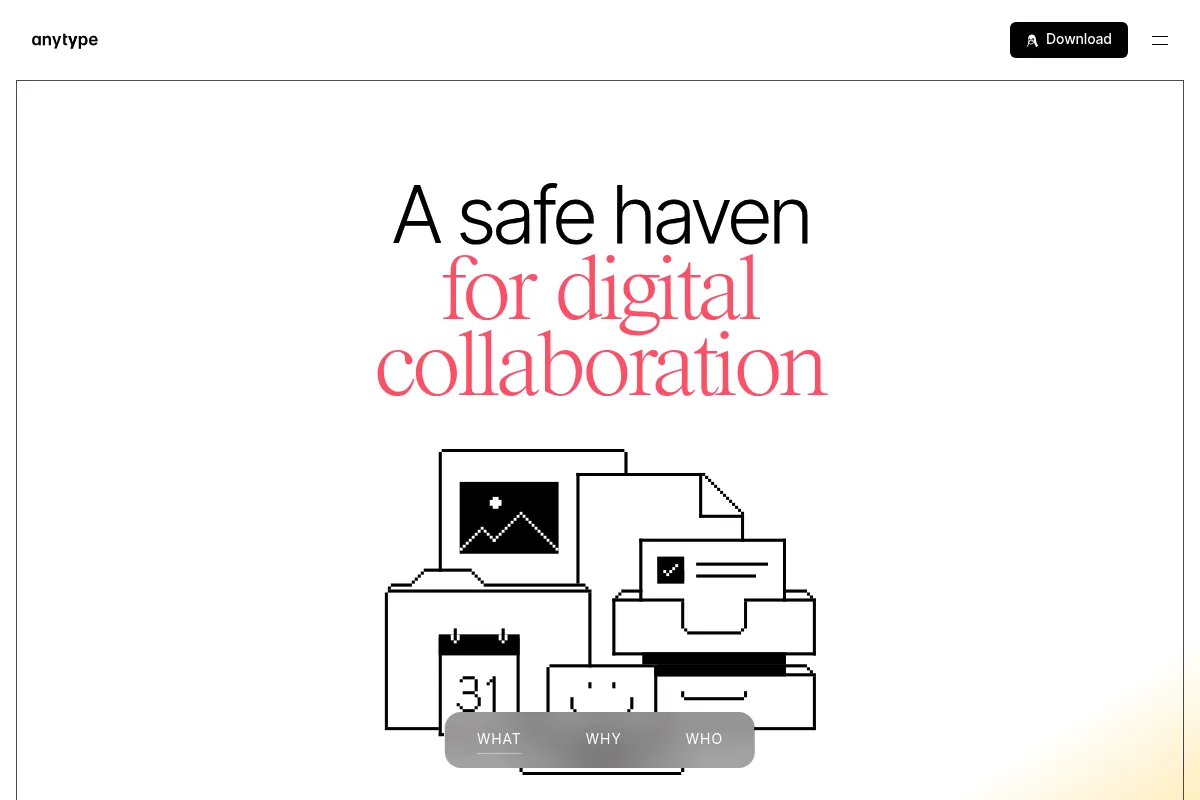
Who Should Use Anytype?
Typical users
Privacy advocates, researchers, and solo operators who want a structured knowledge base without the risks of cloud-only platforms.
Maturity fit
beginner to advanced
Choose this if…
- Data ownership and end-to-end encryption are your primary requirements
- You need a tool that works perfectly offline and syncs via local networks
- You want Notion-style databases and relations but prefer an open-source architecture
- You are comfortable with a non-linear, object-oriented mental model
Skip this if…
- Your workflow depends on publishing pages directly to the public web
- You need deep integrations with third-party apps like Zapier or Slack
- You require a simple, standard folder-and-file structure without the complexity of 'Objects'
About Anytype
Anytype is an open-source, decentralized productivity suite built on the Anysync protocol. It provides a private environment for notes, tasks, and databases, using a peer-to-peer architecture to sync data across devices without relying on a central server.
Official profiles
What it actually does
It allows users to build a personal knowledge graph where every entry is an 'Object' that can be categorized and linked. Users can create custom dashboards, manage complex projects with databases, and sync their data across desktop and mobile using encrypted backup nodes.
What makes it different
Unlike Notion, Anytype stores data locally by default and uses peer-to-peer syncing, meaning it works without an internet connection. Unlike Obsidian, it uses a structured database approach rather than plain Markdown files, allowing for more complex data relationships and built-in visual layouts.
Ratings across the web

Ratings aggregated from independent review platforms.
Key Features
Object-Based System
Everything is an object (note, task, person), allowing for consistent attributes across different data types.
Anysync Protocol
Enables data synchronization across devices via local Wi-Fi or encrypted nodes without a central provider.
Relations and Sets
Creates dynamic views of data similar to Notion databases but with more granular control over object types.
Private Spaces
Segregates data into distinct environments for work, personal, or shared projects.
Widgets and Layouts
Provides a visual interface to build dashboards that surface specific data points or task lists.
On-device Encryption
Keys are generated and stored on your device, ensuring the developers cannot access your content.
Open Source Codebase
Allows for community auditing and ensures the tool can persist even if the company ceases operations.
Pricing
Free
- Unlimited local storage
- 1GB encrypted backup node storage
- 3 shared spaces
- All core features included
Builder
- 32GB encrypted backup node storage
- 10 shared spaces
- Priority support
- Early access to new features
Co-creator
- 128GB encrypted backup node storage
- 20 shared spaces
- Direct access to dev team
- Badges and community recognition
Pricing checked 6 months ago
Pricing guidance
- When you exceed the 1GB backup node limit
- When you need to collaborate in more than 3 shared spaces
- When you want to financially support open-source development
- Backup storage only counts data synced to Anytype's nodes, not local device storage
- Shared spaces are limited by the number of participants allowed per tier
Generous free tier with a premium 'supporter' model for heavy users and collaborators.
Pros & Cons
Strengths
-
True data sovereignty
Because data is stored locally and encrypted, you are not vulnerable to service outages or privacy policy changes from a cloud provider.
-
Superior performance
Local-first architecture means zero latency when switching between pages or searching your database, regardless of internet speed.
-
Flexible data structure
The ability to define custom 'Types' and 'Relations' makes it more adaptable for complex research than standard note-taking apps.
-
Cross-platform consistency
The mobile and desktop apps are highly synchronized in terms of features, which is rare for local-first tools.
Weaknesses
-
Steep learning curve
The 'Object-Type-Relation' mental model is more abstract than folders and requires significant time to set up effectively.
Affects: New users and non-technical individuals
-
Limited web presence
There is no web-based version of the app, and sharing content with people who don't use Anytype is cumbersome.
Affects: Users who need to share documents with external clients or the public
-
No third-party ecosystem
The lack of an API or plugin architecture means you cannot easily automate workflows or pull in data from other tools.
Affects: Power users who rely on integrated tech stacks
Real User Sentiment
Users are generally impressed by the UI polish and privacy features but find the initial configuration daunting.
Users tend to like
- Visual aesthetics and clean interface
- Speed of the local-first experience
- The fact that it is open-source and E2EE
- Mobile app quality compared to competitors
Users commonly complain about
- Confusing terminology (Objects vs. Types)
- Lack of a web clipper for research
- Sync conflicts can be difficult to resolve
- Difficulty in exporting data to other formats
Recurring tradeoffs
- You trade ease of sharing for maximum privacy
- You trade a quick start for a more powerful, long-term data structure
Happiest users
Solo researchers and privacy enthusiasts who enjoy building their own custom productivity systems from scratch.
Often frustrated
Users looking for a 'Notion clone' that they can start using in five minutes without reading documentation.
Use Cases
Personal Knowledge Management
Building a private, interconnected library of notes and research.
Project Tracking
Managing tasks and deadlines without exposing sensitive business data to cloud providers.
Offline Journaling
Maintaining a secure, encrypted daily log that works during travel or in low-connectivity areas.
Inventory Management
Using custom object types to track physical collections or assets with specific attributes.
Collaborative Research
Sharing specific 'Spaces' with a small group of partners while keeping the rest of the vault private.
Frequently Asked Questions
Is Anytype really free?
Yes, Anytype is free for local use with unlimited data on your own devices. The only cost associated with the tool is for their 'Backup Node' service if you exceed 1GB of synced data on their infrastructure, or if you want to increase the number of shared spaces.
How does Anytype compare to Notion?
Notion is a cloud-based platform optimized for team collaboration and easy web sharing. Anytype is a local-first, encrypted platform optimized for individual privacy and offline speed. While they share a similar 'block' and 'database' feel, Anytype requires more setup but offers total data ownership.
Can I use Anytype without an internet connection?
Yes, Anytype is designed to be local-first. All your data is stored on your device, and you can create, edit, and organize your objects entirely offline. Changes will sync to your other devices via your local network or backup nodes once you are back online.
Where is my data stored?
By default, your data is stored on your local devices (computer, phone, tablet). If you use their sync service, an encrypted copy is stored on Anytype's backup nodes, but only you hold the keys to decrypt it. You also have the option to self-host your own backup node.
Does Anytype have a web version?
No, Anytype does not have a web version because a browser-based interface would compromise its local-first, end-to-end encrypted security model. You must download the desktop or mobile application to use it.
Can I import my data from Notion or Obsidian?
Anytype provides import tools for Notion (via HTML/Markdown export) and standard Markdown files. However, because Anytype uses a unique object-based structure, some formatting and database relations may require manual adjustment after importing.
Why trust this page?
This evaluation combines product positioning, pricing analysis, traffic and market signals, and public user sentiment into a single decision-support page. Content is generated editorially — not copied from the vendor's website.
Funding & Company
Founded
2018
Stage
Series a
Total Raised
$14.52M
Latest Round
Series A (Aug 2023)
Notable Investors
Anytype has raised a total of $14.52 million, primarily from a $13.4 million Series A round in August 2023 led by Balderton Capital. This significant funding event, following earlier seed rounds, provides the company with substantial capital to develop its local-first, privacy-focused workspace platform.
Market Signals & Traffic
Estimated visits, global rank, geography, traffic sources, monthly visit trends, and organic search keywords (Similarweb)—on a dedicated page built for depth and search.
- Estimated visits
- 296,077
- Global rank
- #156,551
- Snapshot
- Apr 2026
- Traffic trend
- Falling
Estimated monthly visits
Alternatives to Anytype
View all alternativesNotion AI
AI Assistant, Content Creation
AI assistant integrated into Notion for content creation and task automation.
Joplin
Productivity, Documentation, Privacy & Compliance

Open-source note-taking and to-do application with end-to-end encryption.
Similar Tools
Joplin
Productivity, Documentation, Privacy & Compliance
Open-source note-taking and to-do application with end-to-end encryption.
Nitro PDF AI
Productivity, Documentation, Privacy & Compliance

Professional PDF editing, electronic signatures, and document workflow management.
DSPy
Developer Tools, Research, Automation

Framework for programming and optimizing language model pipelines.
Akash Network
Developer Tools, Research

Decentralized cloud marketplace for high-performance GPU and compute resources.
LivePortrait
Video Creation, Content Creation, Design

Animate static portraits using driving videos or audio
Conceptboard
Communication, Design, Productivity

Collaborative online whiteboard for visual teamwork and brainstorming