

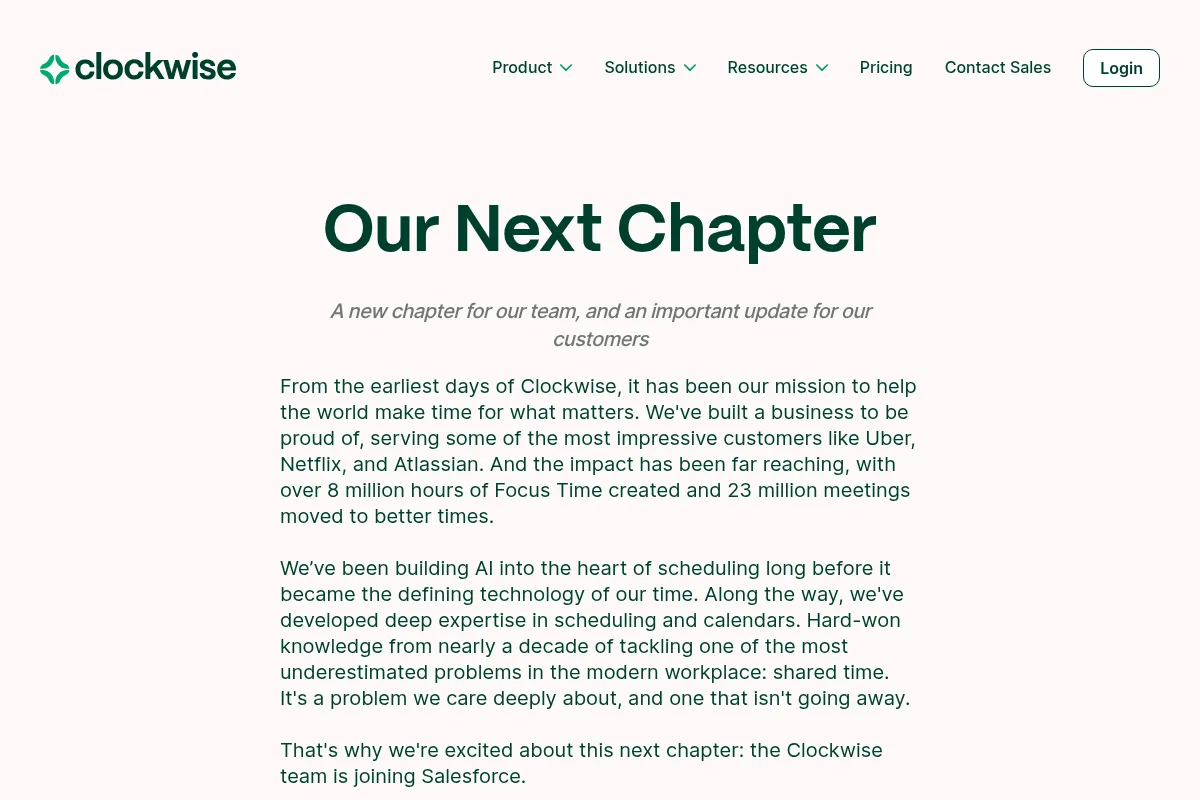
Clockwise is an AI-powered calendar optimization tool that automatically rearranges internal meetings to create more focus time for individuals and teams. It's best for organizations drowning in internal meetings who want to maximize uninterrupted work periods.
Excellent for teams needing to optimize internal meeting schedules for focus time, weaker for external booking or complex task management.
Analysis based on product data, pricing structure, traffic signals, and public user sentiment.
Who Should Use Clockwise?
Typical users
Clockwise is best suited for teams and organizations, particularly those with a high volume of internal meetings. This includes software development teams, product management teams, and engineers who spend significant time in meetings and need dedicated blocks for deep work.
Maturity fit
beginner to scaling
Choose this if…
- Your primary need is to optimize internal team calendars and reduce meeting fragmentation.
- You want to automatically create and protect blocks of focus time for deep work.
- Your team struggles with back-to-back meetings and needs a way to coordinate schedules efficiently.
- You use Google Calendar or Outlook and want a tool that integrates seamlessly.
Skip this if…
- You primarily need to schedule external client meetings or manage appointments with external parties.
- Your main challenge is managing email volume or complex task management workflows.
- You require advanced features for sales, marketing, or customer success workflows.
- You need deep integration with a wide range of CRMs or payment gateways.
About Clockwise
Clockwise is an AI-powered calendar assistant that automatically rearranges internal meetings to create more focus time for individuals and teams. It aims to reduce calendar chaos and make workdays more productive by optimizing schedules and protecting uninterrupted work periods. It's designed for organizations that want to maximize their team's efficiency by intelligently managing meeting density.
What it actually does
Clockwise analyzes team calendars and automatically reschedules internal meetings to create longer blocks of uninterrupted focus time. It also offers features like pre-scheduling lunch breaks, syncing personal calendars, and automatically handling meeting conflicts. The tool aims to give users back hours in their week by reducing the time spent on manual scheduling and meeting coordination.
What makes it different
Clockwise's core differentiator is its AI-driven approach to optimizing *internal* team schedules for focus time, rather than solely focusing on external appointment booking. It proactively rearranges flexible meetings to create contiguous blocks of uninterrupted work, a capability distinct from tools primarily designed for external scheduling.
Ratings across the web


Ratings aggregated from independent review platforms.
Key Features
Focus Time Protection
Automatically creates and defends blocks of uninterrupted time for deep work, crucial for roles requiring sustained concentration.
Flexible Meetings
Allows internal recurring meetings to be automatically rescheduled to optimize attendee availability and minimize disruption.
Automatic Schedule Optimization
Analyzes team calendars to find the least disruptive times for meetings, reducing back-and-forth coordination.
Smart Meeting Breaks
Inserts short breaks after long meetings to prevent burnout and improve focus.
Personal Calendar Sync
Integrates personal calendar events as 'busy' blocks on the work calendar to prevent double-booking.
Team Availability Calendar
Provides real-time visibility into team members' availability, helping to avoid scheduling conflicts with absent colleagues.
Pricing
Free
- One connected calendar
- Automated scheduling for heads-down work
- Flexible Meetings
- Personal calendar sync
- Smart meeting breaks
Teams
- Unlimited access to calendar automation
- Group scheduling links
- Team No Meeting Day holds
- OOO rules
- Team analytics
Business
- Enhanced calendar analytics
- Enhanced administrative controls
- Extended optimization window
- Priority support
Enterprise
- User provisioning
- Configurable processing
- Advanced privacy settings
- Dedicated support
Pricing checked 6 months ago
Pricing guidance
- When you need to coordinate focus time and meeting schedules across multiple team members.
- When you require features like group scheduling links or team analytics.
- When you need to implement features like 'Team No Meeting Day' or OOO rules.
- When your organization requires advanced administrative controls or SSO.
- Limited access to Clockwise Links on the Free plan.
- Microsoft 365 integration may be less robust than Google Calendar integration.
- Focus time blocks are marked as 'busy,' which can sometimes be misinterpreted by external parties.
- Some users have noted that certain branding elements are difficult to remove even on paid plans.
Clockwise offers a robust free tier for individuals and scales to paid plans that are competitively priced for teams, positioning itself as an accessible solution for improving internal calendar efficiency.
Pros & Cons
Strengths
-
Effective Focus Time Creation
Clockwise excels at automatically creating and protecting significant blocks of focus time, which is invaluable for deep work and productivity, especially for roles like engineers and product managers.
-
Reduces Meeting Fragmentation
By intelligently rescheduling internal meetings, Clockwise consolidates fragmented time into longer, more productive work periods, directly addressing a common pain point for busy teams.
-
Seamless Integration
Integrates smoothly with Google Calendar and Outlook, making adoption easy for organizations already using these platforms. Slack integration also enhances workflow by automatically updating status.
-
User-Friendly Interface
Users consistently report that Clockwise is easy to set up and navigate, with an intuitive interface that requires minimal training, making it accessible for all team members.
Weaknesses
-
Limited External Scheduling Capabilities
Clockwise is not designed for external appointment booking or managing client meetings. Users needing to schedule with external parties often find it insufficient.
Affects: Sales, customer success, and client-facing roles
-
Less Control for Complex Scheduling Needs
While it automates scheduling, users seeking highly opinionated parameters or granular control over external booking links may find it less flexible than dedicated scheduling tools.
Affects: Users with complex external booking requirements
-
Potential for Calendar Misinterpretation
Focus time blocks are marked as 'busy,' which can sometimes make a user's calendar appear fully booked to external parties, even if some of that time is flexible.
Affects: Users who need to present a highly transparent or flexible external availability
-
Microsoft 365 Integration Limitations
While it supports Outlook, some users note that the integration might not be as seamless or feature-rich as its Google Calendar counterpart.
Affects: Organizations heavily reliant on Microsoft 365 ecosystems
Real User Sentiment
Generally positive, with users praising its effectiveness in creating focus time and reducing meeting overhead. Some users express frustration with limitations for external scheduling or specific integrations.
Users tend to like
- Creating and protecting focus time for deep work.
- Automating meeting rescheduling to reduce back-and-forth.
- Seamless integration with Google Calendar and Slack.
- Improving overall team productivity and reducing calendar chaos.
Users commonly complain about
- Limited functionality for external meeting scheduling.
- Occasional integration issues or limitations (e.g., M365).
- Focus time blocks appearing as 'busy' to external parties.
- Desire for more granular control over scheduling parameters.
Recurring tradeoffs
- Focus time optimization vs. external scheduling flexibility.
- Internal team coordination vs. individual user needs.
- AI automation vs. manual control over meeting times.
Happiest users
Teams and individuals who are overwhelmed by internal meetings and prioritize maximizing uninterrupted work time.
Often frustrated
Users who primarily need to manage external client bookings or require highly specialized scheduling workflows not supported by Clockwise.
Use Cases
Software development teams needing to protect coding time from internal meetings.
Product managers requiring uninterrupted blocks for strategy and roadmap planning.
Engineers seeking to minimize meeting overhead and maximize deep work sessions.
Any team struggling with calendar fragmentation and back-to-back internal meetings.
Individuals looking to automatically schedule lunch breaks and protect personal time.
Frequently Asked Questions
What is Clockwise and what does it do?
Clockwise is an AI-powered calendar optimization tool designed to help individuals and teams manage their schedules more efficiently. It automatically rearranges internal meetings to create more uninterrupted focus time, resolves scheduling conflicts, and can pre-schedule breaks like lunch. Its primary goal is to reduce calendar chaos and boost productivity by giving users back valuable hours in their workday.
How does Clockwise compare to Calendly?
Calendly is primarily an external scheduling tool designed for booking appointments with clients or external parties, offering customizable booking pages and payment integrations. Clockwise, on the other hand, focuses on optimizing *internal* team calendars by automatically rescheduling internal meetings to create focus time. While they solve different problems, they can be complementary; sales teams might use Calendly for client bookings and Clockwise for internal team coordination.
What are the limitations of Clockwise?
Clockwise's main limitations include its lack of robust features for external scheduling and appointment booking. It's not ideal for sales teams needing to manage client calls or for users who require highly customized booking pages for external use. Additionally, while it integrates with Outlook, some users find its Google Calendar integration to be more seamless. Focus time blocks are also marked as 'busy,' which can sometimes be misinterpreted by external parties.
What integrations does Clockwise offer?
Clockwise integrates with popular calendar applications like Google Calendar and Microsoft Outlook. It also integrates with communication tools such as Slack and Zoom, allowing for features like automatic status updates during meetings. For more advanced workflows, it can be integrated with automation tools like Zapier and Make.
Is there a free plan for Clockwise, and is it sufficient?
Yes, Clockwise offers a Free plan that is suitable for individuals or very small teams. It provides core features like automated focus time protection, flexible meetings, and personal calendar sync. However, its team coordination capabilities and advanced features are limited, making it insufficient for larger teams or those needing to optimize schedules across multiple members. For full team benefits, a paid plan is recommended.
How does Clockwise handle Microsoft Outlook users?
Clockwise supports Microsoft Outlook integration, allowing users to sync their calendars and benefit from features like focus time protection and meeting optimization. However, some user feedback suggests that the integration with Google Calendar may be more seamless and feature-rich compared to Outlook.
Can Clockwise help with task management?
Clockwise's primary focus is on calendar optimization and meeting management, not comprehensive task management. While it offers 'Flexible Holds' that can be used for personal tasks, it lacks the deep task management features found in dedicated tools like Motion or Akiflow, which can automatically schedule tasks alongside meetings.
What happens if I need to schedule external meetings?
Clockwise is not designed for external meeting scheduling. If your primary need is to create booking links for clients or external partners, you would need a tool like Calendly, Chili Piper, or SavvyCal. Clockwise is best used in conjunction with such tools, where external meetings are marked as 'busy' on your calendar, and Clockwise optimizes your internal schedule around them.
Why trust this page?
This evaluation combines product positioning, pricing analysis, traffic and market signals, and public user sentiment into a single decision-support page. Content is generated editorially — not copied from the vendor's website.
Funding & Company
Founded
2016
Stage
Series c
Total Raised
$76M
Latest Round
Series C (Jan 2022)
Notable Investors
Clockwise has raised a total of $76 million over four rounds, culminating in a $45 million Series C in early 2022. This significant funding from top-tier investors like Coatue, Bain Capital, and Accel indicates strong market confidence and provides substantial runway for product development and expansion.
Market Signals & Traffic
Estimated visits, global rank, geography, traffic sources, monthly visit trends, and organic search keywords (Similarweb)—on a dedicated page built for depth and search.
- Estimated visits
- 0
- Global rank
- —
- Snapshot
- May 2026
- Traffic trend
- Rising
Estimated monthly visits
Alternatives to Clockwise
View all alternativesReclaim AI
AI Assistant, Automation, Productivity

AI-powered calendar assistant that automatically schedules tasks, habits, and focus time.
Motion
Productivity, Automation

AI-powered productivity platform for scheduling, task, and project management.
Similar Tools
Motion
Productivity, Automation
AI-powered productivity platform for scheduling, task, and project management.
Kick
Productivity, Automation

Automated bookkeeping and financial management for startups and small businesses.
Zapier AI
Productivity, Automation

Automate tasks and workflows between your favorite apps without code.
RVC.AI
Content Creation, Music Generation

Create and use custom voice conversion models for audio projects.
Crayo AI
Video Creation, Content Creation, Automation

Automated short-form video generator for social media content creators.
Argil AI
Content Creation, Video Creation, AI Assistant

AI video creation platform with realistic avatars and automated editing.