

v0 is an AI-powered UI generator that rapidly produces production-ready frontend code from natural language prompts, best for quick prototyping and component generation.
Excellent for rapid UI prototyping and component generation, weaker for complex full-stack applications.
Analysis based on product data, pricing structure, traffic signals, and public user sentiment.
Who Should Use v0?
Typical users
Frontend developers, designers, product managers, and founders looking to quickly visualize and build UI components or simple web pages. It's suitable for individuals or small teams aiming to accelerate the initial stages of web development.
Maturity fit
beginner to scaling
Choose this if…
- You need to generate UI components or simple landing pages quickly.
- You want to translate design mockups or sketches into code.
- You prioritize speed in the prototyping phase.
- You work with React, Next.js, and Tailwind CSS.
- You want to reduce boilerplate code for frontend development.
Skip this if…
- You need to build complex full-stack applications with intricate backend logic.
- You require extensive customization beyond generated UI components.
- Your primary need is for backend development or database management.
- You have strict budget constraints and find the credit system prohibitive for iteration.
- You need a tool that handles all aspects of application development without manual intervention.
About v0
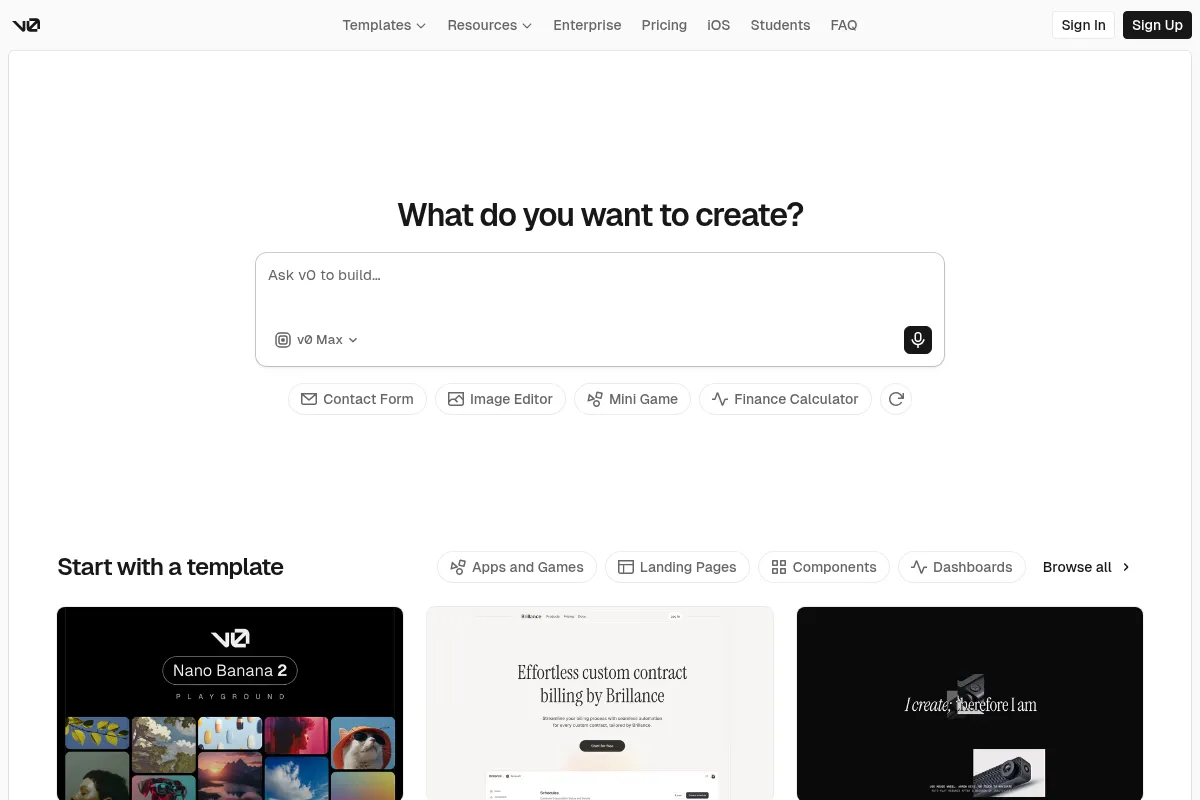
v0 is an AI development platform by Vercel that transforms natural language prompts into production-ready, full-stack web applications. It utilizes a conversational interface to generate sophisticated UIs and backend logic, aiming to accelerate the process from idea to deployment.
Official profiles
What it actually does
v0 generates frontend code (React, Next.js, Tailwind CSS, shadcn/ui) from text prompts or image inputs. It can also generate backend logic, enabling users to create functional web applications and deploy them rapidly.
What makes it different
v0 distinguishes itself by generating production-ready code that can be directly integrated into projects, rather than just mockups. Its integration with Vercel's infrastructure and focus on modern frontend frameworks like React and Tailwind CSS streamline the development workflow.
Ratings across the web

Ratings aggregated from independent review platforms.
Key Features
Text-to-UI Generation
Quickly create user interfaces by describing them in natural language.
Figma Import
Convert existing Figma designs into functional code.
Production-Ready Code
Generates clean, usable code that can be directly integrated into projects.
Full-Stack Capabilities
Generates both UI and backend logic for complete applications.
Iterative Development
Refine and modify generated code through conversational prompts.
Vercel Deployment
Seamlessly deploy generated applications to Vercel's infrastructure.
Pricing
Free
- $5 in monthly credits
- Deploy to Vercel
- Visual editing with Design Mode
- GitHub sync
- 7 message/day limit
Premium
- $20 in monthly credits
- Unlimited projects
- Purchase additional credits
- 5x larger attachment uploads
- Figma import
- Access to v0 API
Team
- $30 in monthly credits per user
- Shared credit usage
- Centralized billing
- Team chat collaboration
- Access to v0 API
Business
- $30 in monthly credits per user
- Training opt-out by default
- Shared usage and billing
- Team collaboration
- Access to v0 API
Enterprise
- SAML SSO
- Role-based access
- Priority performance
- Guaranteed SLA support
Pricing checked 6 months ago
Pricing guidance
- When you need more than 7 messages per day.
- When you want to import Figma designs or use larger attachments.
- When you require unlimited project creation.
- When you need to purchase additional credits for more extensive generation.
- Credit system: Usage is metered by tokens, which can lead to unpredictable costs for extensive iteration.
- Message limits on the free tier.
- Potential for increased costs with complex prompts or lengthy outputs.
- Beta features may have limitations or change without notice.
Tiered pricing with a generous free tier for exploration, scaling to paid plans that offer increased credits and collaboration features for professional use.
Pros & Cons
Strengths
-
Rapid Prototyping
Generates UI components and simple applications in minutes, significantly speeding up the initial development phase.
-
Production-Ready Code
Outputs clean, usable code that can be directly integrated into projects, reducing the need for extensive refactoring.
-
User-Friendly Interface
The conversational chat interface makes it accessible even for users with limited programming knowledge.
-
Modern Tech Stack
Leverages popular frameworks like React, Next.js, and Tailwind CSS, ensuring generated code is up-to-date.
-
Figma and Image Import
Allows conversion of design mockups and sketches into code, bridging the gap between design and development.
Weaknesses
-
Limited Customization for Advanced Users
Advanced users may find the level of customization restrictive, especially for highly specific or complex requirements.
Affects: Advanced developers
-
Loss of Context in Long Conversations
As an AI assistant, it can lose context in extended chat sessions, potentially leading to errors or unexpected outputs.
Affects: Users with complex, multi-turn development needs
-
Manual Intervention for Complex Logic
For intricate tasks requiring complex logic, manual code refinement may be necessary to remove redundancies or fix issues.
Affects: Developers building complex applications
-
Potential for Similar Designs
Designs can sometimes appear similar due to the template-based generation model.
Affects: Users seeking highly unique or varied designs
-
Frontend-Focused
While it generates backend logic, its primary strength and focus are on UI development, not comprehensive backend solutions.
Affects: Teams needing robust backend development tools
Real User Sentiment
Mixed, with users appreciating its speed and code quality for UI generation but expressing concerns about pricing, limitations in complexity, and recent changes to the platform.
Users tend to like
- Rapid UI generation from prompts.
- Clean, production-ready React/Tailwind code.
- Ease of use for prototyping.
- Figma import functionality.
- Integration with Vercel.
Users commonly complain about
- High cost of iteration due to credit system.
- Loss of context in long prompts.
- Limited capabilities for complex full-stack applications.
- Recent platform changes (v0.app) have led to increased costs and perceived regressions in quality/stability.
- Some users find the output too generic or difficult to customize extensively.
Recurring tradeoffs
- Speed of UI generation vs. depth of customization.
- Ease of use for simple components vs. complexity for full applications.
- Cost-effectiveness for rapid iteration vs. potential for high credit usage.
Happiest users
Frontend developers and designers looking for a fast way to prototype UI components and simple interfaces.
Often frustrated
Users who encounter high costs during iterative development, those needing complex backend logic, or those who feel the platform has regressed with recent updates.
Use Cases
Rapid prototyping of UI components and layouts
Generating landing pages for marketing campaigns
Creating dashboards and admin panels
Translating design mockups (Figma) into code
Building simple forms and interactive elements
Accelerating frontend development for MVPs
Exploring new design patterns and frameworks
Frequently Asked Questions
What is v0 and who is it for?
v0 is an AI-powered development platform by Vercel that transforms natural language prompts into production-ready web applications. It's designed for a wide range of users, including founders, developers, designers, product managers, marketers, and sales engineers. Its goal is to remove technical barriers, enabling anyone to bring their ideas to life quickly, whether it's shipping MVPs, prototyping without design queues, testing interactions, skipping boilerplate code, or producing custom demos.
How does v0's pricing work?
v0 uses a credit-based system, where generations consume credits based on input and output tokens. There are several pricing tiers: Free ($0/month with $5 credits), Premium ($20/month with $20 credits), Team ($30/user/month with $30 credits per user), Business ($100/user/month with $30 credits per user), and Enterprise (custom pricing). Unused credits roll over for up to 65 days. Additional credits can be purchased on paid plans.
Can v0 build full-stack applications?
Yes, v0 can generate both UI and backend logic, enabling the creation of full-stack applications. However, its primary strength lies in UI generation. For complex backend logic or extensive database management, users may still need to integrate other tools or perform manual development. Alternatives like Bolt.new and Lovable are often cited as more capable for end-to-end full-stack development from a single prompt.
What are the limitations of v0?
v0's limitations include potential loss of context in long conversations, the need for manual intervention for complex logic, and the possibility of generated designs looking similar. It's not ideal for highly complex application logic or when extensive customization beyond generated components is required. Some users have also reported issues with stability and increased credit usage after recent platform updates (v0.app).
Does v0 integrate with other tools?
v0 integrates with Vercel's infrastructure for deployment. It also supports GitHub integration for code management, allowing users to create branches, commit changes, and open pull requests directly from v0. While it can generate backend logic, direct integrations with third-party databases or services are evolving, with some being rolled out as beta features. The v0 Marketplace also allows for incorporating third-party services.
How does v0 compare to alternatives like Bolt.new or Lovable?
v0 excels at generating frontend UI components and simple applications, particularly within the Vercel ecosystem. Bolt.new is often highlighted as more capable for generating complete full-stack applications (frontend, backend, DB) from a single prompt. Lovable is noted for its design-first approach and visual development capabilities, making it suitable for designers and non-technical founders. The choice depends on whether the priority is rapid UI generation (v0), full-stack MVP creation (Bolt.new), or visual design control (Lovable).
Can I export the code generated by v0?
Yes, the code generated by v0 is production-ready and can be exported for use in your projects. You can copy-paste the code, sync it with GitHub, or use features like 'Add to codebase'. This allows for further refinement and integration into existing or new development workflows.
Is v0 suitable for non-developers?
v0 aims to be accessible to non-developers by using a natural language interface. It can be very helpful for designers, product managers, and founders to quickly prototype ideas and visualize them as code. However, as soon as the requirements become more complex, or if significant customization is needed, a developer's expertise might become necessary to fix errors or implement advanced logic.
Why trust this page?
This evaluation combines product positioning, pricing analysis, traffic and market signals, and public user sentiment into a single decision-support page. Content is generated editorially — not copied from the vendor's website.
Funding & Company
Founded
2015
Stage
Late stage
Total Raised
$863M
Latest Round
Series F (Sep 2025)
Notable Investors
Vercel, the parent company of v0, has raised a total of $863 million across six rounds, culminating in a $300 million Series F in September 2025. This substantial and consistent funding from top-tier investors like Accel, GIC, and GV indicates strong market confidence and provides a very long runway for product development and scaling infrastructure.
Market Signals & Traffic
Estimated visits, global rank, geography, traffic sources, monthly visit trends, and organic search keywords (Similarweb)—on a dedicated page built for depth and search.
- Estimated visits
- 99,763
- Global rank
- #447,507
- Snapshot
- Apr 2026
- Traffic trend
- Falling
Estimated monthly visits
Alternatives to v0
View all alternativesBolt.new
Developer Tools, Automation, Website Builder

AI-powered platform to build websites and apps from natural language prompts.
Lovable
Developer Tools, Website Builder, Productivity

AI platform to build full-stack web apps and websites from natural language prompts.
Replit
Developer Tools, AI Assistant

An AI-powered platform for building and deploying software applications directly from a browser.
Similar Tools
Botsonic
AI Assistant, Automation, Communication

No-code platform for building custom chatbots using company data.
Otter.ai
AI Assistant, Productivity, Documentation

AI-powered transcription and meeting assistant for accurate notes and summaries.
Cosmo
AI Assistant, Productivity, Workflow

Browser extension for summarizing, writing, and interacting with web content
tl;dv
Productivity, Training & Onboarding, Video Creation

AI meeting recorder, transcriber, and summarizer for enhanced productivity.
Romantic AI
AI Assistant, Gaming, Health & Wellness

Virtual companions for romantic roleplay and emotional support
Influencity
Marketing Automation, Communication, Productivity

Influencer marketing platform for discovery, relationship management, and campaign analytics.