
How to Build an AI Text Adventure from Scratch

Matic Pogladič
27 March 2026

An AI text adventure throws out the old rulebook. Instead of a rigid, pre-scripted story, it uses a large language model to generate a dynamic narrative in real-time. This means you're no longer guessing the exact command the developer programmed. You can just talk to the game, and it understands, opening the door to storytelling that is truly interactive and, in a sense, infinite.
The Evolution from Classic Games to AI Storytelling

If you've ever been eaten by a "grue" in a dark cavern, you understand both the charm and the frustration of classic text adventures. Games like Zork were built on a strict parser and a finite, hand-written script. Every interaction was a puzzle of figuring out the one right command—"GET LAMP" worked, but "PICK UP THE LANTERN" might not. While these games were incredible for their time, they were ultimately locked inside their hardcoded logic.
The path from those early days to today's AI-driven experiences is a story of massive technological shifts. The whole genre kicked off back in 1976 with Will Crowther's Colossal Cave Adventure, a game that captivated players with nothing but text and imagination. Fast forward to 2021, and AI Dungeon flipped the script entirely by using GPT-3 to generate endless, player-driven stories on the fly. This marked a profound change in interactive fiction. If you're a history buff, the IF50 project offers a great deep dive into this fifty-year evolution.
From Rigid Scripts to Dynamic Worlds
To really appreciate the difference, let's compare the two side-by-side. The old way was about navigating a maze of pre-written paths, while the new way is about creating the path as you go.
Classic vs AI Text Adventures At a Glance
| Feature | Classic Text Adventure (e.g., Zork) | AI Text Adventure (e.g., AI Dungeon) |
|---|---|---|
| Narrative Structure | Pre-scripted, finite branching paths | Dynamically generated, nearly infinite possibilities |
| Player Input | Strict command parser (e.g., "GO NORTH") | Natural Language Understanding (e.g., "I'll try to sneak past the guard") |
| World Interaction | Limited to programmed objects and actions | Players can attempt almost anything; the AI reacts |
| NPCs | Simple, repetitive dialogue trees | Dynamic characters with memory and evolving personalities |
| Replayability | Low; once solved, the story is the same | High; every playthrough is a unique story |
| Developer's Role | Writes every line of text and code | Designs the initial world, sets AI rules, and curates the experience |
This table really gets to the heart of it: today’s large language models (LLMs) have completely shattered the old constraints. Instead of a developer anticipating every possible action, the AI functions as a live Dungeon Master. It can interpret complex, conversational input, paint vivid scenes with its words, and spin up new plot points based entirely on your choices.
The core difference is moving from a system of finite authored choices to a system of infinite collaborative storytelling. The AI doesn't just present the story; it helps you write it in real-time.
Why Build an AI Text Adventure Now
Building your own AI-powered narrative is more accessible than ever, and it’s a project that offers more than just entertainment. From my experience, this is one of the most rewarding ways to get hands-on with AI.
Here’s why it’s a fantastic project to tackle right now:
-
Rapid Prototyping: You can test out complex story ideas or game mechanics without the overhead of building a massive, graphics-heavy game engine.
-
Educational Applications: Imagine creating immersive history lessons where students can "talk" to historical figures, or interactive science sims that let them explore complex concepts firsthand.
-
Creative Exploration: Honestly, it’s just an amazing playground for anyone who loves storytelling. You get to push the boundaries of what's possible when human creativity meets AI's generative power.
This guide is designed to walk you through the entire process, from designing a compelling narrative all the way to deploying your finished game. We'll start with the most important part: the story itself.
Designing a Compelling Narrative and Game World

The biggest draw of an AI text adventure is the sense of limitless possibility. But that wide-open freedom can be a trap. Without a solid narrative framework, your game can quickly descend into a confusing, inconsistent mess.
Before you touch a single line of code, the real work begins with narrative design. This isn't about scripting every possible outcome—that would defeat the purpose of using an AI. Instead, it's about building a strong narrative skeleton that guides the LLM without putting it in a straitjacket.
Everything starts with genre. Are you building a gritty cyberpunk mystery, a sweeping high-fantasy epic, or a quirky sci-fi comedy? Your choice of genre sets the mood, the vocabulary, and the kinds of actions a player might take. All of this is crucial information you'll eventually feed to the AI.
Next, you need to define the core gameplay loop. What will the player actually be doing moment to moment?
-
Exploration-focused: The main reward is discovering new places, unearthing hidden lore, and piecing together the world's history.
-
Puzzle-centric: The game is built around challenges that demand logic, clever item combinations, or unique interactions with the environment and characters.
-
Social-driven: The experience centers on dialogue, building relationships with NPCs, and navigating complex social webs to reach a goal.
Most great games are a blend, but establishing a primary loop brings clarity. A cyberpunk mystery, for example, might be 70% social-driven and 30% puzzle-centric. Knowing this tells you where to spend the bulk of your creative energy.
Crafting Your World Bible
With your genre and core loop decided, it's time to build a "world bible." This isn't some massive, thousand-page tome. It's a concise, high-level document that acts as your AI's ultimate source of truth. Think of it as the ultimate cheat sheet for your universe.
From my experience, a well-structured world bible is the single most important asset for keeping an AI's creativity on track and consistent.
Your bible should nail down a few key things:
-
The Central Conflict: What's the main tension driving the story? It could be a looming galactic threat, a personal quest for revenge, or the simple mystery of a locked room. A clear conflict gives the entire narrative direction.
-
Key Locations: Define a handful of important starting areas. Give them brief but evocative descriptions, focusing on the atmosphere and a few key interactive elements. You don't need a map of the whole world, just the initial sandbox.
-
Main Characters (NPCs): Outline 3-5 key non-player characters. For each one, note their core personality, their primary motivation, and at least one secret they're holding. This gives the AI a rich foundation for generating dynamic, believable dialogue.
-
Core Lore and Rules: What are the fundamental truths of your world? Does magic have a cost? What are the basic laws of physics? Is this society a utopia or a dystopia? Just a few bullet points are enough to set the stage.
The goal is to provide strong signposts, not a rigid roadmap. The AI needs to know the destination (like solving the central conflict) and see the key landmarks (locations, NPCs), but the path the player carves to get there should be completely unwritten.
Leaving Room for Player Agency
Here’s the part where many new designers trip up: you have to deliberately leave gaps. It’s tempting to over-script every detail, but that completely undermines the power of using an AI in the first place. If you need some help brainstorming, check out this curated list of storytelling tools that can help organize your ideas.
Your world bible establishes what is true, but it should never dictate how a player discovers or interacts with those truths.
For instance, instead of writing "The player must find the silver key in the library to unlock the chest," your world bible should simply state: "The chest in the attic contains the artifact. The silver key is hidden somewhere in the old library."
This subtle difference is everything. It empowers the AI to facilitate a solution whether the player "looks under the desk," "asks the librarian about old keys," or even tries to "smash the chest open." This approach truly respects the player and leads to the kind of emergent, surprising gameplay that makes AI text adventures feel so alive.
Alright, you've designed your world and sketched out a narrative. Now for the hard part: teaching a machine to run it. This is where prompt engineering comes in, and frankly, it's the real craft behind building a compelling AI text adventure.
Getting this right isn't just about telling the model to "be a game master." You’re essentially building the game's entire operating system inside a single, master prompt. It’s the AI’s reality. Get it wrong, and you'll get a story that contradicts itself, forgets key details, and ultimately just frustrates the player.
But when you nail the prompt, the AI can become a truly dynamic storyteller. It will generate rich descriptions, handle complex NPC behavior, and react convincingly to just about anything the player throws at it. This is how you go from a clunky chatbot to an immersive, breathing world.
The Anatomy of a Master Prompt
The key thing to remember is that your master prompt isn't static. It's a document you rebuild from scratch before every single call you make to the model. I've found a layered approach works best, starting with the big picture and narrowing down to the immediate action.
-
Role and Goal: Start by giving the AI its identity. Be explicit. You are a fantasy game master. Your goal is to create a challenging but fair adventure in the world of X.
-
World Bible: This is your lore, but condensed. Think of it as the AI's cheat sheet for the world's fundamental rules, magic systems, and major factions.
-
Game State: Here's the real-time context. Where is the player right now? What's in their inventory? What's the status of their active quests? How do nearby characters feel about them?
-
Recent History: LLMs have terrible short-term memory. You need to give it a summarized log of the last few player-AI interactions to keep it grounded in the present moment.
-
Player Input: The final piece is the raw command from the player, like, "I'll try to bribe the guard."
Putting these pieces together for every turn ensures the AI always has a complete and consistent picture of the game. You’ll want to experiment with different models to see which ones respond best to this kind of structured prompting. You can explore a variety of powerful LLMs on Oryndex to find one that fits your project's style and budget.
Advanced Prompting Techniques in Action
Basic prompts will only get you so far. To build a game that feels truly alive, you have to get more sophisticated in how you guide the model's output. Two techniques I rely on heavily are few-shot prompting and chain-of-thought instructions.
Few-Shot Prompting for Consistent Formatting
Few-shot prompting is essentially showing the AI examples of what a good answer looks like. This is an absolute game-changer for forcing the model to return data in a structured format, like JSON, that your game engine can actually use.
Instead of just asking for a description and hoping for the best, you can demand a specific output structure.
You are the Game Master. Describe the scene and update the player's state.
Your response MUST be a valid JSON object with the keys "description", "new_location", and "inventory_change".
Here are some examples:
Player Input: "go north"
{
"description": "You walk through the creaking wooden door and find yourself in the dusty library. Shelves overflowing with ancient tomes line the walls.",
"new_location": "Library",
"inventory_change": null
}
Player Input: "take the brass key"
{
"description": "You pocket the small brass key.",
"new_location": null,
"inventory_change": { "add": "brass key" }
}
Now, based on the current context, respond to the player's input: "open the heavy oak chest"
This simple trick drastically cuts down on errors and turns the LLM from a loose-cannon storyteller into a predictable, reliable part of your game's logic.
Chain-of-Thought for Better Reasoning
Sometimes the AI needs to think before it speaks. Chain-of-thought (CoT) prompting is a technique where you instruct the model to first reason through a problem step-by-step before it gives the final answer to the player. It’s perfect for handling complex or ambiguous player actions.
By forcing the model to articulate its reasoning process, you significantly improve its ability to make logical, in-world decisions and avoid narrative dead-ends.
For instance, if a player tries something clever, you can add a "thinking" step into your prompt that the player never sees.
First, think through the consequences of the player's action.
-
What is the player's goal?
-
What are the potential obstacles?
-
What is the most likely outcome based on the world's rules and the player's skills?
-
What is a less likely but interesting alternative outcome?
After your reasoning, provide the final "description" for the player.
This internal monologue prevents the AI from defaulting to lazy or nonsensical outcomes. The impact is huge. A 2024 study that used a similar dynamic approach to modernize the classic Adventure game for education found it led to 35% higher engagement and a 28% increase in vocabulary acquisition. You can read more about these findings on generative AI in education in this discussion.
Mastering these prompt engineering methods is what separates a novice from an expert. You stop being a simple user of an LLM and become its conductor, orchestrating a truly living, breathing AI text adventure.
Choosing and Building Your Technical Stack
Once you've sketched out your world and figured out how you'll talk to the AI, it's time to get your hands dirty and build the thing. Picking your tech stack is always a trade-off. You're juggling power, cost, and how quickly you can get from an idea to a playable game. Get it right, and you can iterate fast. Get it wrong, and you'll spend more time fighting your tools than building your adventure.
Fundamentally, your stack will have three moving parts: the Large Language Model (the brains), the state management system (the memory), and the hosting platform (the stage).
Selecting Your Core LLM
The LLM is the heart of your ai text adventure. This is the engine that writes every description, every line of dialogue, and every twist in the plot. Your choice here defines the game's voice, its cleverness, and how much it costs to run.
-
OpenAI's GPT Series (e.g., GPT-4o): These models are incredible at creative writing and, crucially, at following complex rules. I've found they're the best choice when your game has intricate mechanics or you need reliable JSON outputs to run your logic. The downside? That top-tier performance comes with a premium price tag.
-
Anthropic's Claude Series (e.g., Claude 3.5 Sonnet): I often turn to Claude when I want the game's prose to feel more literary and atmospheric. These models are great at producing rich, descriptive text. They also hit a fantastic sweet spot on the cost-to-performance curve, making them a solid all-around choice.
-
Open-Source Models (e.g., Llama 3, Phi-3): If you crave total control and want to escape API dependency, running your own open-source model is the way to go. It’s a much heavier technical lift upfront, but it can significantly cut down on long-term costs.
My advice? Start development with a powerful, premium model like GPT-4o or Claude 3.5 Sonnet. This lets you nail down the game logic without wondering if the AI is the problem. Once everything works, you can swap in faster, cheaper models to see how far you can push the performance-to-cost ratio for the live version.
Managing Your Game State
Here’s the thing about LLMs: they have no memory. Turn to turn, the model is a blank slate. It only knows what you include in the prompt each and every time. That's why state management is so essential. You need a way to track the player's inventory, their location, who they've talked to, and what quests are active, then feed that "memory" back to the AI with every single action.
For most games, a simple JSON object is all you need. Think of it as a digital character sheet that you constantly update. The player takes an action, you update the JSON, and then you stuff that whole object into the next prompt.
This diagram shows how it all comes together. You combine the static world lore, the dynamic game state, and the player's immediate input into a single, context-rich prompt.
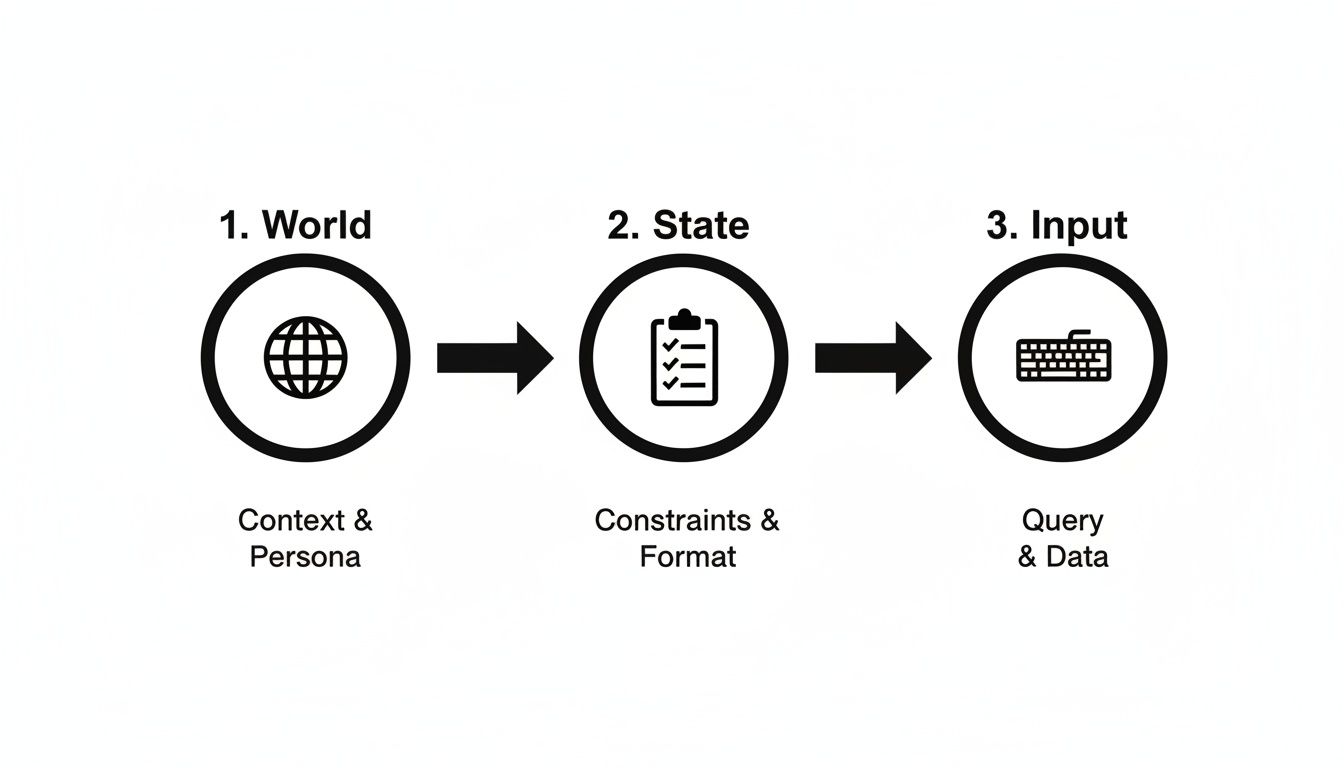
This loop gives the AI everything it needs to make an intelligent, in-character response. But what if your world has a library's worth of lore? A massive JSON file can get slow and expensive. That's when you might upgrade to a vector database like Pinecone, which lets the AI search for and pull in only the most relevant bits of lore on the fly.
Choosing Your Hosting and Deployment Platform
Once you've got a version running on your computer, you'll want to get it online so people can actually play it. The platform you choose really comes down to how comfortable you are with server-side tech. The main goal is to get your game live with as little fuss as possible.
The best stack is the one you don't have to think about. Start simple and only add complexity when you absolutely have to. Your focus should be on the game, not the infrastructure.
It's a great time to be building these, too. We're seeing a huge revival of text adventures, especially in education, where they're being used as powerful AI-driven learning tools. They've come a long way from their 1970s origins. In fact, a review of studies from 2012-2022 found that classic text adventures boosted educational retention by 25-40% in areas like vocabulary and problem-solving. Generative AI is only going to accelerate that impact.
Here are a couple of excellent starting points for getting your game deployed:
-
Replit: This is my go-to for rapid prototyping. It's a full development environment right in your browser. You can write your code, test it, and deploy it all from one place without any server setup. Our guide on getting started with Replit will have you up and running in minutes.
-
Vercel: When you're ready for a more polished, public-facing website, Vercel is fantastic. It's built for modern web apps, integrates perfectly with frameworks like Next.js, and provides scalable, production-grade hosting.
By making smart choices for your LLM, state management, and hosting, you're laying down a solid technical foundation. This is what lets you build a truly immersive ai text adventure without getting bogged down by the engineering.
How to Test and Refine the Player Experience
So you've built the core of your game. Now for the hard part: taming the beast. An AI text adventure is an exercise in managing chaos, and an untested game is guaranteed to be a frustrating one, riddled with narrative dead ends and AI-driven confusion. This is where you roll up your sleeves and transform a promising prototype into something truly immersive.

Your biggest hurdle will almost certainly be maintaining narrative consistency. LLMs are brilliant improvisers, but they can also "hallucinate" bizarre events or forget a critical plot point you just established. Meticulous testing and debugging isn't just a phase; it's your most valuable skill in this entire process.
Getting Under the Hood: The Debugging Playbook
When the AI veers off track with a contradictory response, the first question is always why. The only way I've found to reliably get to the bottom of it is through comprehensive logging.
For every single turn, I log the entire context that gets sent to the model—the full prompt, including the world bible, game state, and recent history. I also capture the AI's raw output. This creates a breadcrumb trail, allowing me to step back in time and see the exact information the model had when it went sideways. It makes spotting the root cause of weird behavior much, much easier.
The single most crucial feature you can build for yourself and your players is a simple 'undo' button. It's an absolute lifesaver when the AI goes off the rails, letting you reset to the previous turn without torching the whole session.
Smoothing Out the User Experience
Beyond just wrangling the AI, the actual user experience (UX) of a text-based game is paramount. It doesn't matter how brilliant your story is if the interface itself is a chore to use. If players are squinting to read the text or fighting the layout, you've already lost them.
A few non-negotiable UX elements to nail down from the start:
-
Readable Fonts: Don't get fancy. Choose a clean, legible typeface with enough size and contrast to be read comfortably for long sessions.
-
A Clean Interface: The story is the star. Keep the screen uncluttered so the player's focus stays on the narrative.
-
Input History: Let players quickly access and reuse their previous commands. Arrow keys are a classic for a reason.
You'll also run headfirst into the limitations of stateful reasoning. Even today’s top models struggle with the kind of long-term memory and complex, multi-step puzzles that defined classic text adventures. Recent benchmarks like TextQuests (2024) show that Claude 3.5 Sonnet solves only about 18% of these puzzles, a huge gap compared to the 65% average for human players. As many have pointed out in discussions around IBM's historical use of Zork to evaluate AI, models are notoriously bad at state-dependent challenges like battling a troll and then remembering it's gone.
A Troubleshooter's Guide to Common Glitches
During playtesting, you'll see the same problems pop up again and again. Having a go-to plan for these common issues will make your refinement cycles much faster.
| Common Problem | My Recommended Solution |
|---|---|
| Narrative Contradiction | The AI introduces something that contradicts established lore. |
| Amnesia | The model forgets a key item or a recent event. |
| Player is Stuck | The player has no idea how to move forward. |
| Bizarre AI Choices | The AI does something wildly out of character or nonsensical. |
Ultimately, testing isn't a final stage you complete. It's a continuous loop: play, log, tweak, and repeat. Each refinement brings you closer to a seamless and captivating AI text adventure that feels less like a program and more like a living, breathing world.
So, you've brought your AI text adventure to life. It’s built, it’s tested, and it works. The big question now is, what's next? If you want this to be more than just a portfolio piece, you need to think about how to sustain it. Let’s be frank: every player action is an API call, and those costs can add up fast. A smart monetization strategy isn't just about turning a profit; it's about keeping the game alive and growing.
One of the most straightforward approaches is a freemium model. You give players a taste for free but gate certain features. A common method I've seen work well is offering a daily allowance of free actions—say, 50 free turns. Once they're hooked and hit that limit, they can pay a small fee for unlimited play. This model directly maps your revenue to your primary cost (API usage) while keeping the initial barrier to entry practically zero.
Another solid route is selling premium, self-contained story packs. Think of it like episodic content. You offer a compelling introductory chapter for free, then sell new adventures as distinct packages. Each pack comes with its own detailed world bible, a new cast of characters, and a fresh conflict to solve. This gives players clear, tangible value for their money and, from a developer's perspective, creates a manageable and predictable content pipeline.
But monetization isn't always direct-to-consumer. I’ve seen companies build short, slick text adventures themed around their industry. It’s a brilliant way to capture and qualify leads by engaging them in a way a boring web form never could.
The Next Frontier for AI Adventures
The pace of change in this space is incredible, and what seems like sci-fi today will be a standard feature tomorrow. The next wave of AI adventures will almost certainly move beyond pure text, incorporating richer media and far more complex social systems.
Here’s a glimpse of what's just over the horizon:
-
Generative Visuals: Imagine your game’s text describing a hidden glade, and a moment later, an AI-generated image of that very scene appears. The goal isn't to replace the player's imagination but to punctuate key moments—finding a rare item, meeting a mysterious character—with stunning visuals to deepen the immersion.
-
True Multiplayer Experiences: The holy grail for many is a fully AI-moderated multiplayer world, a modern take on the classic MUD (Multi-User Dungeon). Picture several players exploring the same world, their actions influencing each other, all orchestrated by a master AI game master. The technical challenges are significant—managing shared state and concurrent actions is no small feat—but the potential for a dynamic, social RPG is immense.
-
AI-Scheduled NPCs: Forget NPCs that just stand around waiting for you. The next generation of non-player characters will have their own lives. An AI can manage their schedules and goals "off-screen," meaning the baker actually goes to the market and the city guard patrols a real route. The world will feel truly alive, evolving and changing even when you're not logged in.
Turning a prototype into a commercially successful game is a marathon, not a sprint. But by planning your monetization from the start and keeping a close watch on where the tech is heading, you can build an evolving world that players will want to get lost in for years.
Common Questions (and Honest Answers) About Building an AI Text Adventure
When people get excited about building their first AI text adventure, a few big questions always seem to pop up. It's easy to get caught up in the creative possibilities, but the practical side—cost, control, and coding—is where the real challenges lie. Let's tackle those head-on.
First, the money question. Is this going to be expensive? Honestly, it can be. Running a game on a powerful model like GPT-4o or Claude 3.5 Sonnet isn't free. Every single player action becomes an API call, and those calls add up. My advice is to start small with a free tier, but have a plan to implement a usage-based freemium model. This way, your costs scale naturally as your player base grows.
Then there's the fear of the story going completely off the rails. How do you give players freedom without the narrative just falling apart? This all comes down to your master prompt. Think of it as the AI's "world bible." By constantly feeding it the core rules, the current game state, and a clear objective in every prompt, you're essentially providing guardrails for its creativity. This keeps the experience consistent, even when a player tries something you never expected.
Do I Really Need to Code to Build an AI Game?
While the world of no-code tools is getting better every day, for a truly dynamic AI text adventure, the answer is yes—some coding is pretty much essential. You need a way to manage persistent state, like tracking a player’s inventory or their progress in a quest.
This kind of logic is best handled by a scripting language like Python or JavaScript. The code handles the game's memory and rules, then structures the next prompt based on what the AI just generated.
Your goal isn't to script the story, but to script the storyteller. The code manages the game's memory and rules, while the LLM handles the creative improvisation within those boundaries.
Finally, a lot of developers worry they need to write an entire novel's worth of content. You don't. You aren't writing a fixed script; you're creating a rich premise. Your job is to define the world's core conflict, sketch out a few key characters, and build some interesting locations. The AI, guided by your prompts and the player's choices, does the heavy lifting of weaving it all into a unique story for every single playthrough.