Unlock Content Growth with Ghost Writing AI in 2026

Matic Pogladič
26 March 2026
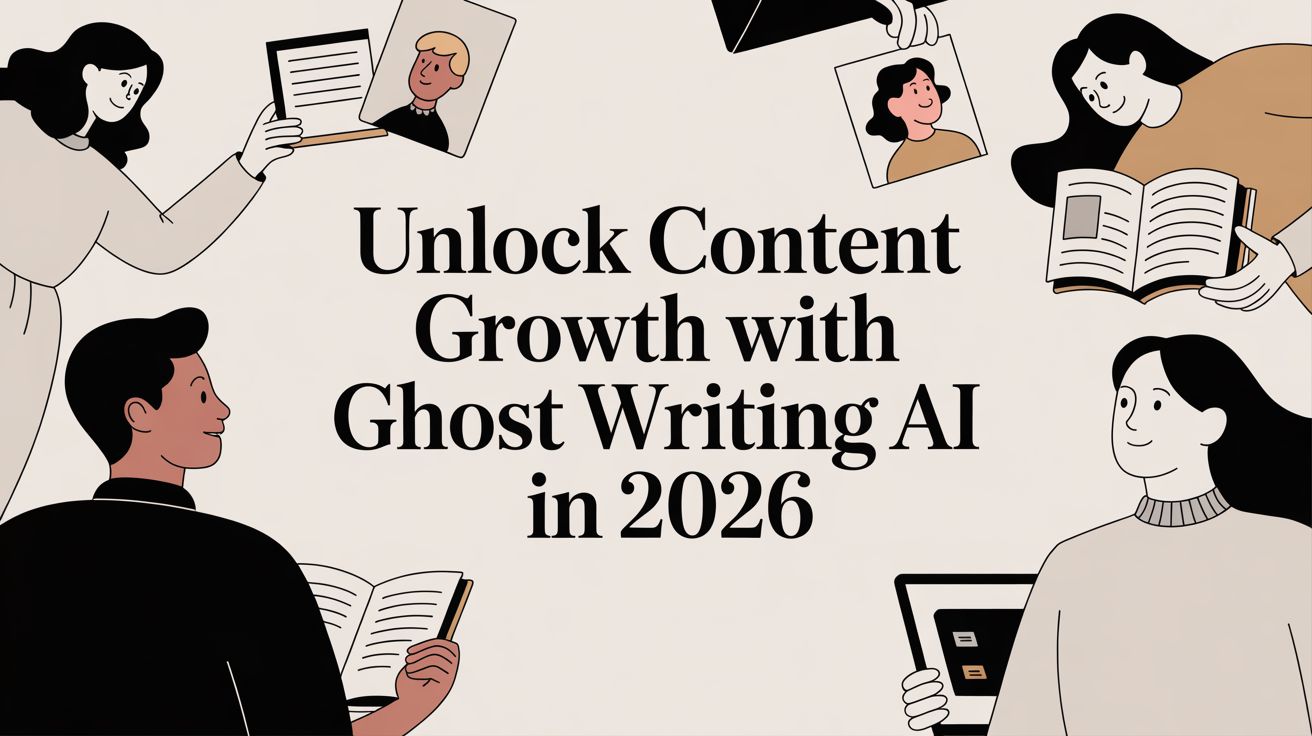
Let's get one thing straight: AI isn't here to replace writers. The real story is about a new kind of partnership—one where human expertise guides artificial intelligence to produce content at scale. When we talk about a ghost writing AI, we’re describing a process where a human expert sets the strategy, provides the unique voice, and outlines the core ideas. The AI then steps in to do the heavy lifting of research and drafting. It’s a powerful hybrid approach to creating content.
The Human-AI Partnership in Modern Ghostwriting
The phrase "ghost writing AI" is a bit of a misnomer. It doesn't mean some faceless algorithm is secretly churning out articles under a person's name. Think of it more like a master chef working with a top-of-the-line food processor. The chef (that’s you, the expert) is still the creative force. You develop the recipe, source the unique ingredients (your ideas and insights), and handle the final, artistic plating. The food processor (the AI) just automates the tedious prep work—the chopping, mixing, and blending—at a speed you could never match on your own.
This new model transforms content creation from a constant bottleneck into a genuine strategic asset. Founders, executives, and creators can now produce a steady stream of high-quality thought leadership, from in-depth articles to social media threads, without burning out. It’s a way to dramatically increase output while keeping the final product completely authentic.
The Rise of a Hybrid Model
The flood of generic, soulless content generated by AI has, ironically, made truly human-led writing more valuable than ever. Smart leaders recognize that building a real connection with an audience demands a human touch. That’s why the professional ghostwriting market is exploding. Projections show the global ghostwriting industry will reach $4.3 billion in 2025 and swell to $6.7 billion by 2030. You can get a deeper look into the evolving ghostwriting market and its growth trajectory. This growth tells us that while automation is helpful, the hunger for genuine expertise and personality is stronger than ever.
To clarify how this modern approach differs from the old way of doing things, let's compare them side-by-side.
Human Ghostwriter vs Ghost Writing AI Model
This table breaks down the key differences between the traditional human-only ghostwriting process and the new hybrid model that incorporates AI.
| Aspect | Traditional Human Ghostwriting | Ghost Writing AI (Hybrid Model) |
|---|---|---|
| Core Process | A human writer interviews an expert and writes content from scratch. | An expert provides prompts, outlines, and key insights to an AI, then edits and refines the output. |
| Speed & Scale | Slow; limited by the writer's individual capacity. Typically a few articles per month. | Fast; allows for rapid drafting and iteration. Can produce content daily or weekly. |
| Cost | High. Involves paying for a professional writer's time for research, interviews, drafting, and editing. | Lower. Reduces the time spent on drafting, making the process more cost-effective. |
| Expert's Role | Subject matter expert (SME). Provides information and reviews drafts. | Creative director and editor. Defines the strategy, shapes the core message, and provides the final polish. |
| Authenticity | High, but filtered through the ghostwriter's interpretation of the expert's voice. | High, as the expert's raw ideas and final edits directly shape the content, preserving their true voice. |
As you can see, the hybrid model doesn't remove the human; it elevates their role from a simple source of information to the true creative director of their own content.
The most effective strategy isn't full automation—it's intelligent assistance. You use AI for what it's good at (processing data and generating drafts) so you can focus on what only a human can do:
- Strategic Thinking: Pinpointing the core message, the audience you want to reach, and what you want your content to achieve.
- Personal Storytelling: Weaving in the unique stories, experiences, and perspectives that an AI could never invent.
- Nuanced Editing: Refining the tone, checking for voice consistency, and adding that final layer of polish that makes content truly connect with a reader.
This approach allows creators and founders to build a library of authentic thought leadership content without succumbing to burnout. It’s a framework for scaling your voice, not outsourcing your soul. By combining human creativity with AI's efficiency, you can establish a powerful presence in a crowded digital world.
An Actionable AI Ghostwriting Workflow
Alright, let's move from theory to a practical, repeatable process. A solid AI ghostwriting workflow isn't about hitting a button and hoping for a masterpiece. It's a structured partnership where human expertise directs the AI's efficiency, ensuring the expert’s unique voice is the star of the show.
The whole system starts with the most crucial step: capturing the expert's knowledge. This is often called a "brain dump," and it can happen in a few different ways.
- A recorded interview: A ghostwriter or content strategist digs in with sharp questions, pulling out stories, analogies, and unique points of view.
- A structured brief: The expert gets a detailed questionnaire to outline their core arguments, audience, and the specific tone they're aiming for.
- Voice notes: The expert simply talks through their ideas while on a walk or during their commute. This creates a raw, authentic audio file packed with genuine insights.
This initial human input is the soul of the content. It’s the raw material—the personal anecdotes, specific data points, and hard-won opinions—that an AI simply can't invent.
The AI's Role: A Drafting Partner
Once you have that brilliant, chaotic mess from the brain dump, the AI steps in. Think of it as a powerful research assistant and drafting partner. Its job is to start wrangling those ideas into a coherent structure, but only under the direction of a human.
For instance, you can take an interview transcript and ask the AI to:
- Synthesize Key Themes: Pinpoint the top three to five arguments or recurring ideas from the conversation.
- Build a Structured Outline: Arrange those themes into a logical flow with an introduction, main points, and a conclusion.
- Conduct Initial Research: Find supporting stats, studies, or examples to back up the expert’s claims.
- Generate a "Zero Draft": Write a very rough first draft based on the outline. The goal here is speed—just get ideas on the page and kill the anxiety of a blank screen.
This "zero draft" is just a starting point. It’s not meant to be pretty; it’s the scaffold upon which the real writing will be built.
The Human Touch: Refinement and Editing
Now for the most valuable—and often most time-consuming—part of the process: the iterative loop of human editing. This is where the magic of ghostwriting truly happens, transforming the AI's generic output into something that sounds exactly like the author. This involves several passes, each with a specific focus.
This flowchart shows how the human-led process works, with our input bookending the entire content cycle.
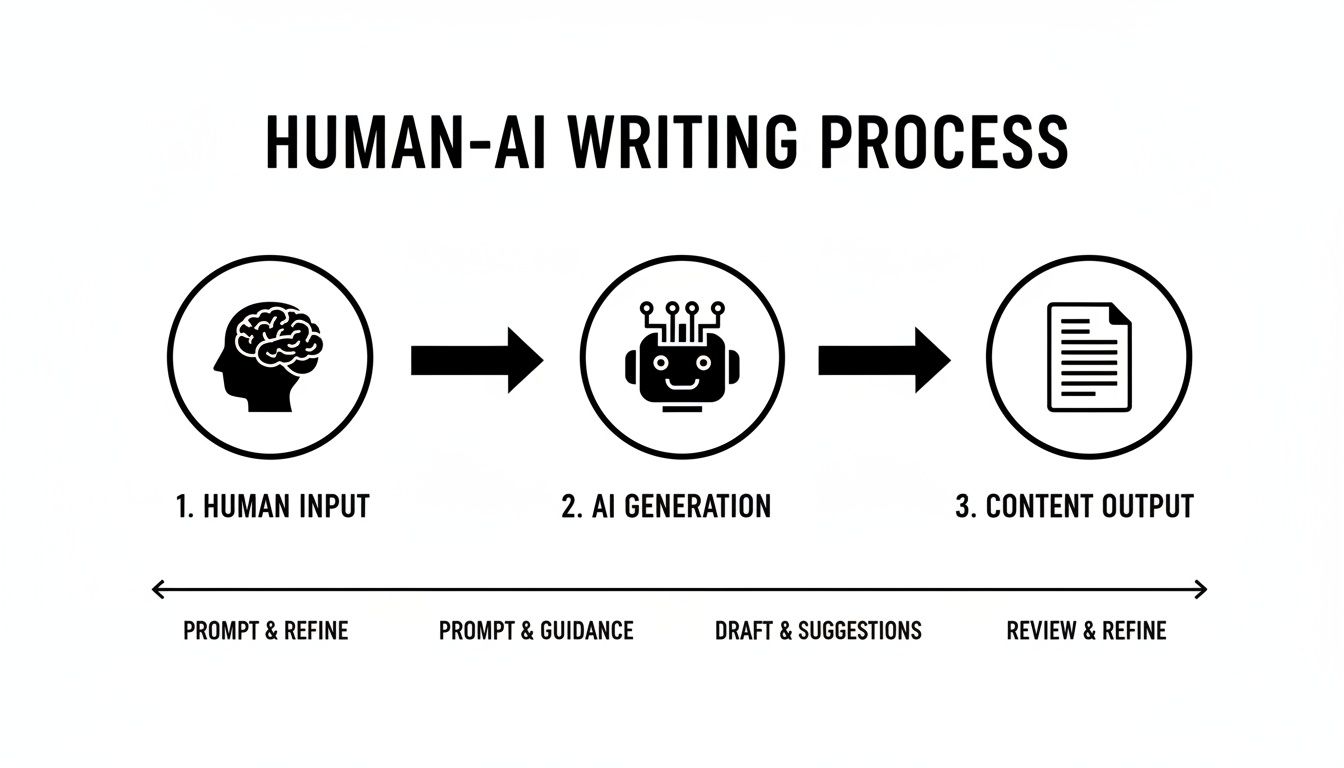
As you can see, the AI is a powerful processor at the center, but the project begins and ends with essential human touchpoints. It’s a force multiplier, not the originator.
Key Insight: The AI generates the skeleton, but the human writer adds the flesh, blood, and soul. This means weaving in personal stories, refining the tone for nuance, and triple-checking every claim for accuracy and context.
This pragmatic approach is fast becoming the industry standard. New data shows that while 68% of professional ghostwriters use AI tools to some extent, only a tiny 7% trust them to write full drafts from scratch. As you can learn more about in this report on how professionals are integrating AI into their writing work, the consensus is clear: AI is an incredible tool for research and brainstorming, but it can't replace the human element.
Prompt Engineering to Capture Authentic Voice
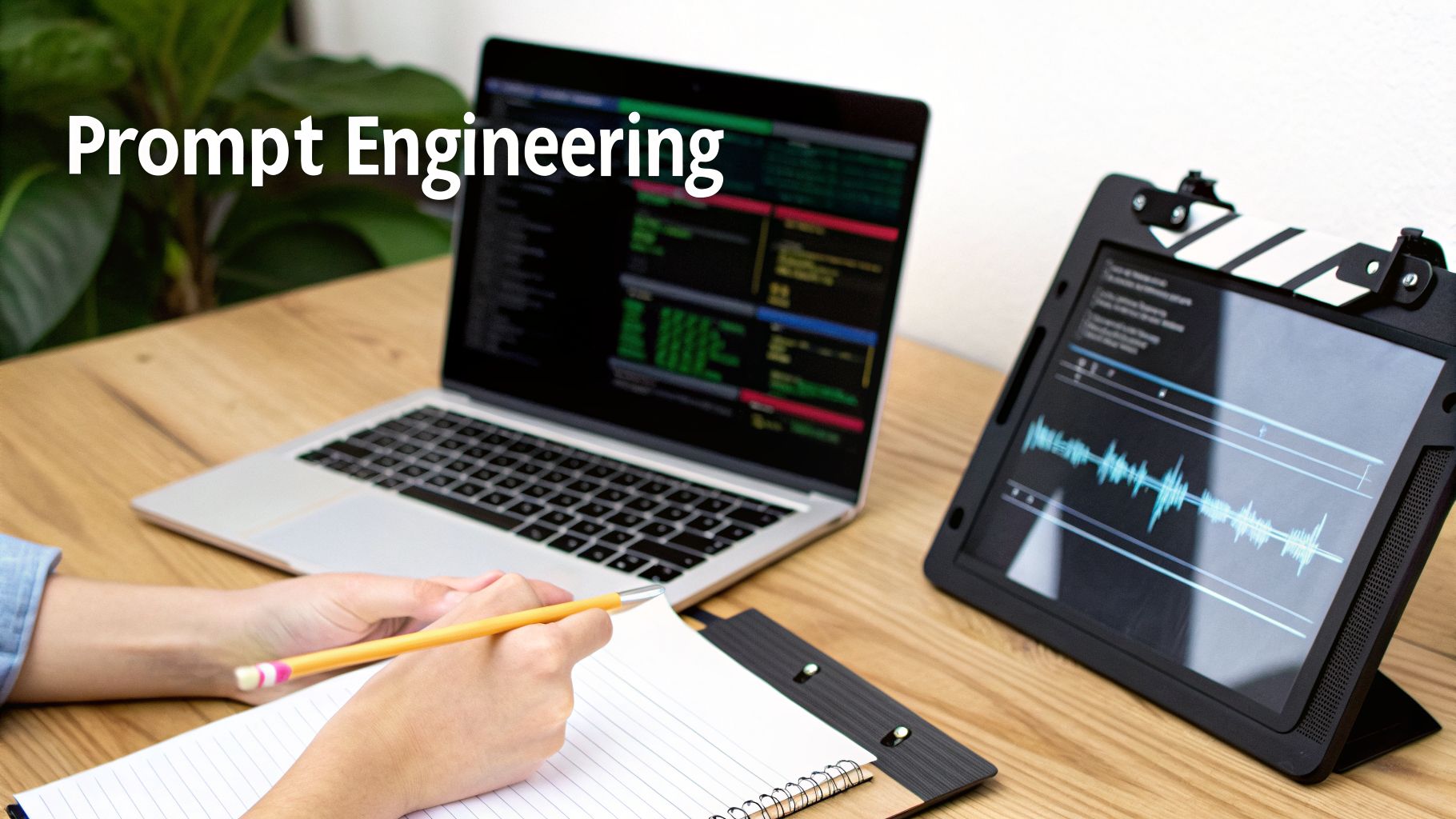
The difference between forgettable AI output and compelling, human-sounding content boils down to one critical skill: prompt engineering. If you give a large language model a generic prompt, you’ll get a generic, soulless result back. The real craft in using ghost writing AI is in giving the model a perfect creative brief.
Think of it like directing a brilliant actor. A lazy instruction like "act sad" will get you a clichéd, uninspired performance. But give them specific motivation—"You just lost a family heirloom, but you're trying to stay strong for your kids; let the grief show in your eyes, but keep your voice steady"—and you'll get something nuanced and powerful. The same exact principle applies when you're working with AI.
Building a Voice and Tone Profile
Your first job is to build a detailed “voice and tone” profile for the AI to follow. This needs to go way beyond simple adjectives like "professional" or "friendly." A great profile becomes your digital style guide, giving the AI a concrete persona to inhabit.
A complete voice profile should have a few key ingredients:
- Voice Samples: Feed the AI 3-5 pieces of existing content that nail the voice you're after. These can be anything from blog posts and email newsletters to social media threads. The model will analyze these to pick up on sentence structure, vocabulary, and rhythm.
- Audience Definition: Get specific about who you're talking to. Are they busy startup founders? Technical engineers? Skeptical C-suite executives? Define their goals, what keeps them up at night, and what they already know about the topic.
- Emotional Tone: Pinpoint the feeling you want to create. Is the goal to be inspiring and optimistic, analytical and cautious, or witty and a little irreverent? You can even use a percentage breakdown, like "70% educational and 30% motivational."
- Negative Constraints: Tell the AI what not to do. This is an incredibly powerful way to refine the output. For example, you can command it to "avoid buzzwords like 'synergy' and 'leverage'" or "do not use a formal, academic tone."
By building this detailed profile, you create a reusable asset. You can save this "master prompt" and use it as the foundation for all future content requests, ensuring consistent voice and quality across every piece.
From Generic to Specific: A Practical Example
Let's look at how a well-crafted prompt can completely transform a piece of content. Imagine we need a LinkedIn post about the challenges of scaling a startup, written from the perspective of a seasoned founder.
Generic Prompt: "Write a LinkedIn post about the challenges of scaling a startup."
AI Output (Before): "Scaling a startup is an exciting journey, but it comes with many challenges. From hiring the right team to managing cash flow, founders face numerous obstacles. It is important to have a clear strategy to navigate these hurdles and achieve sustainable growth."
Frankly, this is boring. It's forgettable, offers zero real insight, and sounds like a dozen other posts clogging up your feed. Now, let's try again using the principles from our voice profile.
Detailed Prompt: "Act as a seasoned startup founder with a gritty, direct, and slightly contrarian voice. Your audience is other early-stage founders who are in the trenches. Write a 150-word LinkedIn post about the unspoken challenge of scaling: how your role has to change from 'builder' to 'manager.' Avoid corporate jargon. Use a personal anecdote about having to fire your first 'brilliant jerk.' End with a question to drive engagement."
AI Output (After): "Scaling isn't about raising another round. The real gut punch is when you realize you can't be the one building everything anymore. I remember my first 'brilliant jerk'—an amazing engineer who was toxic to the team. Firing him was the hardest thing I'd done, but it was the moment I became a real CEO, not just a founder. My job shifted from writing code to building a healthy culture. It’s a painful but necessary evolution. When did you realize your role had to change?"
The difference is night and day. This version feels specific, personal, and emotionally resonant. The detailed prompt gave the AI the exact direction it needed to create a draft that sounds genuinely human—the entire point of using a ghost writing AI in the first place. Exploring tools designed for this kind of narrative shaping can be helpful, and you can learn more about one such tool in our review of Sudowrite.
Proven Use Cases for Founders and Creators

The theory behind AI ghostwriting is one thing, but its real power snaps into focus when you see how it solves concrete problems for incredibly busy people. It’s where the abstract idea of a human-AI partnership meets the day-to-day grind of running a business or building a personal brand. For founders and creators, this isn't just a neat trick; it's a direct route to saving hundreds of hours while scaling their unique voice.
So let's get practical. These aren’t just hypothetical situations. They’re proven strategies that top performers are using right now to generate a massive amount of high-quality content without sounding like a robot.
For the Startup Founder
If you're a founder, you know that time is the one resource you can never get back. You're constantly juggling product development, team management, and investor relations. Content creation, while crucial for building a brand, often gets pushed to the back burner. This is where an AI ghostwriting workflow becomes your secret weapon.
Here’s how a founder can put this model to work:
- Weekly Investor Updates: Instead of blocking out hours to draft updates from a blank page, you can record a 10-minute voice memo outlining key metrics, progress, and roadblocks. The AI can then transcribe it and structure a professional email draft. Your job is just to spend a few minutes editing for tone and accuracy.
- Building a Thought Leadership Library: You've got big ideas about your industry. Start with a simple outline—say, on "hiring for culture." Let the AI generate a first draft fleshed out with general data and examples. Then, you can swoop in and do the high-value work: injecting your personal stories and sharpest strategic insights. That’s how a generic article becomes a must-read.
- Scripting Marketing Videos: For an upcoming product launch video, feed the AI a list of key features, benefits, and your target audience profile. It can draft a solid script to get you started, which you then refine to make sure it sounds like you and connects with your brand's voice.
This isn’t about outsourcing your personality. It’s about delegating the tedious first-draft drudgery so you can pour your limited energy into adding the vision and expertise that only you can provide.
For the Content Creator
For any content creator, consistency is everything. Your audience expects to hear from you regularly. An AI ghostwriting setup acts as a content engine, allowing you to maintain a powerful presence on platforms like X and LinkedIn without burning out. The idea is to automate the daily grind of post creation while making sure your authentic voice is always front and center.
Here’s a mini-case study on a typical creator workflow:
- Voice-Powered Idea Dump: The creator opens a voice memo app and just talks—spitting out raw, unedited thoughts on industry news and trends. This audio file is pure gold because it’s packed with their authentic opinions and unique way of phrasing things.
- AI-Assisted Content Breakdown: They upload the transcript to an AI and give it a sharp prompt, like: "Extract five distinct LinkedIn post ideas from this. Write them in a skeptical but optimistic tone." The AI "atomizes" the long-form ramble into bite-sized, platform-ready drafts.
- Human-Led Refinement: Now, the creator simply reviews the AI’s output. They spend a few minutes tweaking the posts to add more nuance, a personal story, or a stronger call-to-action. What used to take all morning is now done in under an hour.
By handing off the initial drafting and structuring, creators can reinvest their energy where it truly matters: engaging with their community and developing bigger, more strategic content pillars. It’s a system for scaling your presence without sacrificing your personality.
This efficiency is also creating new business opportunities. For instance, high-ticket ghostwriting is booming. Top-tier writers are now charging $10,000 per month using these hybrid workflows to write for major influencers, giving their clients instant access to a "borrowed audience." These engagements, which can cost the client between $5,000 and $10,000, are fueling entire creator empires. You can see a breakdown of how these lucrative deals are structured in the ghostwriting playbook for scaling to high monthly incomes.
In the end, whether you're building a company or a community, a smart AI ghostwriting process lets you operate at a higher, more strategic level. To see how these same principles apply to social platforms, take a look at our guide on how to automate social media posts while keeping your content genuine.
Building Your Ghost Writing AI Tech Stack
Putting together the right ghost writing AI toolkit isn't about chasing every shiny new app. It's about building a cohesive system where each tool serves a specific purpose, handing off the project smoothly from one stage to the next. You're aiming for a seamless workflow that takes you from a raw idea to a polished, published piece.
Think of it like setting up a professional kitchen. You don't just grab random gadgets. You strategically choose a razor-sharp knife for prep (ideation), a powerful and reliable stove for the actual cooking (drafting), and elegant plating tools for the final presentation (editing). Each component is chosen for its function, and they all work together to create the final dish.
Essential Tools for Your Ghost Writing AI Stack
The key is to think in terms of workflow stages, not just individual tools. Below is a breakdown of the core functions your AI stack needs to cover, along with what to look for when choosing a tool for each job. This approach helps you build a complete and powerful toolkit.
| Workflow Stage | Tool Category | Key Selection Criteria | Example Tools |
|---|---|---|---|
| Ideation & Research | Conversational Search & Synthesis | Cites sources, allows follow-up questions, summarizes complex information. | Perplexity AI, ChatGPT (with browsing) |
| Drafting & Generation | LLM with Voice Customization | Accepts style guides/voice samples, offers templates, integrates with other apps. | Jasper, Copy.ai |
| Editing & Consistency | AI Writing Assistant & Governance | Custom style rules, robust data privacy, built-in plagiarism checks. | Writer.com, Grammarly Business |
By selecting one or two top-tier tools from each category, you create a powerful, end-to-end system that supports your entire ghostwriting process. Now, let's look at each stage in more detail.
H3: Ideation and Research Tools
Every great piece of content starts with great ingredients. In our world, that means brainstorming solid topics, digging up compelling data, and making sense of it all. The AI you use for this phase should be a world-class research assistant, capable of pulling insights from across the web and helping you organize your thoughts.
When you're evaluating tools for research and ideation, here’s what really matters:
- Source Transparency: Can the AI show you its work? A tool like Perplexity AI is fantastic because it provides direct links to its sources. This is crucial for fact-checking and for digging deeper into the original material.
- Conversational Search: You need a tool that lets you go beyond a single query. The best platforms allow for a natural back-and-forth, so you can ask follow-up questions and refine your search as you explore a topic.
- Synthesis Capabilities: The real magic is in its ability to summarize dense reports, compare different perspectives, and pull out the core themes from a mountain of text.
H3: Drafting and Generation Tools
Once your research is solid and you have a clear outline, it's time to draft. This is where your AI acts as your co-writer, generating the initial text based on the detailed prompts and voice profile you provide. This is the heart of the ghost writing AI process.
For your main drafting tool, the criteria are non-negotiable:
- Deep Voice Customization: Simply telling an AI to be "friendly" isn't enough. A professional platform like Jasper lets you upload documents, paste text samples, and build a detailed Brand Voice that the AI can consistently draw from.
- Workflow Integrations: Does it play well with others? Look for tools with browser extensions or robust integrations that let you use the AI directly inside Google Docs, WordPress, or wherever you do your writing.
- Template Variety: A strong library of templates for different formats—blog posts, social media threads, email newsletters—is a huge time-saver. It gives you a proven structure to build upon.
The goal is to find a tool that can produce a strong "zero draft" quickly. This initial output should be structurally sound and directionally correct, even if it requires heavy editing to inject the final human touch and personality.
H3: Editing and Voice Consistency Tools
The final stage—editing—is where the real craft comes in. This is where you transform the AI's competent draft into something that sounds genuinely human and perfectly captures the author's unique voice. The AI tools you use here act as a final, rigorous quality check.
For this critical step, prioritize tools that offer:
- Custom Style Rules: Platforms like Writer.com are built for this. You can define your own specific grammatical rules, preferred terminology, and stylistic no-gos. This ensures every piece of content is perfectly on-brand.
- Strong Data Privacy: You're often handling sensitive client information, so a tool with a rock-solid data privacy policy is essential. Enterprise-level plans usually guarantee that your inputs are not used to train the public model.
- Plagiarism Detection: A built-in plagiarism checker is your last line of defense. It's a must-have for verifying the originality of the content before it ever sees the light of day.
If you're hunting for more options, you can browse our complete directory of AI tools for content creation to find the perfect addition to your stack.
Navigating the Ethical and Legal Questions
Using a ghost writing AI isn't just a technical decision; it opens up a new world of ethical and legal considerations. These aren't just theoretical debates for academics anymore. As AI tools become standard, how you handle transparency, ownership, and accountability will directly shape your brand's reputation and legal standing.
The first, and maybe biggest, question is about disclosure. Do you need to tell your audience that AI helped create your content? While there's no single law forcing you to, a clear ethical line is being drawn in the sand. Being upfront builds trust. Trying to pass off AI content as purely human, on the other hand, is a gamble that can backfire spectacularly. If readers feel they've been misled, they often see it as lazy at best and deceptive at worst.
The crucial takeaway is this: the moment a reader suspects content is AI-generated but presented as purely human, any intended emotional connection fails. The illusion of authenticity shatters, and the message, no matter how well-crafted, loses its impact.
Ownership and Copyright in the AI Era
So, what about the legal side of things? Who actually owns the copyright when you're working with an AI? This is a developing area of law, but the current consensus from bodies like the U.S. Copyright Office is pretty clear: work generated entirely by an AI cannot be copyrighted.
However, the story changes when a human is heavily involved. Content that you’ve substantially guided, edited, and refined—exactly like the workflow we recommend—is a different beast. Here, the key is the level of your creative input. Think of it this way:
- Human Authorship is Non-Negotiable: The final piece must clearly show your own intellectual and creative effort. You can’t just copy, paste, and claim ownership.
- The AI is a Tool, Not the Author: Treat the AI like a sophisticated word processor or a research assistant. The responsibility for the work's quality, accuracy, and originality ultimately falls on you.
- When in Doubt, Consult a Lawyer: For high-stakes projects like a book, a major company report, or anything touching on sensitive legal topics, it's always smart to talk to an attorney specializing in intellectual property.
Accountability is Not Automated
At the end of the day, using a ghost writing AI doesn't let you off the hook. In fact, it puts even more responsibility on your shoulders. You are the publisher, and the buck stops with you.
This means you have to be the final guard against misinformation. AI models are known to "hallucinate"—a term for making up facts with complete confidence. It's your job to catch these errors before they go live. You are also the one responsible for making sure the work is original and doesn't plagiarize or infringe on anyone else's copyright. The AI is an incredibly powerful assistant, but the human author is, and must remain, the final authority.
Frequently Asked Questions About AI Ghostwriting
If you're exploring AI-assisted writing, you probably have a few big questions. That's a good thing. It means you're thinking critically about how to make these tools work for you, not just blindly accepting them. Let's get into the nitty-gritty and tackle the most common concerns.
Can AI Truly Replicate My Unique Voice?
The short answer is no, not entirely on its own. But it can get surprisingly close with the right direction.
Think of an AI model as a talented method actor. To play a role convincingly, it needs to study the source material. You have to "train" it by feeding it your best work—blog posts, email newsletters, even your most popular social media threads. The more it sees your style, the better it can mimic your cadence, vocabulary, and overall tone.
That said, the AI will only ever get you about 90% of the way there. The final 10%—the part that contains your real personality, unexpected insights, and genuine stories—that’s always going to come from you during the edit. The AI lays a fantastic foundation, but you provide the soul.
How Much Time Can I Realistically Save?
The time savings are significant, but it’s less about elimination and more about reallocation. You're trading the hours spent staring at a blank cursor for more focused time on strategy and refinement.
Here’s a realistic breakdown:
- Initial Drafting: This is where you see the biggest leap. AI can slash pure drafting time by 70-80%. A task that once took half a day might now take less than an hour.
- Research & Outlining: This phase gets a massive speed boost, too. An AI can pull together sources, synthesize information, and structure an entire piece in just a few minutes.
- Editing: This is where you reinvest that saved time. A good way to think about it is that the AI will hand you a solid "B-" draft. Your job is to take that raw material and polish it into an "A+" article by sharpening the arguments, adding your unique perspective, and ensuring the voice is perfect.
When all is said and done, most people find they cut their total content creation time in half while actually increasing their output.
Is Using AI for Ghostwriting Considered Plagiarism?
No, as long as you're using the tool correctly. Plagiarism is presenting someone else's finished work as your own. When you use a ghostwriting AI, you are using a tool to generate original text based on your ideas, your prompts, and your direction. You're the creative director, and the final ownership and responsibility are yours.
Important Distinction: Copyright law is still catching up, but the consensus is clear. For a work to be copyrightable, it needs substantial human authorship. A piece generated entirely by an AI with zero human input can't be copyrighted. Your role as the prompter, editor, and final approver is precisely what establishes you as the legal author.
However, you absolutely should run your final draft through a plagiarism checker. It's rare, but large language models can occasionally produce phrases or sentences that are unintentionally similar to existing text. It's your responsibility to catch and fix those instances before you hit publish.
Ready to build your own effective AI stack? Find the perfect tools for your workflow with Oryndex, the curated directory of AI products for builders and founders. Explore the library and find your next tool today.