
How to Use AI for Lead Generation A Modern Playbook

Matic Pogladič
25 March 2026
Let's get real for a moment: the old playbook for generating leads is falling apart. We've all been there—grinding away at manual list building, sending out generic email blasts that get ignored, and making cold calls that go nowhere. It's a high-effort, low-reward numbers game, and frankly, it's an exhausting way to grow a business.
If you're still stuck in that cycle, you're not just working hard; you're working against the grain of where sales is headed. This is precisely why figuring out how to use AI for lead generation has stopped being a futuristic "nice-to-have" and become a critical survival skill.
The fundamental change is moving from brute force to intelligent, surgical precision. Instead of casting a wide net and hoping for the best, AI gives you the power to analyze mountains of data—everything from your own CRM to the public web—to find prospects who are actually signaling they're ready to buy. It uncovers the subtle patterns and buying triggers that a human team, no matter how skilled, could never hope to spot on their own.
Building Your AI-Powered Growth Stack
The modern approach is all about assembling your "AI-powered growth stack"—a connected system of tools that automates and sharpens the entire lead generation pipeline. The goal isn't to replace your people but to give them superpowers. Imagine your sales team armed with a perfectly qualified, high-intent list of leads every single morning. That's the objective.
You can start exploring options for your stack by looking at the new wave of AI-driven prospecting tools designed specifically for this purpose.
The impact isn't just theoretical; the numbers speak for themselves. Companies that have made this pivot are seeing dramatic, bottom-line improvements.
In 2026, businesses leveraging AI-powered lead generation platforms are pulling in an average of 3,142 leads per month, a staggering 67.4% increase from their previous baseline. More importantly, AI-assisted qualification has cut the number of junk leads by 41%, meaning sales teams get a cleaner pipeline they can actually close. For startups and SMBs, this translates into customer acquisition costs falling by as much as 60%.
This isn't a small adjustment. It's a complete overhaul of your customer acquisition engine, one that leads directly to better leads, significantly lower costs, and much shorter sales cycles.
Here’s a look at what this shift means for the metrics that truly matter.
AI Impact on Key Lead Generation Metrics
This table summarizes the core improvements businesses can expect when implementing an AI-driven lead generation strategy, based on recent industry benchmarks.
| Metric | Improvement with AI | Why It Matters for SMBs & Startups |
|---|---|---|
| Lead Volume | 67.4% Average Increase | More at-bats mean more opportunities to grow, fueling a faster path to market penetration without a linear increase in headcount. |
| Lead Quality | 41% Reduction in Unqualified Leads | Sales teams waste less time on dead ends and focus their energy on prospects with a high probability of closing, boosting morale and efficiency. |
| Customer Acquisition Cost (CAC) | Up to 60% Reduction | Lowering the cost to acquire each customer directly improves profitability and extends runway, which is critical for early-stage companies. |
| Sales Cycle Length | 20-30% Shorter, on Average | AI identifies high-intent leads who are further down the buying funnel, shortening the time from first contact to closed deal and accelerating revenue. |
Ultimately, adopting an AI-powered framework moves your team from guessing and grinding to making data-driven decisions that produce a predictable, scalable pipeline. It’s the difference between hoping for growth and engineering it.
Here’s the rewritten section:
Laying a Foundation That AI Can Actually Use
Before you even think about plugging in an AI tool, you have to get your own house in order. AI is not a mind reader; it runs on the data and instructions you provide. If you feed it vague goals and messy data, you'll just get messy results, only much faster.
The first move is to get brutally specific about who you're targeting. Forget the generic "target audience" and start building a laser-focused Ideal Customer Profile (ICP). Basic demographics are just the beginning. To really get an AI working for you, you need to dig much, much deeper.
From Vague Ideas to Actionable Data
Think less about "startups in the tech space" and more about concrete, verifiable details. A truly effective ICP gives an AI the specific traits it needs to find your perfect lead in a sea of noise.
This means layering different types of data:
Firmographics: The essentials—industry, company size, revenue, and location.
Technographics: The exact tech stack they use. For instance, "companies running on Marketo and Salesforce." This is a goldmine for integration-focused products.
Buying Intent Signals: The real magic. These are recent, tangible actions that signal a need for what you sell. This is the data that AI can turn into immediate opportunities.
For example, a weak ICP sounds like, "Marketing managers at mid-sized SaaS companies."
An AI-ready ICP is more like, "Marketing VPs at B2B SaaS companies with 50-200 employees, using Marketo, who have recently posted a job for a 'Head of Demand Generation,' and whose company website saw a 20% traffic spike to their 'integrations' page last month." See the difference? Now the AI has clear marching orders.
Pulling Your Data Together
Your best insights are probably scattered across a dozen different systems. To let an AI do its best work, you need to bring all that information into one place. This means consolidating data from your Customer Relationship Management (CRM) system, website analytics, and any other tools you use.
Start by mapping out where your data lives:
First-Party Data: This is the information you already own. It includes your CRM contacts, website visitor behavior, email lists, and past sales notes. This is your ground truth.
Third-Party Data: This is data you get from outside sources. Think intent data providers that track online research, lists from trade shows, or public business databases.
The goal is to merge these sources. An AI can then connect the dots in ways a human simply can't. It might see a new visitor on your site (first-party data) and instantly cross-reference that with a recent funding announcement for their company (third-party data), flagging them as a high-value lead before your competitor even knows they exist.
This diagram shows just how much the process changes when you shift from a manual approach to one driven by data and AI.
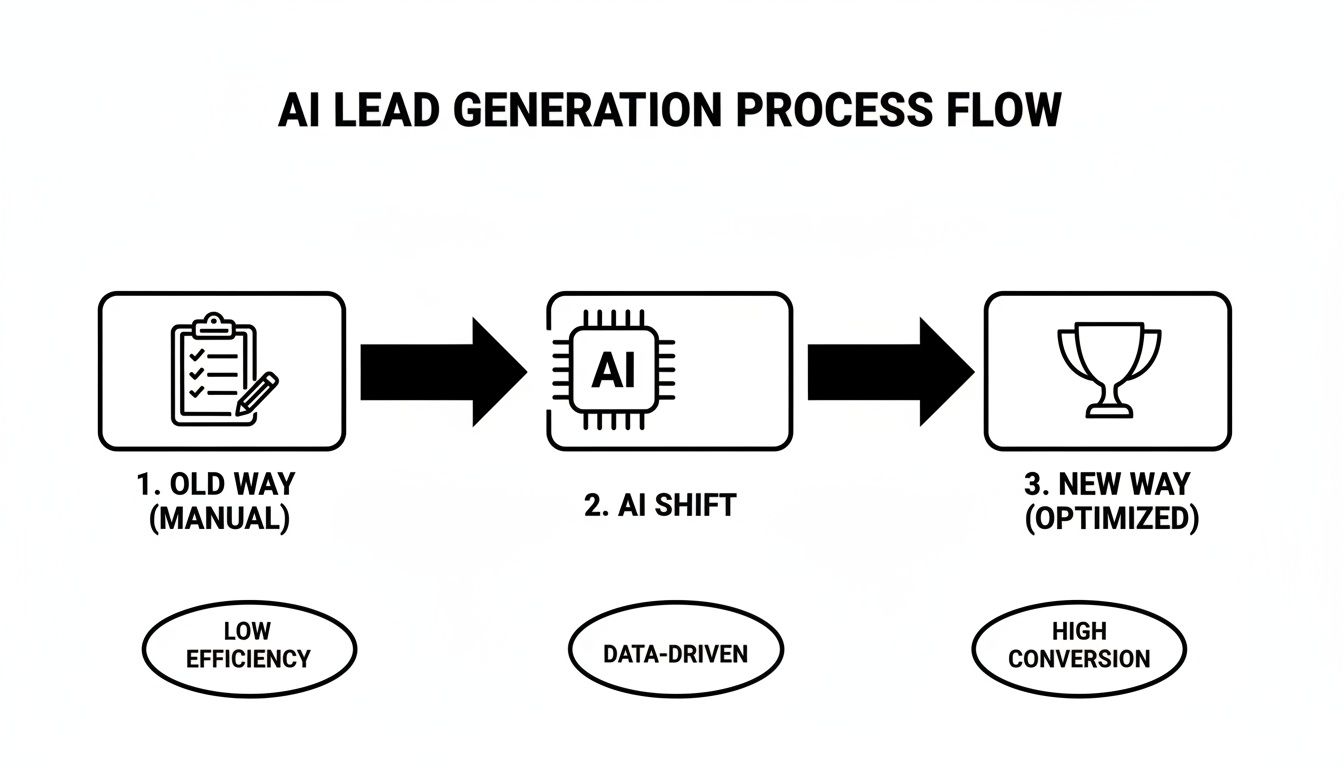
It’s a move from disconnected, manual list-building to an intelligent, automated workflow that surfaces the best leads.
The Real Takeaway: AI's value in lead gen isn't just about speed; it's about synthesis. It pieces together fragmented data to create a complete picture of your market, showing you opportunities you couldn't see before.
Think about it in a practical sense. Let's say you have a list of 500 emails from a recent webinar. Right now, that's just a list. But by running it through an AI-powered enrichment tool, you can instantly turn it into a rich database with job titles, company sizes, tech stacks, and even recent buying signals—all without lifting a finger. That foundational work makes every other step you take smarter and more effective.
Picking the Right AI Tools for Your Stage of Growth
So you've got your data strategy and a crystal-clear Ideal Customer Profile. Now it’s time to choose your tech. The market for AI lead generation tools is a jungle, and it’s easy to get lost. The real key is to pick tools that solve your most immediate problems, not just chase the shiniest new object.
I’ve seen so many startups make the same mistake: they try to build a massive, enterprise-grade AI stack right out of the gate. That's a recipe for wasted time and money.
Instead, ask yourself one simple question: what’s our biggest bottleneck right now? Are you struggling just to find prospects? Is your CRM data stale and useless? Or is your team drowning in unqualified inbound chats? Your answer points directly to your first, and most important, AI investment.
Breaking Down the AI Lead Gen Toolkit
Your AI system will probably be a mix of tools from a few core categories. The goal isn't just to have a bunch of tools, but to build a stack where each piece has a clear job and they all work together seamlessly.
Think about these essential functions first:
Lead Discovery Platforms: These are your digital prospectors. They use AI to scour public data and intent signals, hunting down companies and people who fit your ICP. It’s the modern, infinitely smarter version of buying a list.
Data Enrichment Services: These tools take a single piece of information, like an email address, and fill in the blanks. They'll add critical details like job titles, company size, the tech they use, or recent funding rounds.
AI Sales Agents: You've seen these as chatbots on websites. But they’ve come a long way from just answering basic questions. Now, they can actually engage visitors, ask qualifying questions, book meetings, and send the best leads straight to your sales team’s calendar.
Predictive Lead Scoring: These models dig into your past wins and losses to figure out what a perfect lead looks like. They then score all your incoming leads, so your team knows exactly who to call first.
For example, if you’re a B2B SaaS founder trying to land your first 50 customers, an AI prospect discovery tool is where you should start. Your main challenge is just finding people, not nurturing a huge database. A simple search for 'AI prospect discovery tools for tech' will point you to platforms built for exactly that.
On the other hand, if you’re a more established small business with a massive but messy CRM, you’ll get a much faster return from a data enrichment tool. Cleaning up the data you already own is a quicker path to cash than starting from scratch. You might also want to check out our guide on other powerful AI tools for business automation to see how this fits into a bigger picture.
Expert Insight: The best AI stacks aren't just a collection of cool tools; they're integrated systems. Before you sign any contract, make sure the tool plays nice with your CRM and other software. If it doesn't integrate, you're just creating more data silos and manual work for your team.
Making the Right Call for Your Business
To make this super practical, let's map it out. Where your company is today should absolutely dictate your first AI purchase.
| Company Stage | Primary Challenge | Recommended First AI Tool | Example Scenario |
|---|---|---|---|
| Pre-Seed/Seed Startup | Finding that initial batch of perfect customers to validate the market. | AI Prospect Discovery | Your goal is to find 50 companies that match your ICP. An AI tool can build that target list in a few hours, not weeks of manual grinding. |
| Growth-Stage SMB | Lead quality is all over the place, and your CRM is a forgotten wasteland. | Data Enrichment Service | You have thousands of contacts but no idea who's good. An enrichment tool highlights the sales-ready leads hidden in your database. |
| Established Business | Tons of website traffic but terrible conversion rates and an overwhelmed sales team. | AI Sales Agent (Chatbot) | Your site is busy, but reps can't talk to everyone. An AI agent qualifies visitors 24/7, booking demos only with the best prospects. |
This phased approach solves your most painful problem first and helps you show a quick return on your investment. When you use AI for lead generation, you're building a system piece by piece. Each new tool adds another layer of intelligence and efficiency.
Ultimately, the objective is to create a unified workflow where data flows effortlessly from discovery to enrichment to engagement, building a predictable engine for growth.
Automating Outreach That Still Feels Human

Once your data is clean and your tools are in place, you can get to the most exciting part: putting AI to work engaging your prospects. This is where you graduate from simply sending more emails to actually starting more conversations.
We’re not talking about those clunky, rules-based chatbots from a few years ago. Modern AI sales agents are smart assistants that can work your website 24/7, engaging visitors, asking sharp qualifying questions, and booking demos right on your team's calendar.
This means you’ll never miss out on a high-intent visitor who’s browsing your pricing page at 10 PM. Instead of forcing them to fill out a static form, the AI starts a helpful conversation, capturing and qualifying the lead when they’re most interested.
Crafting Hyper-Personalized Outreach at Scale
The real breakthrough, however, happens when you take this intelligence beyond your website. This is where you can finally achieve personalization at scale and ditch generic templates for good.
Think about how long it takes a good sales rep to research a single prospect—they’ll check out the company, find the person on LinkedIn, and hunt for a recent event or article to break the ice. Now, imagine an AI doing that for hundreds of prospects at once.
This is exactly what signal-based prospecting does. Your AI can be set up to monitor target accounts for specific buying signals, such as:
New Hires: A company just brought on a "VP of Sales," which often signals a new strategy and budget.
Funding Rounds: A fresh Series B announcement means they have new capital to spend on growth tools.
Tech Stack Changes: You notice they just dropped a competitor's marketing software from their site.
Social Media Activity: A key decision-maker you're tracking just shared an article about a pain point your product solves.
An AI system can spot these signals in real-time and instantly draft a tailored opening line for an email or a LinkedIn message. A cold outreach suddenly becomes a warm, relevant touchpoint.
The performance gap is huge. While traditional cold outreach struggles to get a reply rate above 3%, this kind of hyper-personalized, signal-based approach consistently sees reply rates between 5% and 25%.
You're no longer interrupting someone's day with a random pitch. You're joining a conversation that's already in progress, armed with context that proves you’ve done your homework.
From Signals to Booked Meetings
The data speaks for itself. For many top-performing sales teams, AI agents now handle over 30% of all initial outreach, effectively tripling their capacity. But it's not just about volume; businesses using AI chatbots are seeing a 64% jump in higher-quality leads.
These signal-qualified prospects are converting 47% better and closing 38% more often quarter-over-quarter. The bottom line? Teams using this approach are booking 2-3 times more meetings than they were with traditional methods. If you want to dig deeper into the numbers, the latest research on modern lead generation stats paints a clear picture.
Here’s what that workflow looks like in practice. Your AI platform flags that a target company just posted a job for a "Demand Generation Manager." It then finds the VP of Marketing, confirms they're active on LinkedIn, and drafts an email starting with something like, "Saw you're expanding the demand gen team—congrats on the growth. Scaling lead volume is a top priority for most marketing leaders in your shoes."
Your sales rep just needs to review the draft, maybe add a quick personal touch, and click send. This "human-in-the-loop" model gives you the speed of AI with the strategic mind of your sales team—a seriously powerful combination.
AI Outreach Methods Comparison
Of course, not all AI-powered outreach is the same. The channels you choose have to match your goals and your audience. This table breaks down some of the most effective methods I've seen work for B2B lead generation.
| AI Method | Primary Use Case | Typical Reply/Conversion Rate | Best For |
|---|---|---|---|
| AI Website Agents | Engaging and qualifying inbound website traffic in real time. | 2-5% Visitor-to-Lead Conversion | Businesses with significant website traffic, especially on high-intent pages. |
| AI Email Outreach | Scaling personalized cold outreach based on buying signals. | 5-25% Reply Rate | B2B companies targeting specific accounts with a longer sales cycle. |
| AI Social Prospecting | Automating LinkedIn connection requests and messages. | 10-30% Connection Acceptance Rate | Sales teams focused on building relationships with key decision-makers on social media. |
By layering these methods, you create a system that engages prospects on multiple fronts. An AI agent might capture an anonymous visitor on your site, use data enrichment to identify them as a decision-maker at a target account, and then trigger a personalized email sequence. This is how you stop chasing leads and start building a machine that brings them to you.
Measuring Performance and Tuning Your AI Engine
Getting an AI lead generation system up and running is just the beginning. The real magic happens when you treat it not as a static tool, but as a performance engine that needs constant monitoring and fine-tuning.
I’ve seen too many teams get excited about a higher volume of leads, but that’s often a vanity metric. It can easily mask underlying problems in your pipeline. The goal isn't just more leads; it's connecting your AI efforts to actual revenue and proving its worth.
Key Performance Indicators That Actually Matter
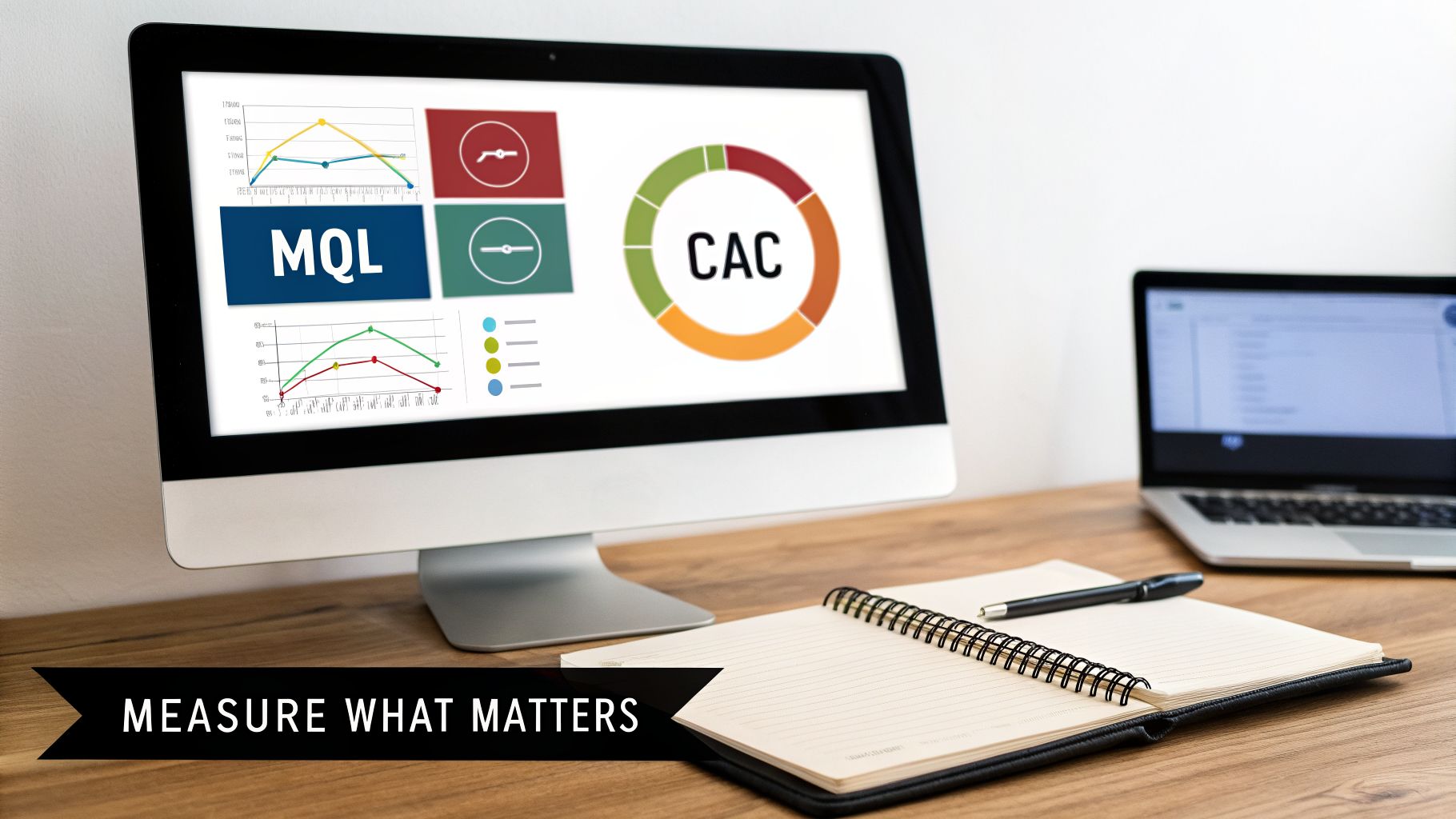
To get a true read on your AI's effectiveness, you need to track the right KPIs. This isn't about counting every last click. It's about monitoring the overall health and speed of your sales pipeline from start to finish.
Here are the core metrics that should be on your dashboard:
Lead Quality Score: Your AI shouldn't just find names; it should be scoring them based on their fit with your ICP and their potential buying intent. Watching the average score trend over time tells you if your targeting is getting sharper.
MQL-to-SQL Conversion Rate: This is the ultimate acid test for alignment. It shows you the percentage of Marketing Qualified Leads (MQLs) that your sales team actually accepts as Sales Qualified Leads (SQLs). If this number is low, your AI's definition of a "good lead" is out of sync with what sales needs to close deals.
Customer Acquisition Cost (CAC): Simply put, how much are you spending to bring in a new customer through these AI-driven campaigns? A consistently decreasing CAC is one of the clearest signs of a positive return on investment.
Pipeline Velocity: This tracks how quickly leads are moving through your pipeline and converting into revenue. A well-tuned AI system should be speeding this up, not creating a bottleneck with unqualified prospects.
Putting these four metrics into a dashboard in your CRM or a BI tool gives you an honest, at-a-glance view of performance. The conversation shifts from "we got more leads" to "we're building a more qualified pipeline, and we're doing it faster."
A Framework for Continuous Improvement
With your core metrics established, the next step is iterative improvement. The most effective way I've found to do this is with disciplined A/B testing—a method you can apply to every single part of your AI engine.
The idea is to methodically test one variable at a time to see what actually moves the needle. This removes the guesswork and lets you make data-driven decisions that build on each other.
Think of it as a repeatable cycle. First, you isolate a single variable to test, whether it's the tone of your AI sales agent, the call-to-action in an email, or a specific data point in your scoring model.
Next, you formulate a clear hypothesis. For example: "Using a direct, qualifying question in the opening line will book more demos than a softer, conversational approach."
Then you run the experiment, deploying both versions to a meaningful segment of your audience and letting it run long enough to gather data. After the test, you analyze the results against your core KPIs, paying close attention to MQL-to-SQL conversion and pipeline velocity. Finally, you implement the winner and move on to the next test.
A Practical Example: Imagine you're testing two different AI-generated email subject lines. For a month, 50% of your outreach gets a subject line referencing a prospect’s recent company funding (Signal A). The other 50% gets one that mentions a key technology in their stack (Signal B). After checking the numbers, you find that referencing their tech stack produced 30% more qualified appointments.
This isn't a one-and-done project. It’s a perpetual cycle of testing and learning. By constantly refining your prompts, your outreach sequences, and your AI models, you turn a static process into a dynamic growth engine that adapts to the market and consistently delivers better results.
Answering Your Toughest AI Lead Generation Questions
Alright, let's get real. Jumping into AI for lead generation is exciting, but it’s normal to have some healthy skepticism. It's smart to ask the tough questions and think through how this stuff actually works in the real world.
Let's tackle the most common concerns I hear from founders and marketers. These aren't just theoretical worries; they're the same hurdles I've navigated myself. Here’s what I’ve learned from being in the trenches with these tools.
Will Using AI for Outreach Make My Brand Sound Robotic?
This is probably the biggest hang-up I see, and for good reason. No one wants their brand to come across as a generic, impersonal machine.
The mistake is thinking AI has to replace human connection. It doesn’t. Think of it as a powerful research assistant, not a ghostwriter.
Modern AI is incredible at finding personalization hooks at scale. Instead of tasking it with "writing an outreach email," you direct it to find hyper-specific details you can use. For instance, it can instantly scan a prospect's recent LinkedIn activity, flag a new funding announcement their company just made, or even pinpoint a key challenge they mentioned on a podcast.
The AI automates the tedious research and delivers the perfect opening line or a relevant data point. Your team then weaves that into a genuine, strategic message. Used this way, AI doesn't kill personalization; it actually makes genuine personalization possible at a scale you could never achieve by hand.
The goal isn’t to automate the entire conversation. It's to automate the grunt work of finding a compelling reason to start one. This frees up your team to do what they do best: build real relationships.
What Is a Realistic Budget for a Small Business to Start?
You do not need a massive, enterprise-level budget to see results. In fact, starting small is the smarter move. The great thing about the current AI ecosystem is that most of the best tools are built on flexible Software as a Service (SaaS) models.
A totally realistic starting budget for a small business is somewhere in the $150 to $500 per month range. This is more than enough to cover a core set of tools and prove the concept with a measurable return.
For example, that initial investment could cover:
An AI-powered sales agent on your website to engage and qualify visitors.
A data enrichment tool to clean up a specific list of contacts in your CRM.
An AI writing assistant to help your team sharpen their email and ad copy.
The strategy here is to start lean. Target one specific bottleneck, prove the ROI, and once you see that initial spend turning into booked meetings, you can reinvest those profits with confidence. From there, maybe you add a predictive lead-scoring tool. Almost every platform offers a free trial, so you can test the waters before you commit a single dollar.
How Do I Stay Compliant with Privacy Regulations Like GDPR?
Compliance isn't just a box to check; it's a foundational part of your strategy. While the responsibility for handling data ethically and legally is ultimately yours, building a compliant process from the ground up is entirely manageable.
First, prioritize tools that are explicitly built with regulations like GDPR and CCPA in mind. Reputable vendors are transparent about this. Dig through their documentation and security policies to see how they handle data—if they hide it, that's a red flag.
Second, be transparent with your audience. That means clear consent language on your forms, cookie banners, and any chatbot interfaces. When you're doing outbound prospecting, the focus should always be on publicly available business information—think professional roles, company news, and business contact details—not scraped personal data that has no clear business purpose.
Finally, you need a solid internal data governance policy. Know where your data comes from, understand how your AI tools are using it, and have a clear process for handling data access or deletion requests. By combining compliant tools with transparent processes, you can navigate this landscape without the headaches.
Finding the right tools is the first step in building a modern, efficient lead generation engine. At Oryndex, we've done the heavy lifting by curating and vetting the best AI tools on the market. Ask our discovery engine in plain English for what you need—like "AI chatbots for small business" or "data enrichment tools"—and get a shortlist of products that can solve your exact problem.
Stop wasting time sifting through endless options. Find the perfect AI tools for your growth stack on Oryndex today.