
The 12 Best Photo Age Calculator APIs for Devs in 2026

Matic Pogladič
03 April 2026
A photo age calculator uses artificial intelligence to estimate a person's age from an image, providing a specific number or an age range. Developers use these tools to build features for age-gated access and personalized content. Choosing the right API is a critical business decision.
This guide provides a detailed, comparison-style catalog of the top photo age calculator tools. We will analyze leading commercial vendors like Amazon Rekognition, explore open-source alternatives like CompreFace, and give you the criteria to make a sound decision. For each option, you will find direct links, screenshots, and practical implementation guidance focused on real-world scenarios.
The core challenge is not just finding a model that works, it is managing bias, cost, and user privacy. I once worked on a project where our initial model consistently aged users by five years in poorly lit rooms. A frustrating lesson. It was a valuable lesson in the importance of real-world testing and understanding a model's limitations. This guide is built from that kind of hands-on experience. It will help you evaluate commercial vendors versus self-hosted models, understand pricing structures, and navigate privacy concerns. Our goal is to equip you to find the right tool for your specific project. We did the research so you can build.
1. Yoti – Facial Age Estimation
Yoti offers a Facial Age Estimation service designed for enterprise deployment, focusing on regulatory compliance and user privacy. Unlike consumer-facing photo age calculator apps, Yoti's system is engineered for integration into business workflows requiring age verification. It is a robust tool. Its core function provides an estimated age from a selfie in sub-second time without needing to store the image or personal user data, operating on a "zero ID" principle.
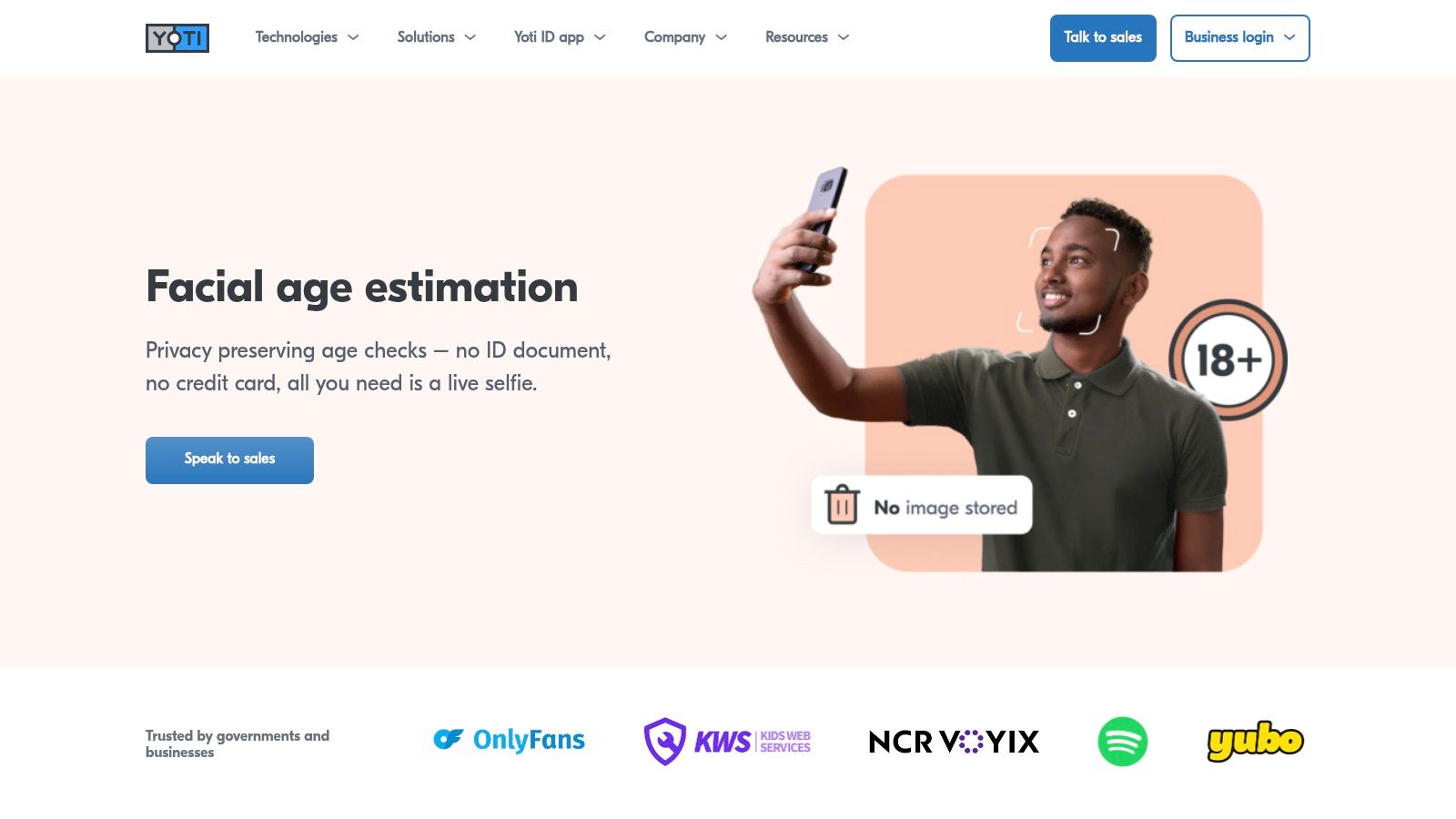
This platform stands out due to its strong reputation and adoption by major global brands for online safety and compliance. The technology has been independently benchmarked, including a 2021 study by the UK's Age Check Certification Scheme which found its average error to be just 1.52 years. This provides a layer of assurance for businesses concerned with accuracy and legal standards. Developers integrate the service via API or SDK with liveness detection to prevent spoofing attacks. This focus on privacy makes it a leading solution. You can find resources on similar privacy-first tools on Oryndex.
Implementation and Use Case
Yoti is not a casual tool. Access is quote-based and aimed at commercial entities. The implementation process is well-supported, reflecting its enterprise focus.
- API/SDK Integration: Primarily for developers to embed into apps or websites for seamless age checks.
- Use Cases: Best for social media platforms, e-commerce sites selling controlled goods, and online gaming communities.
- Pricing: Commercial terms are not public. Businesses must contact Yoti for a custom quote based on expected volume and specific needs.
Yoti's strength is its privacy-by-design architecture. For founders building platforms that handle sensitive user interactions, this "zero ID" approach is a significant risk mitigator, as it performs the age check without retaining the user's photo.
Website: Yoti Facial Age Estimation
2. Amazon Rekognition – DetectFaces
For developers already invested in the Amazon Web Services ecosystem, AWS Rekognition offers a powerful, scalable computer vision service. Its DetectFaces API is a robust function that returns an estimated AgeRange for each detected face, making it a practical photo age calculator for applications handling high volumes of images. It's a mature, infrastructure-level tool. The service is not a standalone app but an API designed for integration.
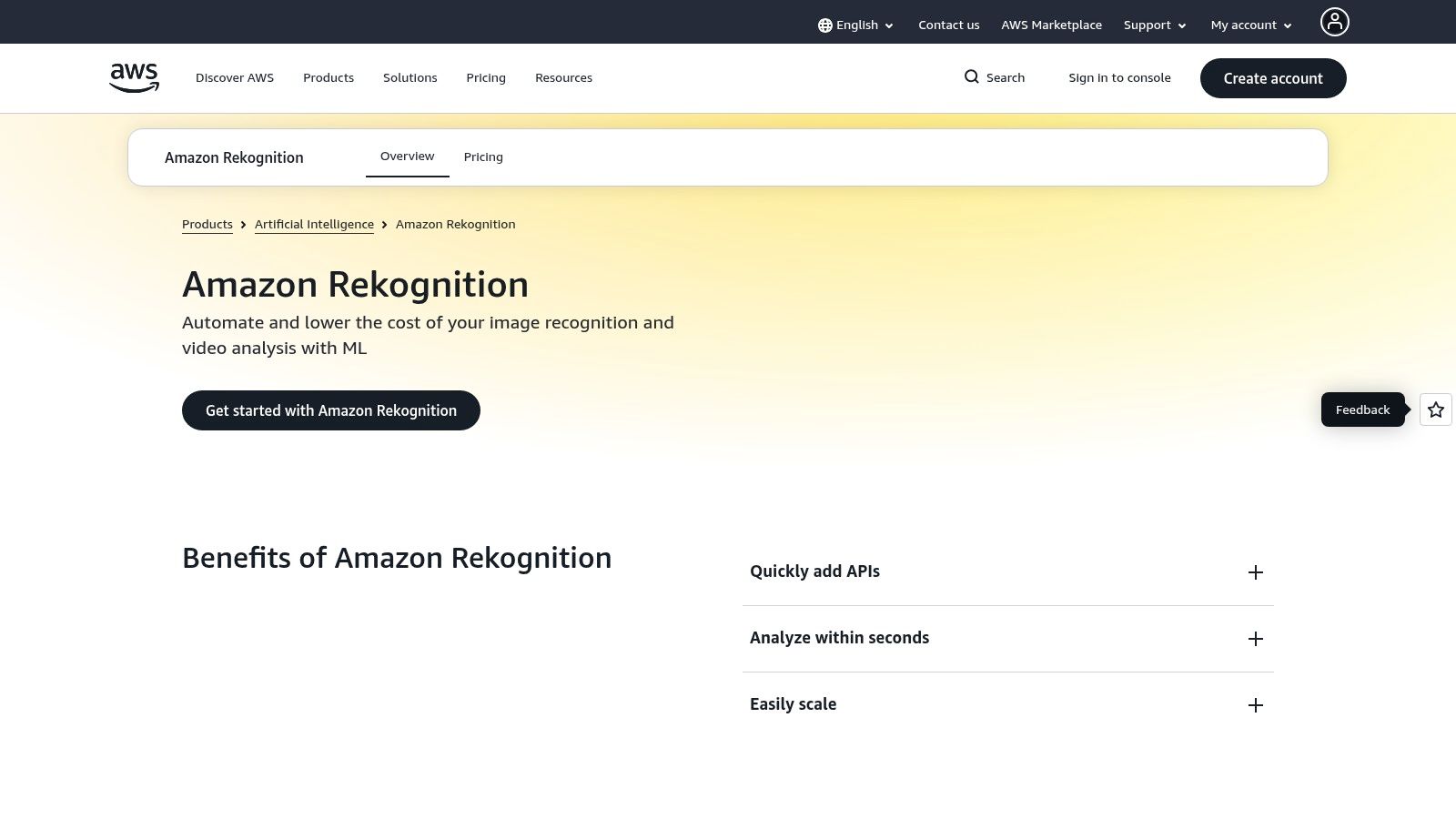
This platform's primary strength is its seamless integration with other AWS services like S3 for storage and IAM for security management. The API call is straightforward, returning a JSON object containing the low and high values of the estimated age range, along with a Confidence score for the entire face detection. This output is ideal for programmatic use, allowing developers to build logic around the returned range. You can explore more developer-focused tools by reviewing other API resources on Oryndex.
Implementation and Use Case
Rekognition is a developer-centric tool accessible via AWS SDKs and CLI. It’s built for integration, not direct consumer use.
- API/SDK Integration: Implemented via AWS SDKs available for Python, Node.js, Java, and other popular languages.
- Use Cases: Excellent for large-scale content moderation, demographic analysis from user-generated content, or building custom age verification flows within an existing AWS architecture.
- Pricing: Follows a pay-as-you-go model based on the number of images processed per month, with a free tier for initial development.
The key benefit of Rekognition is its raw utility. It returns an age range, not a single number, which is a more honest representation of the model's capability. For tasks like audience segmentation, this range is often more useful than a specific, less accurate integer.
Website: Amazon Rekognition
3. Face++ (Megvii) – Face Analyze API
Face++ by Megvii provides a mature and widely-used Face Analyze API that goes well beyond simple age estimation. This service is a comprehensive facial attribute analysis tool, returning a predicted age, gender, emotional state, and dense facial landmarks from an image. It is built for developers who need a rich set of facial data, not just a single metric. Its power lies in its REST API ecosystem, which is well-documented and supported by SDKs.
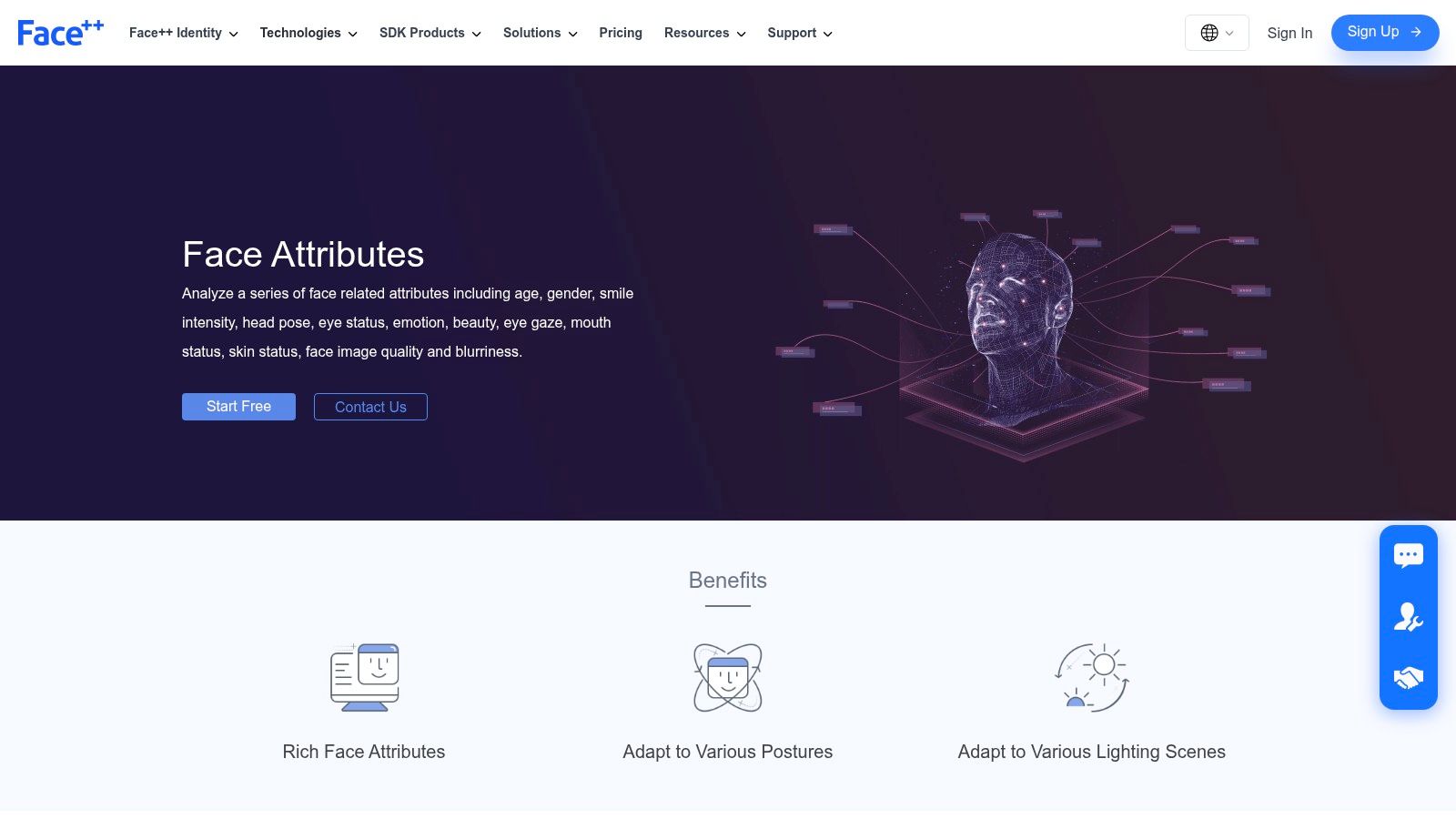
This API stands out for its speed and the depth of information it returns in a single call. Developers can submit a photo and receive a detailed JSON response containing a variety of analytics, making it efficient for applications requiring multiple data points. The platform supports batch processing and can detect multiple faces within a single image, assigning unique attributes to each one. This makes it a great photo age calculator for analyzing group photos or user-generated content streams.
Implementation and Use Case
Face++ is designed for straightforward integration into applications, offering a free tier for development and low-volume usage before scaling up to paid plans.
- API/SDK Integration: Primarily a REST API, making it language-agnostic. SDKs for Python, Java, and PHP simplify the process.
- Use Cases: Excellent for social media content analysis, photo gallery organization by age, or demographic research applications.
- Pricing: Offers a free plan with rate limits. Paid plans are based on calls per second (QPS), with pricing available on the website for different tiers.
The real strength of Face++ is its data density. For a project I worked on that required categorizing user-submitted photos for a marketing campaign, the ability to get age, gender, and even a "beauty score" in one API call was a massive time saver.
Website: Face++ Attributes
4. Luxand – FaceSDK
Luxand's FaceSDK is engineered for developers requiring on-device facial analysis, shifting the processing from the cloud to the edge. This commercial software development kit performs face detection, tracking, and attribute recognition, including a reliable photo age calculator function. It runs directly on Windows, macOS, Linux, iOS, and Android. The primary advantage is its offline capability, which makes it a strong choice for applications where privacy and real-time performance are critical. It is a powerful local tool.
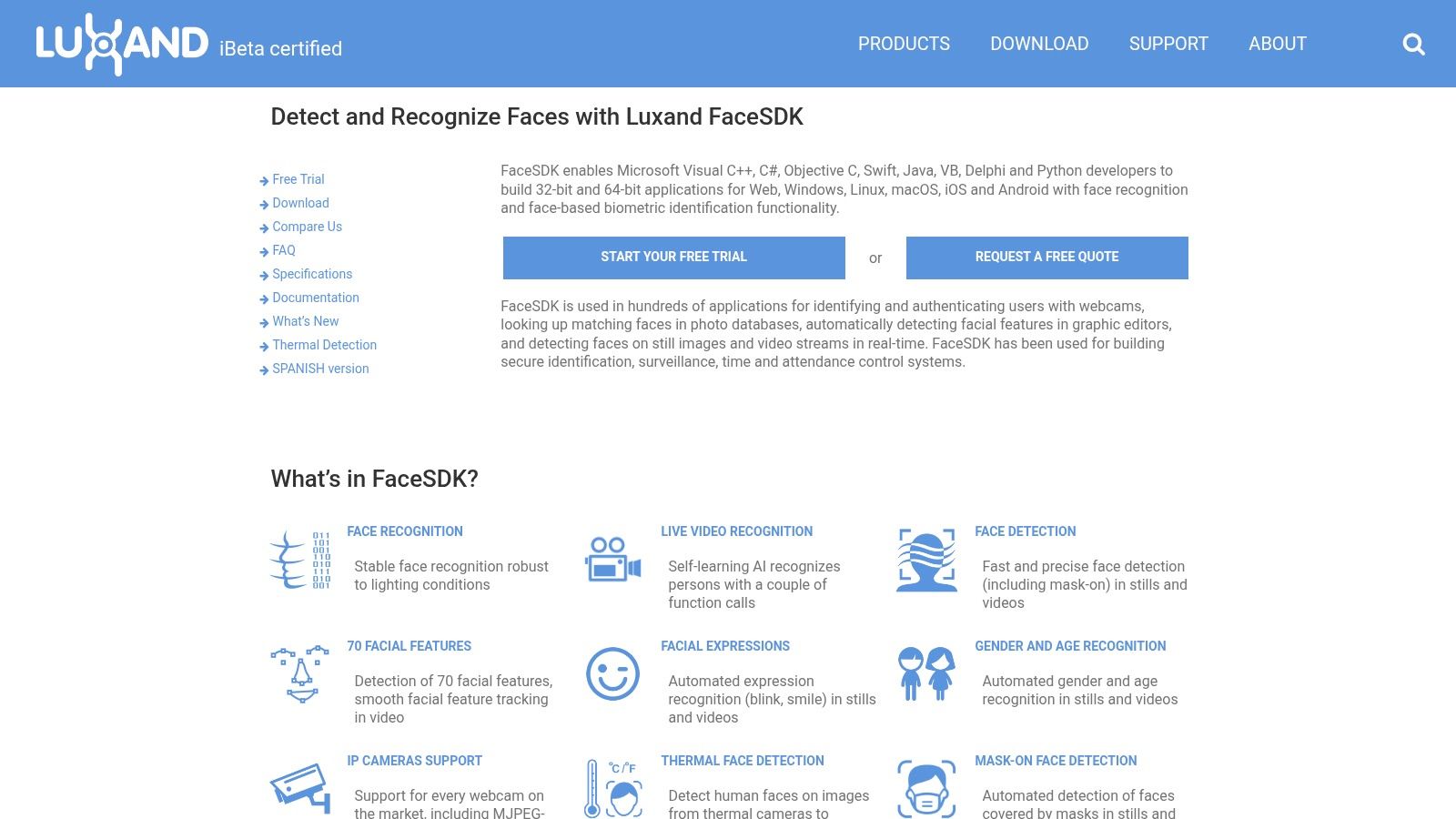
Unlike simple API calls, Luxand provides a library that integrates deeply into an application's codebase, with bindings available for C/C++, Java, and .NET. This setup eliminates per-call cloud fees, operating on a license-based model instead. This can be more cost-effective for high-volume, continuous use cases like digital signage analytics. The integration effort is higher, but the control and low latency it provides are significant benefits. You can learn more about how apps like FaceApp handle image data on Oryndex.
Implementation and Use Case
Accessing FaceSDK requires engaging with Luxand's sales team for a commercial license, as it is a professional developer tool, not a consumer service.
- SDK Integration: Designed for software developers to embed directly into native applications for various operating systems.
- Use Cases: Best suited for offline scenarios like audience measurement in digital signage, real-time filters in kiosk photo booths, and on-premise security systems.
- Pricing: Licensing costs are not public. Businesses must contact Luxand for a quote tailored to their specific deployment needs and scale.
The key strength of Luxand is its independence from network connectivity. For a project like an interactive museum exhibit that needs to react to a visitor's age without sending data to the cloud, this on-device SDK is an ideal solution.
Website: Luxand FaceSDK
5. Betaface API
Betaface API offers an established and comprehensive face analytics service, providing developers with a straightforward REST API for attribute detection. While it functions as a photo age calculator, its capabilities extend far beyond a single data point. It returns a rich set of facial attributes, including gender, ethnicity, emotional state, and physical features. This makes it an excellent choice for projects requiring deep facial analysis. It's a workhorse tool.
This platform's main advantage is its speed for prototyping and the sheer breadth of data it returns from a single API call. As a long-standing vendor in the face analytics space, Betaface provides a stable and tested solution. Developers can experiment quickly using the public web demo before committing to programmatic integration. The API supports analyzing multiple faces in a single image. A key differentiator for applications processing group photos.
Implementation and Use Case
Betaface is designed for easy experimentation and integration, with a clear path from a free demo to paid production use. Its attribute-rich output suits a variety of applications.
- API/SDK Integration: A simple REST API makes it easy to integrate into most web or mobile applications.
- Use Cases: Ideal for academic research, demographic analysis tools, or social media apps that need to tag or categorize user-submitted photos with multiple attributes.
- Pricing: Offers a free tier for low-volume testing, with paid subscription plans available for higher usage. Note that free or public use cases require visible attribution per their terms.
Betaface is great for rapid validation. If you're building a proof-of-concept that needs more than just an age estimate, its rich attribute set lets you test multiple features without stringing together different APIs.
Website: Betaface API
6. Clarifai – Demographics (Age Appearance) Workflow
Clarifai offers more than a simple photo age calculator. It provides a comprehensive MLOps platform for teams needing to build, customize, and deploy AI models at scale. Its Demographics workflow includes a pre-built age appearance model, but its true strength lies in the surrounding infrastructure. This is not a casual tool. It's an enterprise-grade system for developers who plan to integrate age estimation as part of a larger, custom AI pipeline.
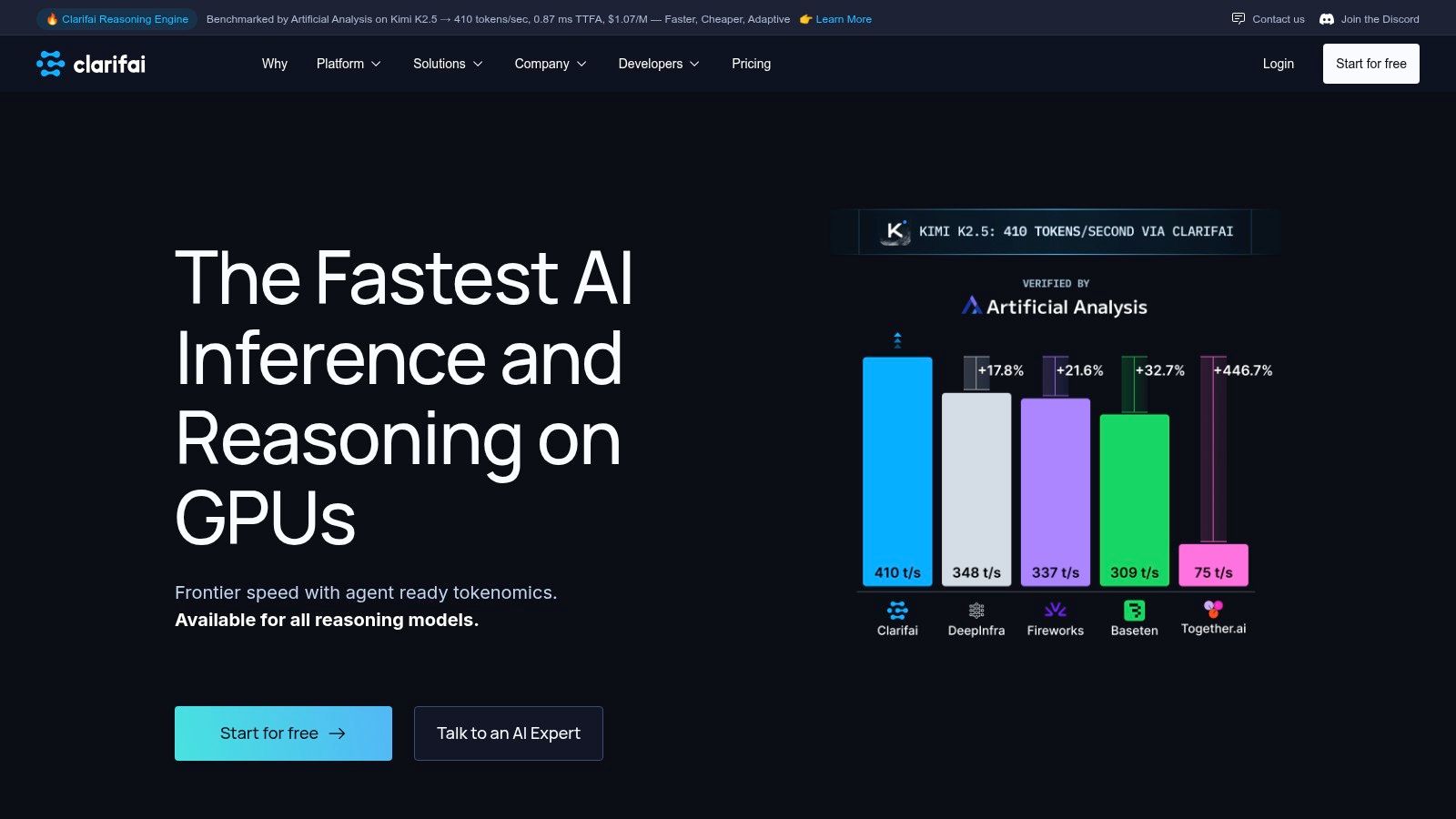
The platform stands out by empowering developers to go beyond a single API call. You can chain models together in a workflow, fine-tune the age appearance model with your own labeled data for improved accuracy, or build entirely new solutions. This level of control is essential for companies targeting specific demographic groups where off-the-shelf accuracy is insufficient. For teams building complex systems, exploring other advanced tools in machine learning is often the next logical step.
Implementation and Use Case
Clarifai is a developer-centric platform with usage-based pricing, making it accessible for projects of varying sizes, from startups to large enterprises.
- API/SDK Integration: Provides robust SDKs and a clear API for integrating age appearance and other computer vision models into your applications.
- Use Cases: Ideal for advanced content moderation, personalized marketing campaigns, or any application where age data needs to be combined with other visual analytics.
- Pricing: Operates on a usage-based model. Costs depend on the volume of API calls, model training, and data storage, requiring careful monitoring to manage expenses.
Clarifai's value is its platform depth. If your roadmap includes eventually training a custom model for a niche task, starting with Clarifai for a simple photo age calculator function means you are already on a platform that can support your future needs without a painful migration.
Website: Clarifai
7. Visage Technologies – visage|SDK FaceAnalysis
Visage Technologies provides a commercial software development kit, the visage|SDK, focused on real-time face analysis for professional applications. Unlike cloud-based photo age calculator APIs, this SDK is designed for on-device processing where low-latency and performance are critical. It is built for integration into native mobile apps and AR/VR experiences. Its primary function is to deliver immediate age estimations directly from a live video stream, with documentation citing an average accuracy of approximately ±5 years.

This SDK stands out because it bundles a suite of facial analysis features beyond just age. It includes real-time tracking of 3D head pose, facial landmarks, eye gaze, and expression recognition. This makes it a powerful choice for interactive applications. The technology is optimized for edge-first deployment, ensuring all analysis happens on the user's device. A major benefit for privacy. It avoids network latency entirely. Development teams receive cross-platform native SDKs, a clear signal of its focus on deep, high-performance integration.
Implementation and Use Case
Visage|SDK is a tool for developers building complex applications, not a simple REST endpoint. Access requires purchasing a commercial license.
- API/SDK Integration: Requires native C++ integration for desktop, embedded, iOS, or Android platforms. This is for projects needing maximum performance.
- Use Cases: Ideal for interactive advertising that reacts to a viewer's age, driver monitoring systems, AR try-on apps, and academic research in human-computer interaction.
- Pricing: A commercial license is mandatory. Pricing is quote-based and requires contacting the Visage Technologies sales team to discuss the scope and scale of the project.
Visage's edge-first architecture is its core advantage. For a product like a smart mirror in a retail store, processing age and expression locally means instant feedback without sending customer images to the cloud, addressing both performance and privacy concerns head-on.
Website: Visage Technologies
8. Sightcorp (by Raydiant) – DeepSight Toolkit
Sightcorp, now part of Raydiant, offers the DeepSight Toolkit, an audience analytics stack that shifts the focus from online verification to physical environments. Its core strength is real-time, on-device facial analysis for applications like digital-out-of-home advertising and retail analytics. This is not a typical online photo age calculator. It is built for continuous operation. The system anonymously estimates age, gender, and attention metrics from live video streams, providing aggregated data without storing personal information.
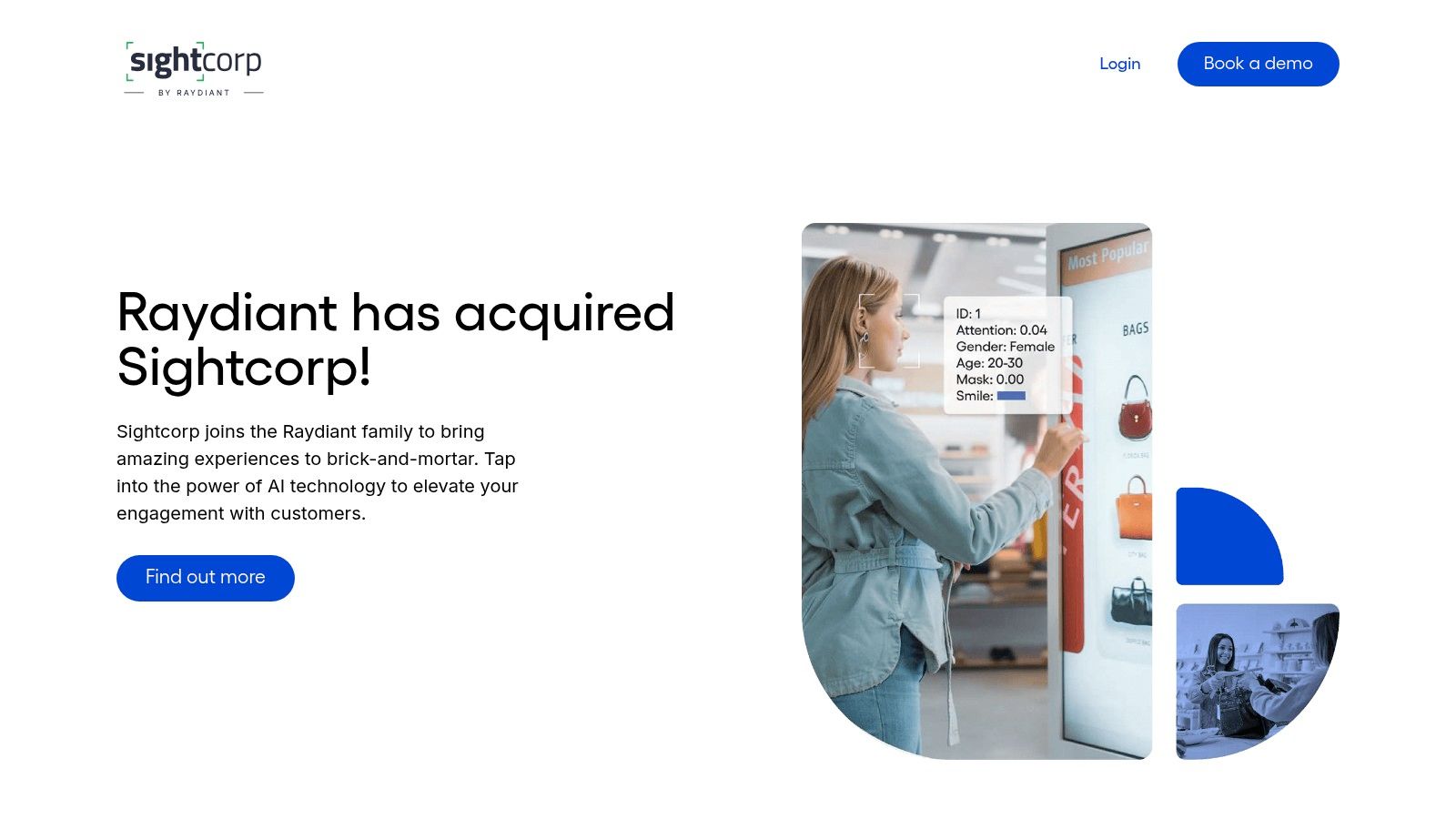
This platform stands out because its architecture is designed for edge computing, which is critical for privacy and performance in public spaces. By processing data directly on-premise, it sidesteps the need to send sensitive video feeds to the cloud. This makes it a robust solution for GDPR-compliant audience measurement. The toolkit is engineered for integration with interactive digital signage platforms, allowing content to adapt dynamically based on the detected demographics of the audience.
Implementation and Use Case
Sightcorp is a commercial solution for businesses aiming to understand physical foot traffic and engagement. Its implementation requires specific hardware and is geared toward analytics.
- Deployment: Runs on-device using standard 2D cameras connected to a local processing unit.
- Use Cases: Ideal for retailers measuring ad effectiveness, airports gauging audience dwell time, or interactive kiosks delivering targeted content.
- Pricing: Access is commercial and requires contacting Sightcorp for licensing details, which will depend on the scale of deployment and hardware needs.
The real power of Sightcorp is its ability to provide anonymous, aggregated insights. For a retail chain, this means understanding which in-store displays attract a specific demographic without ever collecting a single piece of personal data from shoppers.
Website: Sightcorp
9. ROC.ai – Face Analytics (Age Estimation)
ROC.ai provides an enterprise-grade face analytics suite with SDKs and APIs that feature a powerful age estimation component. This platform is engineered for high-stakes, regulated environments where accuracy and real-time processing are critical. It moves beyond a simple photo age calculator, offering a complete analytics package for use cases like age assurance and secure access control. It is a serious tool. The system is designed for direct integration into camera feeds, delivering performance for safety-critical deployments.

This solution distinguishes itself through its focus on government and commercial sectors that demand high performance and reliability. ROC.ai is not a casual app. It is a developer-focused toolkit for building robust systems. The inclusion of gender, sentiment, and behavior analytics alongside age estimation makes it a versatile choice for organizations looking to derive deeper insights from video or image data. The heavier integration effort is a trade-off for its extensive capabilities.
Implementation and Use Case
ROC.ai is strictly for commercial and government implementation, with access provided on a quote-based model. Its deployment is a more involved technical process.
- SDK/API Integration: Designed for developers to build into custom applications, often requiring on-premise or dedicated cloud deployments for real-time video analysis.
- Use Cases: Ideal for law enforcement, airport security, retail analytics, and regulated industries needing certified age verification mechanisms.
- Pricing: Commercial pricing is not public. Organizations must contact ROC.ai for a custom quote based on their specific deployment needs and scale.
For organizations in regulated spaces, ROC.ai's strength is its certified performance and ability to operate in closed-loop systems. This provides a level of control and security that consumer-grade cloud APIs simply cannot match, making it a viable option for critical infrastructure protection.
Website: ROC.ai Face Analytics
10. Youverse – YouAge API
Youverse offers a focused facial age estimation service, YouAge, designed as a lightweight API for integration into broader identity verification or age-gating workflows. Its primary function is to serve as a pre-screening microservice. The API processes a still image and returns an apparent age along with a confidence score. This allows platforms to perform a quick, low-friction age check before escalating to a full Know Your Customer (KYC) process. It is a purpose-built tool.
The platform stands out for its simplicity and clear-cut use case. Rather than offering a comprehensive identity suite, Youverse provides a single, easy-to-integrate endpoint for one specific task: age estimation. This makes it an excellent photo age calculator for developers who need to add a quick age-check layer without the overhead of a larger verification system. Its documentation is clear, enabling fast testing and implementation.
Implementation and Use Case
YouAge is an API-first product aimed at developers needing a discrete age estimation function. Access and pricing details require direct contact, suggesting a B2B commercial model.
- API/SDK Integration: Delivered as a REST API that accepts a still image and returns JSON data with the estimated age and confidence level.
- Use Cases: Ideal for pre-screening users on platforms with age-sensitive content, such as online communities or retail sites, to filter out obviously underage users before a more rigorous check.
- Pricing: Commercial terms are not public. Businesses must contact Youverse to discuss pricing, which is likely based on API call volume.
Youverse's strength is its focused, minimalist approach. For a startup needing to quickly implement a basic age check as part of its user onboarding flow, this API provides a direct and efficient solution without committing to a full-blown identity verification platform.
Website: Youverse – YouAge API
11. Exadel – CompreFace (open-source, self-hosted)
Exadel's CompreFace is a free, self-hosted face analytics suite offering a powerful alternative to subscription-based APIs. It provides plugins for age and gender estimation, allowing teams to build a photo age calculator with full control over their infrastructure. The solution is deployed via Docker and can run entirely offline. This makes it an ideal choice for projects prioritizing data sovereignty and avoiding per-call fees. It is a technical tool.
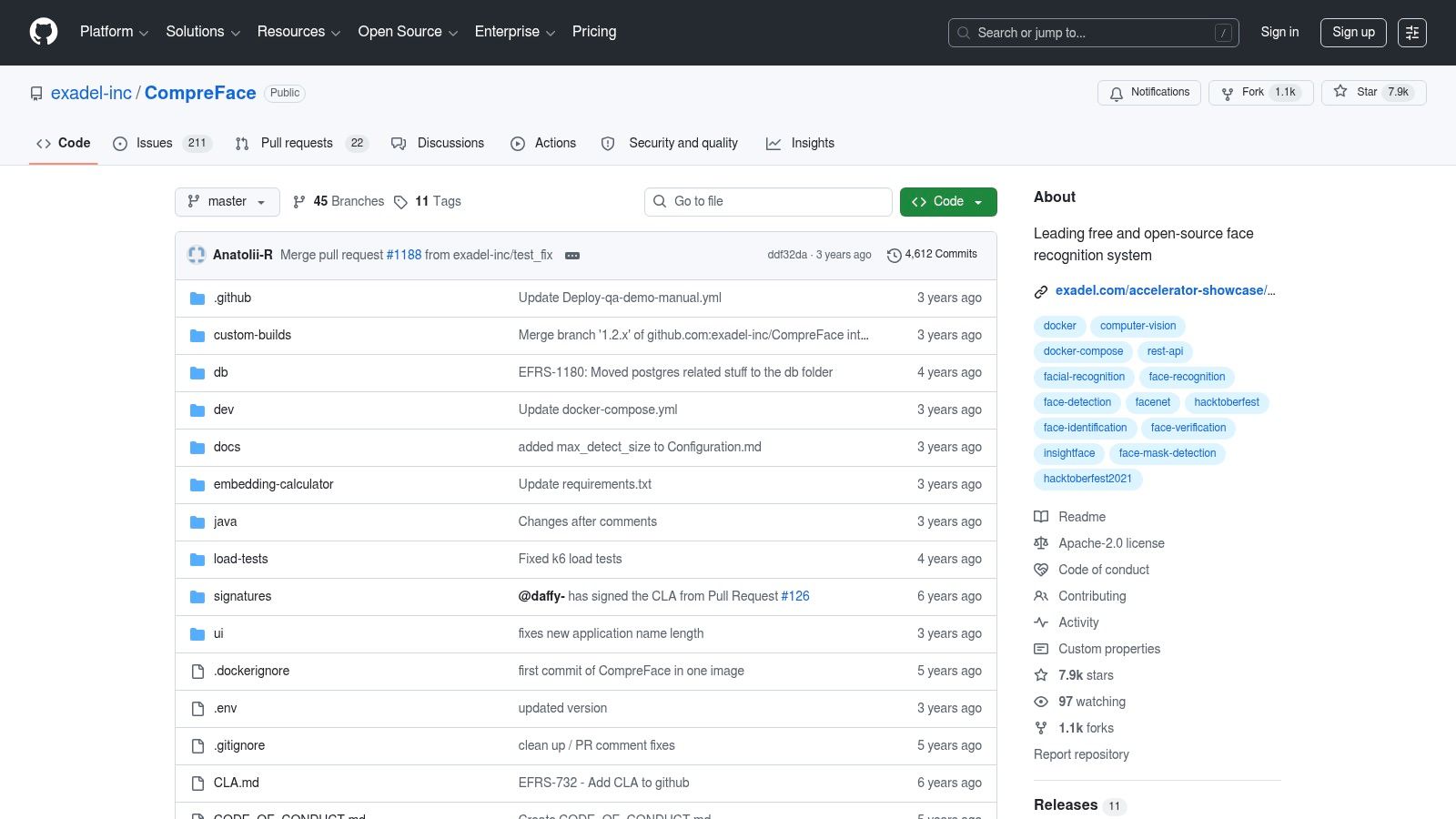
This platform stands out because it is open-source under an Apache 2.0 license, eliminating licensing costs entirely. For teams with DevOps capabilities, this means you can deploy a robust facial analysis system on your own servers, whether on-premise or in a private cloud. This control is critical for applications handling sensitive user data or operating in regions with strict data residency laws. The community-supported nature offers extensibility. You can find more information about similar open-source projects on Oryndex.
Implementation and Use Case
CompreFace is for technical teams comfortable with managing their own software stack. The Dockerized nature simplifies setup, but infrastructure management is a key consideration.
- API/SDK Integration: Developers interact with the service via a REST API after deploying it in a Docker container.
- Use Cases: Excellent for internal tools, research projects, or consumer apps where the business model cannot support per-transaction API costs. It is also suited for environments requiring offline processing.
- Pricing: Completely free. The only costs are related to the infrastructure (servers, bandwidth) you use to host it.
The primary advantage of CompreFace is cost-efficiency at scale. If your application anticipates millions of API calls, the savings from avoiding per-call fees with a self-hosted solution can be immense, justifying the initial setup and maintenance overhead.
Website: Exadel CompreFace on GitHub
12. Didit – Age Estimation
Didit provides a specialized, headless Age Estimation API designed for fast age-gating and pre-verification checks. It operates as a streamlined photo age calculator, where a business can submit a user's face image and receive a JSON response containing the estimated age and a confidence score. This service is positioned as an efficient alternative or a preliminary step before initiating more intensive document checks. It is a focused tool. Its primary function is to offer a quick, low-friction age signal that integrates easily into existing verification workflows.
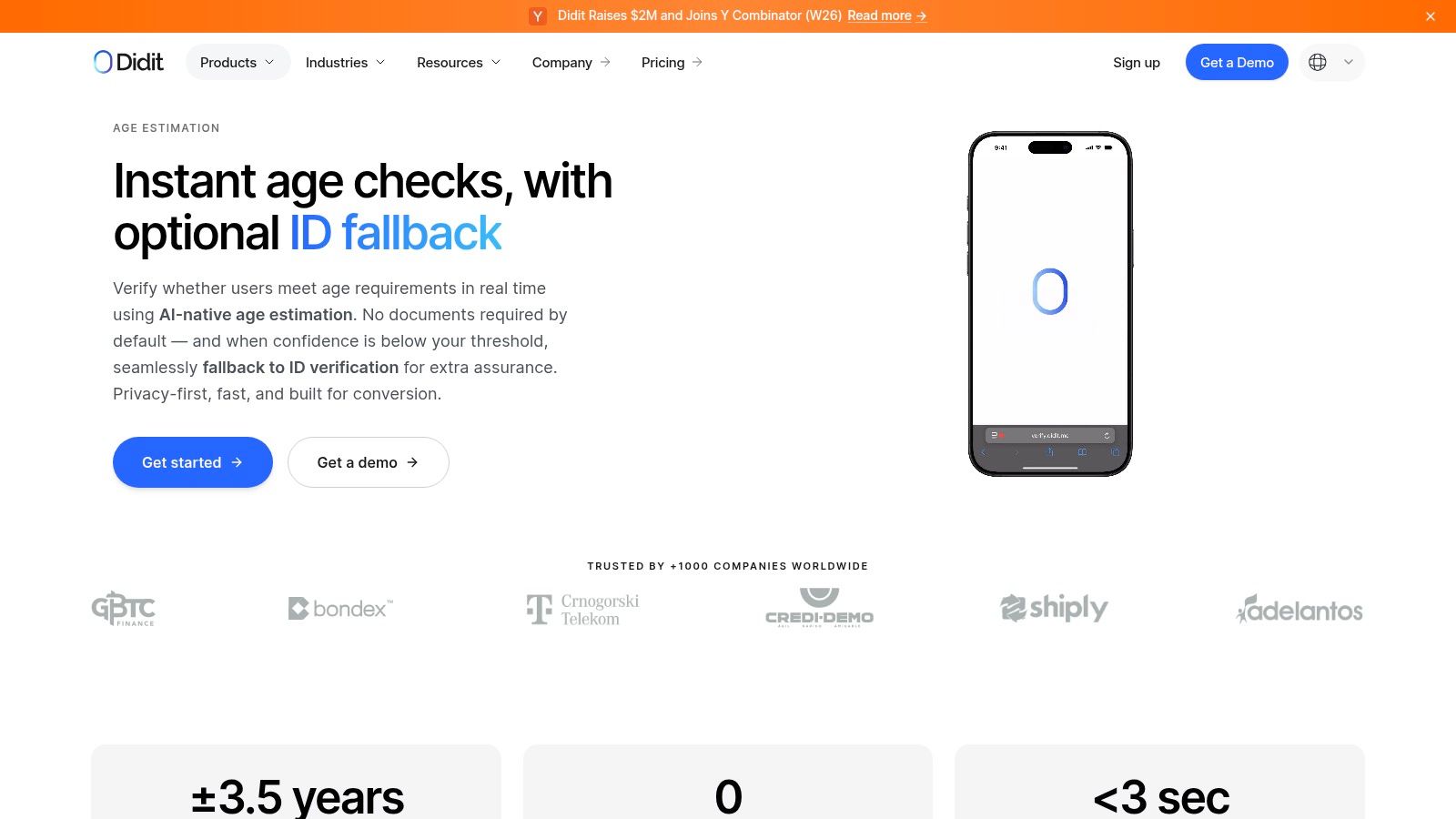
As a newer vendor in the age assurance market, Didit stands out with its developer-first simplicity. The API is purpose-built for easy integration, allowing companies to add a quick age check without overhauling their user onboarding process. While it provides materials comparing its performance against other providers, prospective clients should still conduct their own evaluations. Public performance data is not as widely available as for more established competitors. This makes due diligence critical.
Implementation and Use Case
Didit is aimed at businesses needing a fast, programmatic way to estimate user age without the complexity of a full identity verification suite.
- API Integration: The core offering is a simple API that accepts an image and returns a JSON object. This makes it ideal for developers looking for a quick headless solution.
- Use Cases: Best suited for initial age-gating on websites with age-restricted content, as a pre-check to reduce friction before asking for ID, or in social platforms to flag potentially underage accounts.
- Pricing: Access is quote-based. Companies must contact Didit to discuss their expected volume and specific integration needs to receive a custom pricing plan.
Didit’s value lies in its simplicity for pre-verification. For a platform that wants to filter out obviously underage users before triggering a more expensive KYC process, this API serves as an effective and low-cost initial gate.
Website: Didit Age Estimation
Photo Age Estimators — 12-Tool Comparison
| Tool | Key features ✨ | Quality ★ | Audience 👥 | Pricing 💰 | Standout 🏆 |
|---|---|---|---|---|---|
| Yoti – Facial Age Estimation | Sub-second selfie age estimates, privacy‑preserving zero‑ID, liveness guidance | ★★★★★ | 👥 Enterprises, platforms, retailers | 💰 Quote-based enterprise | 🏆 Privacy-first age assurance trusted by major brands |
| Amazon Rekognition – DetectFaces | Face detection + ageRange, confidence & landmarks, AWS SDK/IAM | ★★★★☆ | 👥 AWS customers, scale-focused teams | 💰 Pay-as-you-go (AWS) | 🏆 Deep AWS ecosystem & scalability |
| Face++ (Megvii) – Face Analyze API | Age, gender, dense landmarks, batch & multi-face REST API | ★★★★☆ | 👥 Developers prototyping & production apps | 💰 Tiered API plans | 🏆 Rich facial attributes and language SDKs |
| Luxand – FaceSDK | On-device age estimation, 70-point landmarks, cross-platform SDKs | ★★★★☆ | 👥 Kiosks, digital signage, privacy-sensitive apps | 💰 License-based (quote) | 🏆 Low-latency edge SDK with no per-call cloud fees |
| Betaface API | Age + confidence, rich attributes, web demo & REST API | ★★★☆ | 👥 Experimenters, rapid prototyping | 💰 Freemium / attribution & quotas | 🏆 Fast demos and broad attribute coverage |
| Clarifai – Demographics Workflow | Prebuilt age models, workflow chaining, fine-tune & labeling | ★★★★☆ | 👥 ML teams, teams needing MLOps | 💰 Usage-based platform pricing | 🏆 Platform for retraining and model orchestration |
| Visage Technologies – visage | SDK | Real-time age (±~5 yrs), landmarks, gaze, native SDKs | ★★★★☆ | 👥 AR/VR, mobile, embedded systems | 💰 Commercial license (quote) |
| Sightcorp (by Raydiant) – DeepSight Toolkit | On-device age/gender & attention metrics, dwell time aggregation, signage integrations | ★★★☆ | 👥 Retail, DOOH, signage operators | 💰 Enterprise/licensing | 🏆 Retail analytics + anonymized audience insights |
| ROC.ai – Face Analytics | Age, gender, sentiment, real-time camera integrations, enterprise SDKs | ★★★★☆ | 👥 Regulated & safety-critical deployments | 💰 Quote-based enterprise | 🏆 Compliance-focused enterprise face analytics |
| Youverse – YouAge API | REST apparent age + confidence, designed for pre-screen flows | ★★★☆ | 👥 Teams adding quick age-gating pre-checks | 💰 Not public / quote | 🏆 Lightweight microservice for pre-KYC screening |
| Exadel – CompreFace (open-source) | Age & gender plugins, face detection/verification, Dockerized self-host | ★★★☆ | 👥 Self-hosting teams, privacy-first orgs | 💰 Free (Apache 2.0) — infra costs apply | 🏆 Open-source control and no per-call fees |
| Didit – Age Estimation | JSON age + confidence, headless API, comparative materials | ★★★☆ | 👥 Developers needing fast age gating | 💰 Quote-based / smaller vendor | 🏆 Purpose-built headless age-gating API |
Choosing Your Tool: A Final Checklist for Developers
You have explored a dozen different paths to integrating age estimation. We analyzed the accuracy of Yoti, the scalability of Amazon Rekognition, and the self-hosted freedom of CompreFace. Now, the final decision rests on a pragmatic evaluation of your project's unique needs. Choosing the right photo age calculator is less about finding a single "best" tool and more about identifying the optimal fit for your specific technical and business constraints. The journey starts with asking the right questions.
This selection process is a balancing act. It is a series of trade-offs between precision, cost, user privacy, and engineering effort. Your answers to the following checklist items will illuminate the best path forward, ensuring the tool you integrate serves your purpose without creating unforeseen problems down the line.
Your Core Requirement: Accuracy vs. Application
How accurate does a photo age calculator need to be for your project? This is the most critical question. Your answer directly segments the available tools.
- Entertainment & Personalization: For a social media app adding a fun "guess my age" filter, a wider error margin is acceptable. Tools like the Betaface API or even open-source models can provide a general age range that is good enough for non-critical functions. A +/- 5-7 year variance is unlikely to break the user experience.
- Compliance & Age-Gating: For applications verifying legal age for restricted products or content, precision is paramount. A +/- 1-2 year accuracy, as claimed by providers like Yoti and Youverse, becomes the baseline requirement. Here, the potential legal and financial repercussions of an inaccurate estimation make investing in a high-precision, often more expensive, solution a necessity. The risk is simply too high.
The Implementation Gauntlet: API vs. SDK vs. Self-Hosted
Your development resources and infrastructure will dictate the feasible implementation path. Each approach has distinct advantages and demands.
- Cloud APIs (e.g., Amazon, Clarifai, Face++): This is the fastest route to market. You make a simple HTTP request and get a JSON response. It requires minimal upfront engineering. The downside is a dependency on an external service, potential latency, and recurring costs based on usage. It is ideal for startups and teams needing to validate an idea quickly.
- On-Device SDKs (e.g., Luxand, Visage): Integrating a Software Development Kit directly into your mobile or desktop application offers significant benefits for privacy and user experience. Processing happens on the user's device. This also enables offline functionality. However, it demands more skilled engineering to implement and maintain, and you'll manage SDK updates.
- Self-Hosted Models (e.g., CompreFace): For teams with strong DevOps capabilities and a critical need for data privacy and cost control at scale, self-hosting is a powerful option. You have complete control over the environment and the data. The trade-off is the significant operational overhead of provisioning servers, managing model updates, and ensuring security. This is not a path for the faint of heart.
The Final Tally: Total Cost of Ownership
Finally, look beyond the sticker price. The "free" open-source model is not truly free when you account for the engineering hours and server costs required to run it. When assessing cost, consider these factors:
- API Fees: Per-call pricing, monthly subscription tiers, and charges for exceeding quotas.
- SDK Licensing: One-time fees, annual licenses, or per-installation costs.
- Infrastructure Costs: The price of servers, data transfer, and storage for self-hosted solutions.
- Maintenance Burden: The engineering time spent on integration, updates, and troubleshooting.
Before you commit, create a short list of your top two or three candidates. Run your own benchmark tests using a diverse, real-world dataset that reflects your user base. Do not rely solely on the vendor's marketing claims. This hands-on evaluation is the single most important step in selecting a photo age calculator that will work for you, not against you.
Navigating this crowded market of AI tools can be overwhelming. To cut through the noise and directly compare the APIs and SDKs we've discussed, check out Oryndex. It is a curated directory of developer tools designed to help you quickly find, compare, and choose the right AI solutions for your stack. Explore the AI tool library on Oryndex.