
Artificial Intelligence Weekly: Top 7 Newsletters & Digests for 2026

Matic Pogladič
29 March 2026

The best artificial intelligence weekly newsletters are those that deliver a crucial signal, not distracting noise. They help you track important tools and trends. Curated digests from sources like The Batch, Import AI, and specialized directories such as Oryndex provide actionable insights, filtering out hype so you can focus on building. This listicle breaks down the top newsletters that bring you impactful research, new product releases, and vital policy changes. These resources provide context that generic news feeds often miss.
I learned this lesson the hard way. Years ago, my browser was perpetually clogged with hundreds of open tabs filled with undigested news. Information overload was real. My team's productivity suffered until we adopted a strict 'one in, one out' policy for our weekly reads. We cut our information diet by nearly 80%, but our actionable insights increased tenfold. It was a counter-intuitive move. Success is not about consuming more information; it is about consuming smarter.
This guide helps you achieve that focus. We will analyze top resources providing a high-value look at the AI space each week. For each option, you will find a concise summary, target audience, pros and cons, and a direct link. It is your shortcut to a more effective information strategy.
1. Oryndex
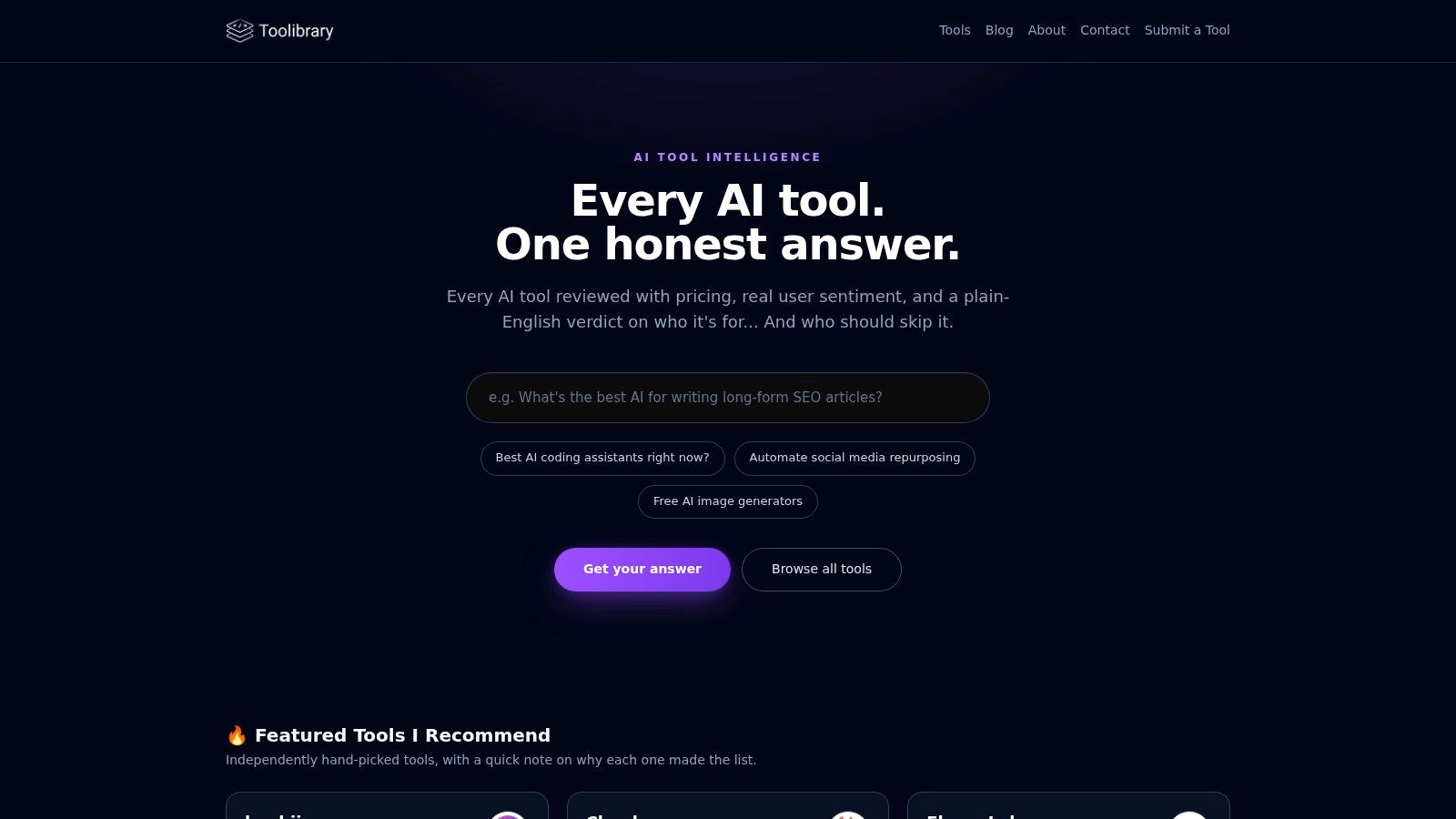
For builders, operators, and founders seeking to integrate AI without getting lost in marketing hype, Oryndex stands out. It is an essential resource. It is not a traditional "artificial intelligence weekly" newsletter but rather a living, operator-led directory of production-ready AI tools. Think of it as a constantly updated playbook for building your AI stack. The platform’s core strength is its curation, driven by hands-on experience in scaling real-world businesses, not just vendor promises. It delivers signal over noise.
This focus makes it an indispensable weekly checkpoint for anyone actively building with AI. Instead of waiting for a digest, you can search for a solution to an immediate problem, like finding a better AI-powered documentation tool. The curation reflects a practitioner's perspective. It prioritizes tools that solve genuine operational challenges.
Why It Excels: A Practitioner's Edge
The primary differentiator for Oryndex is its operator-led curation. Matic Pogladič, the site's creator, brings experience from scaling AI products and managing an eight-figure e-commerce stack. This background informs every listing. A recent study by Gartner highlights that 68% of executives believe the benefits of AI outweigh the risks, but they struggle to identify the right tools. The "Editor's Shortlist" on Oryndex directly addresses this by featuring proven tools like beehiiv and GitHub Copilot that have demonstrated value in real business contexts.
This practical foundation is supported by several key features:
- Natural Language Search: Find what you need by describing your problem in plain English.
- Market Leaderboard: A top-30 list, ranked by Similarweb traffic estimates, offers a data-backed signal of which tools are gaining adoption. This is a quick way to see what the market validates.
- Concise, Actionable Listings: Each tool entry includes clear use cases, tags, and pricing information, allowing for rapid evaluation. You can quickly see if a tool is for "content creation" or "developer tools" and assess its fit.
Practical Application: Finding Your Next Tool
To get the most from Oryndex, use its structured approach. Start with a specific business need. For example, if your support team is overwhelmed, search for "customer support automation." The platform will surface relevant options.
From there, cross-reference the results with the Market Leaderboard to gauge popularity. Then, investigate the individual listings. The concise tags and use cases will help you build a shortlist in minutes, not hours. For a deeper look at the curated options, you can explore the full range of AI tools on their website to see how they are categorized.
Final Verdict
Access: Free to browse. Website: https://oryndex.co
Oryndex’s power lies in its focus on execution. While some resources excel at tracking theoretical AI advancements, this platform is built for the builder who needs to ship a feature or optimize a workflow this week. It's very direct.
- Pros: Operator-led curation provides vetted, practical recommendations. The traffic-backed leaderboard gives a clear signal of market adoption. Its fast, no-nonsense interface speeds up the evaluation process.
- Cons: The curated nature means some niche tools might be overlooked. Traffic data is a useful proxy for popularity but should not be the only factor in your decision. Always conduct your own trials.
2. The Batch by DeepLearning.AI
For practitioners who need to bridge the gap between AI research and real-world application, The Batch by DeepLearning.AI is a standout resource. It is not just another news feed. It is an analytical briefing from a trusted name in AI education, founded by Andrew Ng. This weekly digest serves a specific purpose. It distills complex research papers, product updates, and industry trends into actionable intelligence for engineers, product managers, and business leaders.
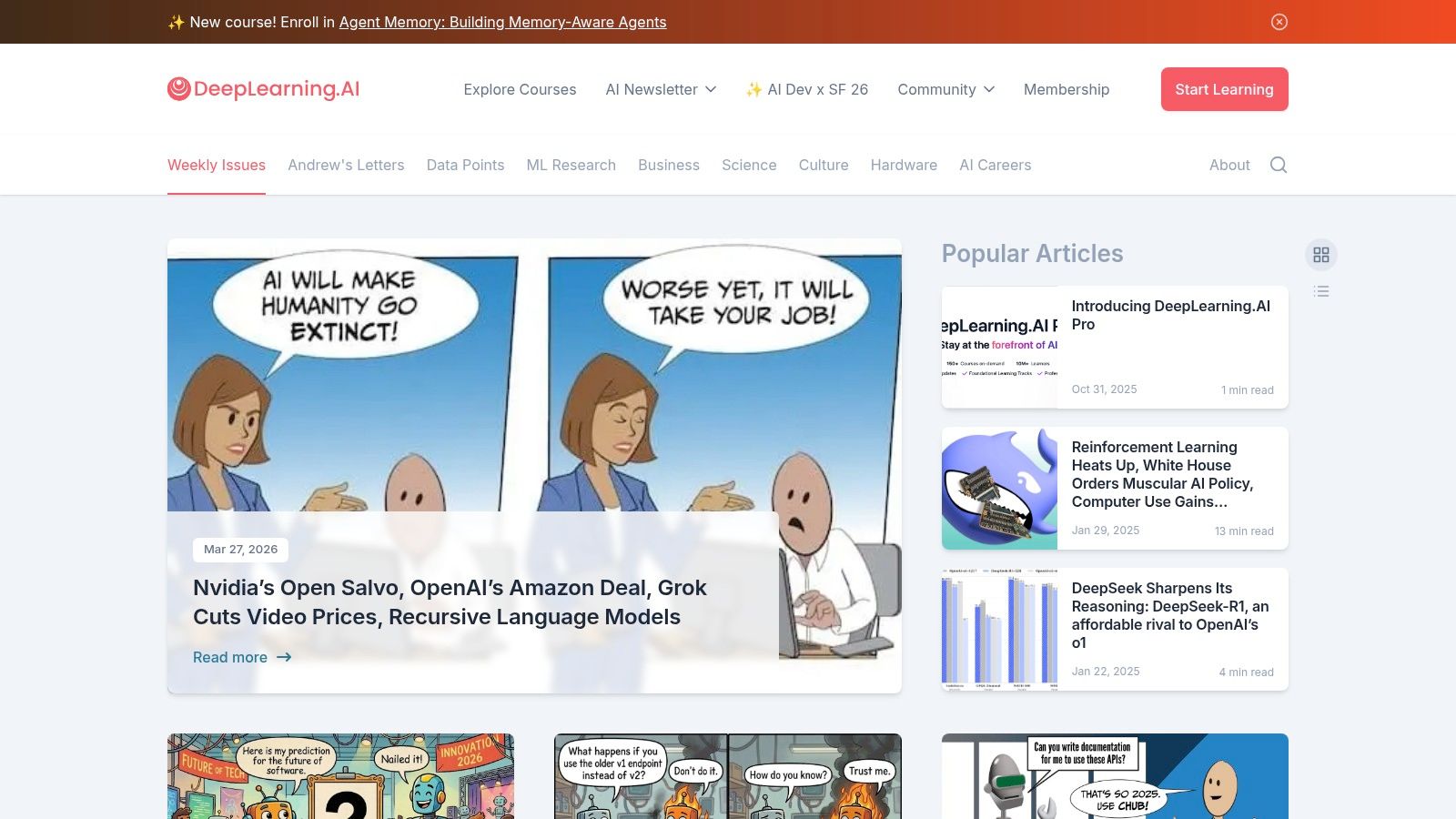
The Batch excels by providing context. It doesn't just link to a new paper on ArXiv. It explains the paper's significance, who it impacts, and how a team might use the findings. Its structure is clean and skimmable, with clear headings for different topics. This makes it easy to consume in under ten minutes.
Key Features and Content Focus
What makes The Batch a critical artificial intelligence weekly for so many is its balanced approach. A typical issue is segmented into concise stories covering everything from a new open-source model’s architecture to how a major tech company is applying AI to solve a specific operational problem. It connects dots.
- Research Highlights: Summaries of important academic papers, often with a "Why it matters" section.
- Industry and Business: Analysis of how AI affects markets, business models, and company strategies.
- Practical Applications: Spotlights on new tools, APIs, and techniques that developers can immediately explore. You can find more practical options by exploring a directory of machine learning tools for specific use cases.
Pros and Cons Analysis
The newsletter’s biggest strength is its authoritative voice. Coming from DeepLearning.AI, the content is credible and curated with an educator's eye for clarity. This makes it particularly valuable for cross-functional teams where not everyone has a deep technical background. The information is trustworthy.
However, its affiliation is also a minor drawback. Readers will notice occasional promotion of DeepLearning.AI courses or other ecosystem properties. Furthermore, while it covers business news, it offers less depth on AI policy and regulatory shifts compared to newsletters focused solely on governance.
Expert Insight: The Batch is the newsletter I recommend to product teams. It's the perfect conversation starter for Monday morning meetings, allowing technical and non-technical members to start from a shared understanding of last week's most important developments.
The Batch is free and accessible directly from the DeepLearning.AI website. Its disciplined focus on turning news into usable knowledge secures its spot as a top-tier weekly briefing.
3. Import AI by Jack Clark
For leaders who need to understand the strategic implications of AI beyond the headlines, Import AI by Jack Clark is an essential briefing. This is not a simple news aggregator. It is a thoughtful, analytical digest focused on significant research breakthroughs, their second-order effects, and the critical issues of safety and governance. Written by a co-founder of Anthropic, it provides foresight for those anticipating risk, regulation, and competitive shifts.
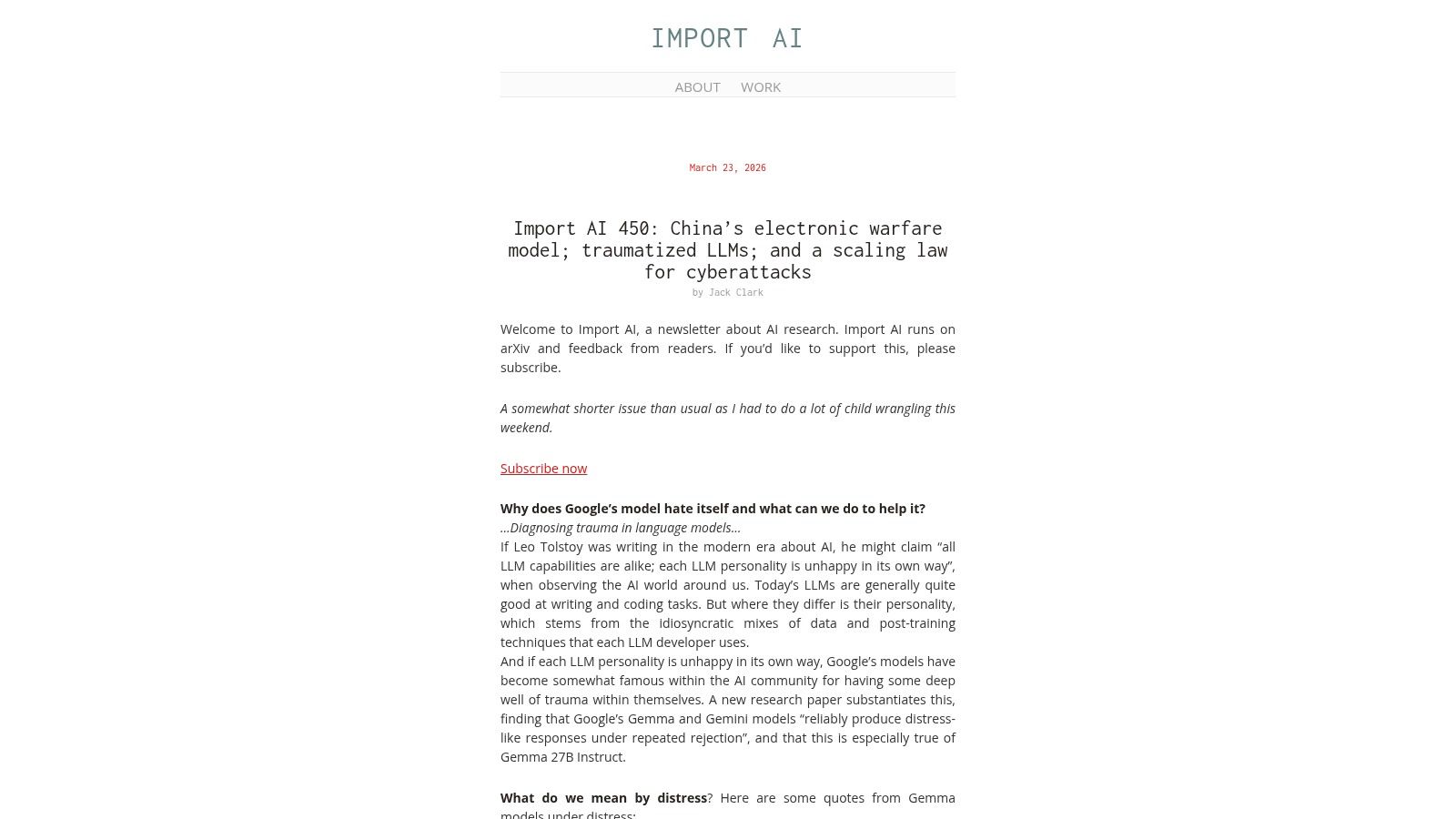
Import AI's distinction lies in its depth and perspective. Clark often identifies and explains the importance of a new capability or research direction weeks before it enters mainstream tech media. The analysis is sharp. The analysis connects technical advancements to real-world consequences, making it a valuable tool for strategic planning.
Key Features and Content Focus
What solidifies Import AI as a top-tier artificial intelligence weekly is its consistent focus on what matters for the long term. It cuts through the noise of daily product launches to highlight foundational changes. It delivers profound insights.
- Meaningful Research: Deep explorations into research papers that signal a new direction or a significant leap in capability. Clark explains the technical "why" and the strategic "so what."
- Safety and Governance: Regular, dedicated attention to AI safety, alignment, and the societal impact of powerful systems. This includes exploring tools for privacy and compliance in an AI context.
- Expert Commentary: The author’s own informed opinions and context are often the most valuable part of the newsletter.
Pros and Cons Analysis
The newsletter's primary strength is its contrarian and insightful analysis, perfect for preparing executive briefings. It provides the "why this matters" commentary that helps leaders make informed decisions instead of just reacting to news. It forces better thinking.
However, the content is dense. It is not designed for a quick skim. Readers should set aside dedicated time to absorb the material. Its publication cadence can also be irregular, shifting from weekly to bi-weekly depending on the author's schedule and the flow of significant news.
Expert Insight: I turn to Import AI when I need to prepare for a board meeting. It provides the substantive, forward-looking arguments on AI risk and opportunity that are far more useful than a simple list of product updates. It forces a higher level of thinking.
Import AI is free and delivered directly to your inbox. You can subscribe via the Jack Clark website. Its focus on the profound, long-term implications of AI makes it an indispensable resource for any serious strategist.
4. Last Week in AI (newsletter + podcast)
For busy professionals who consume information on the move, Last Week in AI offers a powerful dual-format approach. It is both a detailed newsletter and an accompanying podcast. It provides a weekly analysis of the biggest news in artificial intelligence. This resource is designed for builders, operators, and investors who need not just the "what" but the "so what." It moves beyond simple headlines to provide editorial commentary that contextualizes the week's events.
The format flexibility is its defining characteristic. You can read the detailed breakdown in your inbox or listen to the discussion during your commute. It is a one-stop briefing. The content efficiently covers new research papers, significant product launches, and important policy shifts, making it a comprehensive artificial intelligence weekly digest.
Key Features and Content Focus
What sets Last Week in AI apart is its blend of thorough reporting and opinionated analysis, all delivered in a format that respects your time. The dual format ensures you can catch up whether you are at your desk or on the go. The options are great.
- Dual-Format Delivery: Receive a text-based newsletter and a link to the podcast episode, allowing you to choose how you consume the information.
- Comprehensive Coverage: Sections are dedicated to research, product and business developments, policy and societal impact, and even synthetic media.
- Editorial Commentary: The hosts provide their takes on the news, often highlighting the direct implications for developers and business strategists, particularly in the context of recent developments like those found in directories of generative AI tools.
Pros and Cons Analysis
The biggest advantage is efficiency. The ability to switch between reading and listening makes it one of the most versatile AI briefings available. The editorial opinions are also a major plus. They help connect the dots between disparate news items and surface actionable insights.
However, its comprehensiveness can also be a minor drawback. A typical weekly edition is quite long, both in text and audio form, which might be daunting for those seeking a quick five-minute summary. Additionally, while the analysis is sharp, the depth on any single topic can vary from week to week depending on the news cycle.
Expert Insight: Last Week in AI is my default recommendation for founders and VCs. The podcast format is perfect for multitasking, and the hosts consistently frame news in terms of market opportunities and strategic threats, which is exactly the lens this audience needs.
This excellent weekly resource is free and accessible via the Last Week in AI website, where you can subscribe to the newsletter or find links to the podcast on your favorite platform.
5. Axios AI+ (policy, governance, and market impact)
For business leaders and strategists who must understand the intersection of AI, policy, and market forces, Axios AI+ is an essential briefing. This is not a technical journal. It is a high-level report from a news organization known for its "Smart Brevity" format. The newsletter’s core purpose is to inform executives about how U.S. and global regulators, policymakers, and corporate leaders are shaping the future of artificial intelligence. It focuses on governance, compliance, and economic impact.
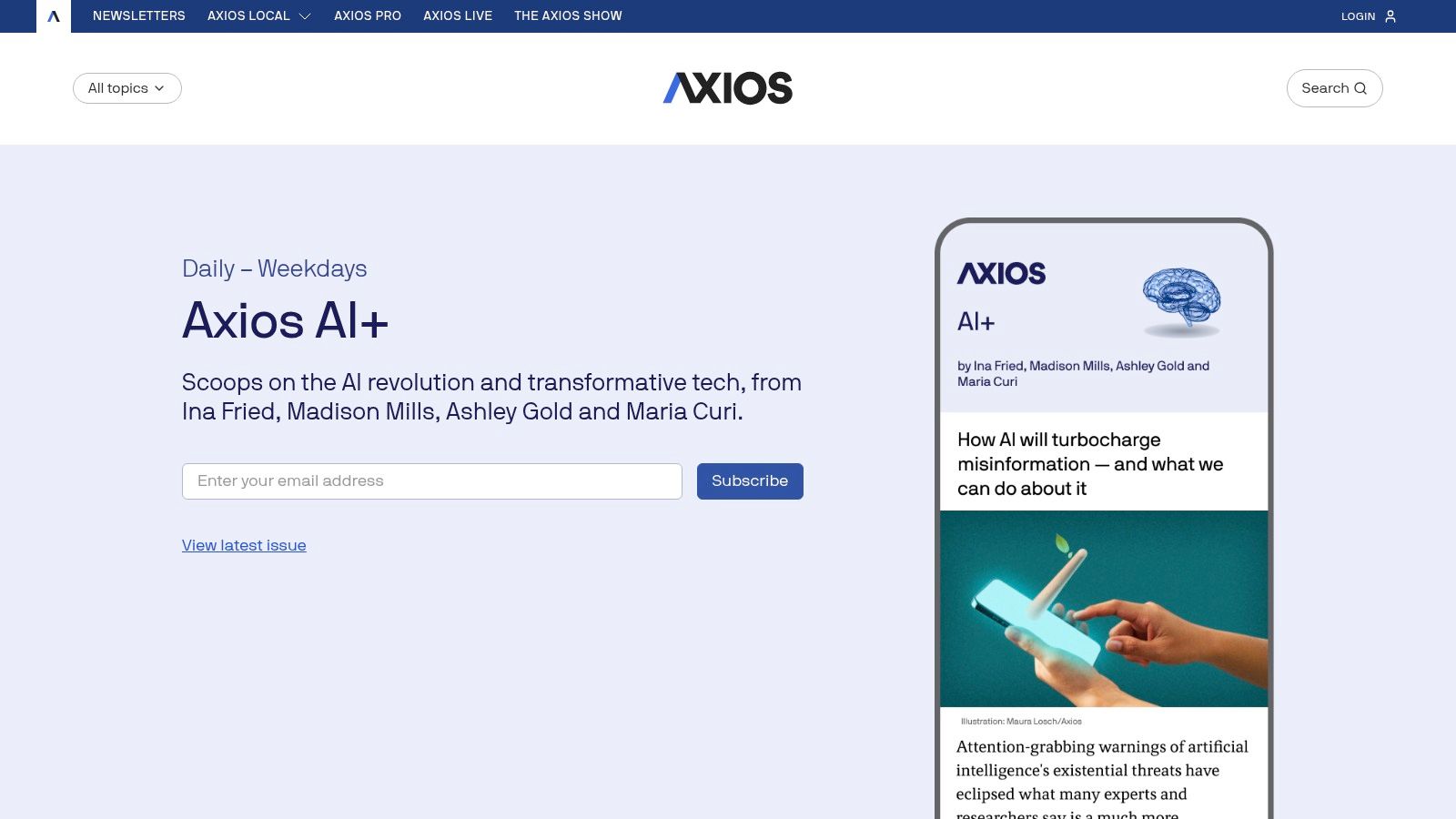
Axios AI+ excels at providing concise, actionable context. It doesn't just mention a new piece of legislation. It explains what it means for enterprise adoption, who is lobbying for or against it, and the immediate business implications. The format is designed for quick scanning. A busy executive can grasp the week's key developments in minutes.
Key Features and Content Focus
What makes Axios AI+ a go-to artificial intelligence weekly for decision-makers is its laser focus on the "so what" behind the headlines. A typical issue distills complex regulatory discussions and industry chess moves into clear summaries. This perspective is vital for organizations looking to integrate new systems while remaining compliant. It is smart.
- Policy and Regulation: Timely updates on hearings, proposed legislation, and agency actions affecting AI development and deployment.
- Enterprise Adoption and Market Moves: Analysis of how major companies are using AI, alongside news of significant investments and strategic shifts.
- Smart Brevity Format: Each story is extremely concise, often using bullet points to highlight key takeaways for quick consumption.
Pros and Cons Analysis
The newsletter’s primary strength is its direct, U.S.-centric policy lens, making it practical for risk assessment and compliance planning. The "Smart Brevity" writing style is perfectly suited for its target audience of busy leaders who need to stay informed without getting bogged down in technical jargon. You will understand the business climate. If you're looking for how these business trends translate into practical tools, you can explore the use of AI tools for business automation.
Its tight focus is also a limitation. Readers seeking deep technical breakdowns or academic research summaries will find it lacking. The content is heavily weighted towards policy and market news. It avoids underlying engineering or data science innovations.
Expert Insight: Axios AI+ is the first email I check to understand the regulatory temperature. It's the perfect brief for any leader who needs to answer the board's questions about AI risk and opportunity, not just the technical team's. It keeps the business conversation grounded in reality.
Axios AI+ is a free subscription available directly from the Axios website. Its disciplined focus on the business and political forces shaping the industry makes it an indispensable weekly resource.
6. AI Weekly (aiweekly.co)
For those who prefer a rapid, link-heavy briefing, AI Weekly has been a reliable fixture in the community for years. It operates as a straightforward roundup that curates significant news and resources across AI research, industry trends, and practical applications. Its design principle is speed. The newsletter is built for quick scanning, offering concise summaries that link directly to the source material for anyone wanting a deeper look.
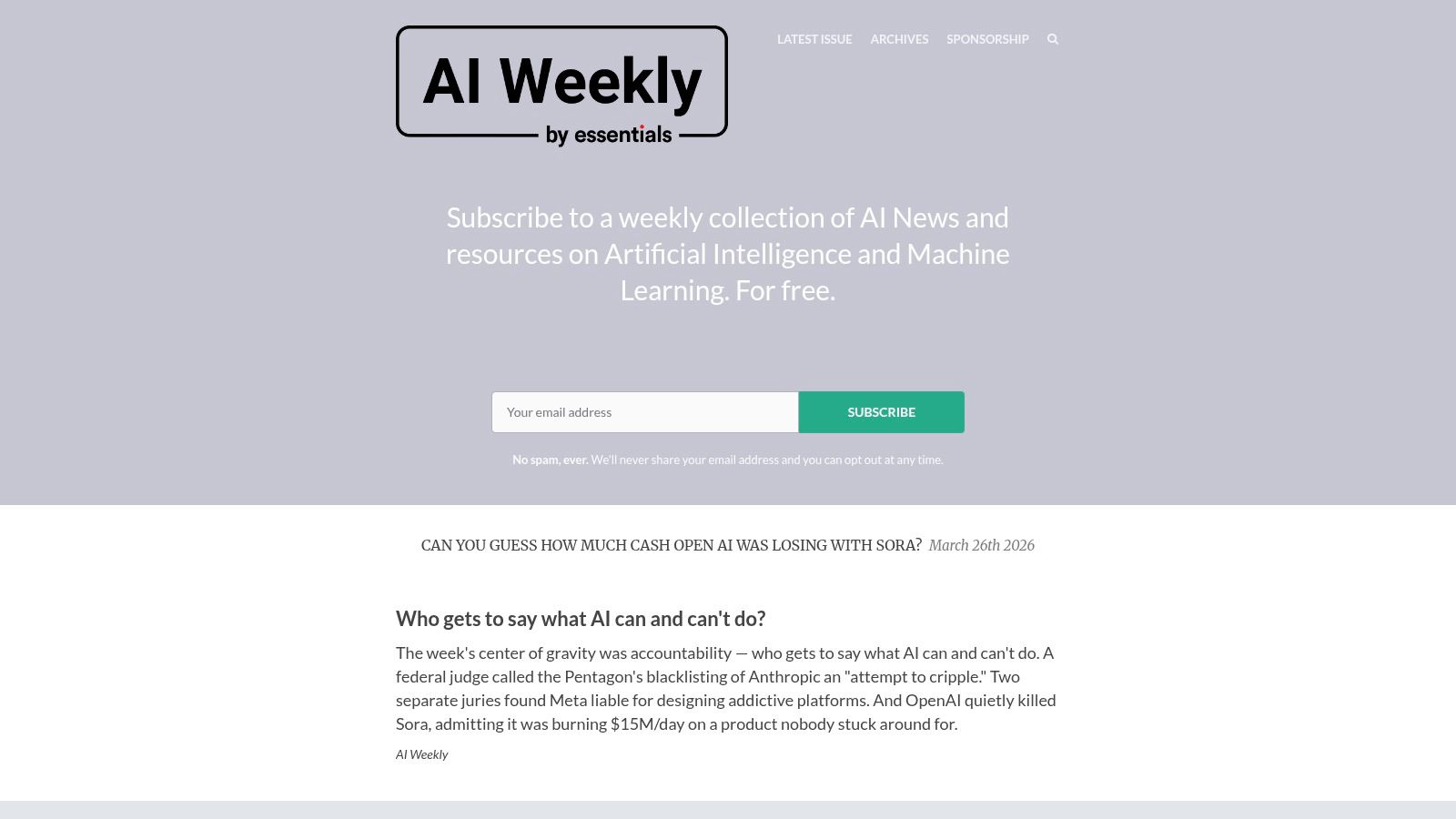
AI Weekly’s strength is its curated efficiency. Instead of providing deep original analysis, it acts as a skilled librarian. It points you to the most important articles, papers, and discussions of the week. This makes it an excellent choice for busy professionals who need to stay informed but lack the time to sift through dozens of sources themselves. The structure is clean and predictable. It just works.
Key Features and Content Focus
What solidifies AI Weekly as a go-to artificial intelligence weekly is its consistent and balanced curation. Each issue is a digest of links grouped into logical sections. This makes it simple to find what is most relevant to your interests, from new models to market shifts. It is very organized.
- Top AI News: A collection of the most impactful headlines from major tech publications and industry blogs.
- Research & Tools: Links to noteworthy academic papers, open-source projects, and new developer tools.
- Business & Startups: Updates on funding rounds, product launches, and how companies are commercializing AI.
- Media: A selection of must-watch videos or listen-to podcasts from the week's AI discourse.
Pros and Cons Analysis
The newsletter’s biggest advantage is its reliability and no-nonsense approach. Its consistent weekly cadence and simple, shareable format make it easy to forward to team members or use as a basis for internal discussions. You know exactly what you are getting.
However, its primary focus on curation means it offers very little original reporting or deep analysis. Readers looking for unique takes or in-depth explanations of complex topics will need to click through to the source articles. It is fundamentally a high-quality aggregation service. It is not a source of original thought leadership.
Expert Insight: AI Weekly is my digital water cooler. It’s the first thing I scan on a Friday to catch anything I might have missed. I can get the gist in two minutes and flag 2-3 links to read over the weekend. For pure awareness, its signal-to-noise ratio is hard to beat.
AI Weekly is free and you can subscribe directly on the AI Weekly website. Its disciplined curation secures its place as an essential, time-saving briefing for anyone in the AI space.
7. AI‑Weekly (ai-weekly.ai)
For teams that prioritize reliability and a straightforward digest of the week's AI news, AI-Weekly delivers with impressive consistency. This free service is a pure aggregation and curation platform. It publishes every Tuesday at 6:00 AM ET like clockwork. Its purpose is clear: to provide a predictable, no-frills summary of news, articles, and projects without the deep analysis found in more editorialized publications. It’s for the professional who needs headlines.
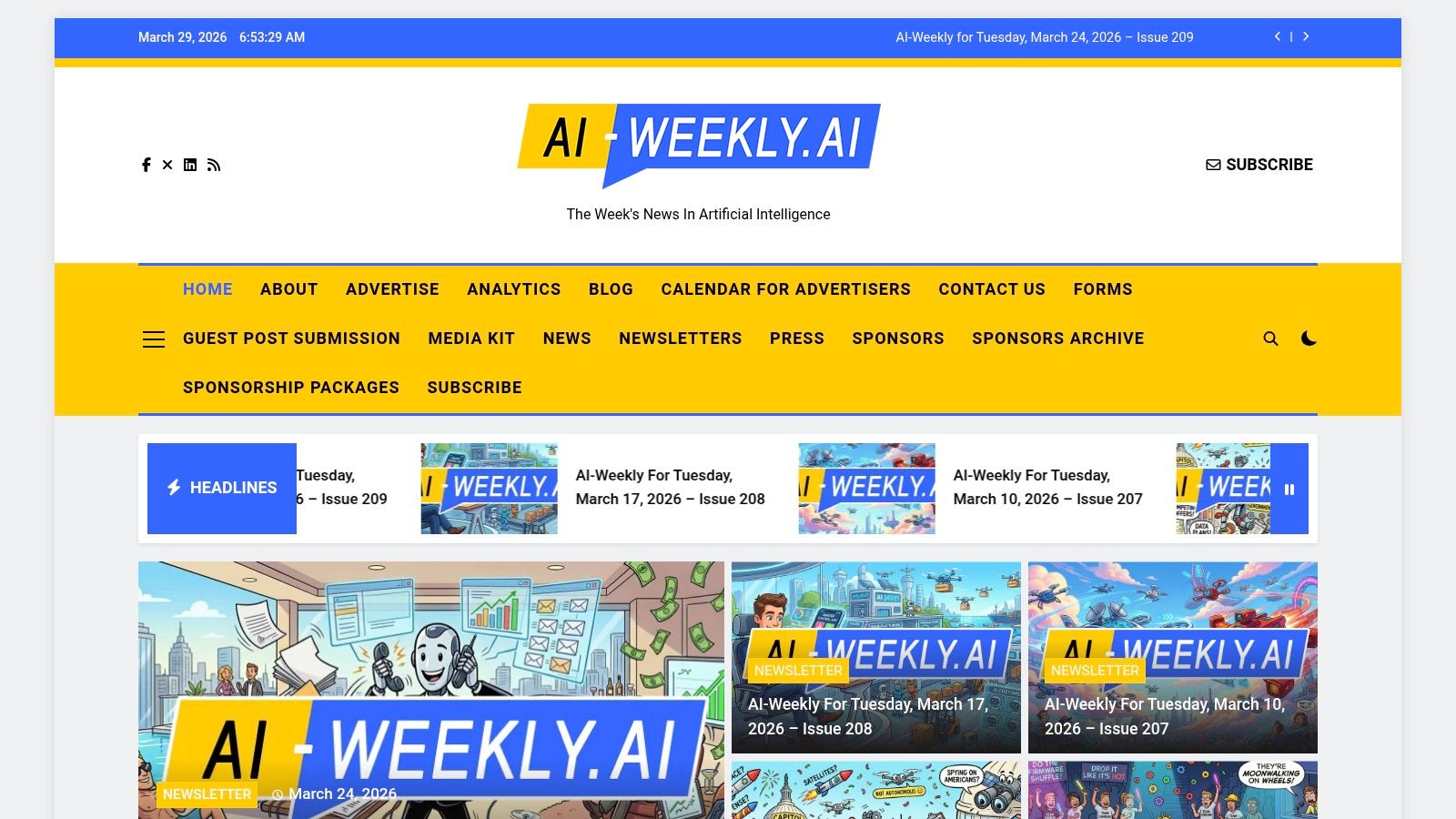
AI-Weekly stands out with its transparent, human-in-the-loop workflow. While AI assists in gathering potential stories, human editors make the final selections. This ensures relevance and quality. This balanced approach creates a dependable artificial intelligence weekly brief that is both broad and scannable, perfect for a quick morning update. The format is clean, accessible, and designed for easy consumption.
Key Features and Content Focus
The newsletter's value comes from its disciplined structure and transparent operations. It doesn't pretend to be an analytical journal. It is a meticulously compiled list of what you need to know from the past week. This makes it a reliable tool for staying current.
- Consistent Schedule: Arrives every Tuesday morning, making it easy to integrate into a weekly routine.
- Transparent Curation: A human-in-the-loop process ensures that while the net is cast wide, the final links are hand-picked for relevance.
- Public Metrics: The platform openly publishes its subscriber numbers and sponsorship details, adding a layer of credibility.
Pros and Cons Analysis
The biggest strength of AI-Weekly is its predictability and compliance-focused approach. The clear editorial standards and adherence to regulations like CAN-SPAM and PECR make it a safe choice for corporate environments. Its simple, accessibility-minded formatting means it can be easily shared and digested by entire teams. Very dependable.
However, its primary function as an aggregator is also its main limitation. Readers seeking original analysis or deep explorations of research papers will need to look elsewhere. Additionally, the regular presence of sponsor content, while clearly marked, might be a distraction for some users who prefer a purely editorial experience.
Expert Insight: I recommend AI-Weekly to operations managers and IT leaders. Its dependable schedule and link-based format make it perfect for populating internal wikis or team chat channels with relevant AI news, keeping everyone informed without requiring a deep time commitment.
AI-Weekly is completely free and you can subscribe directly on the ai-weekly.ai website. Its commitment to structured, reliable curation makes it an essential resource for professionals who value efficiency.
7 AI Weekly Newsletters Comparison
| Item | Implementation complexity 🔄 | Resource requirements ⚡ | Expected outcomes 📊 | Ideal use cases 💡 | Key advantages ⭐ |
|---|---|---|---|---|---|
| Oryndex | Low — browseable directory, minimal setup 🔄 | Minimal — web access; optional submissions ⚡ | Faster tool discovery and shortlist for evaluation 📊 | Founders, builders, operators selecting production-ready tools 💡 | Operator-curated listings + traffic-informed leaderboard ⭐ |
| The Batch (DeepLearning.AI) | Low — weekly newsletter, simple subscribe 🔄 | Low — short reads for busy practitioners ⚡ | Actionable research-to-product insights for teams 📊 | Engineers and product/ops leaders applying research 💡 | Trusted analysis balancing technical and business angles ⭐ |
| Import AI (Jack Clark) | Low — subscription; irregular cadence 🔄 | Moderate — requires time to digest dense issues ⚡ | Strategic foresight on safety, governance, and risk 📊 | Executives, boards, and policy-focused leaders 💡 | Deep, expert-driven perspectives on safety and impact ⭐ |
| Last Week in AI (newsletter + podcast) | Low — weekly text/audio editions 🔄 | Moderate — choose text or audio for commute ⚡ | Broad weekly overview with editorial context 📊 | Multitaskers and builders who prefer audio + text 💡 | Dual-format delivery with clear editorial “so what” ⭐ |
| Axios AI+ | Low — concise weekly briefings 🔄 | Low — very skimmable for executives ⚡ | Timely policy and market impact updates for planning 📊 | Compliance teams, execs tracking regulation and markets 💡 | Executive-friendly “Smart Brevity” on policy and adoption ⭐ |
| AI Weekly (aiweekly.co) | Low — consistent weekly curation 🔄 | Low — quick skim and link follow-ups ⚡ | Reliable link-rich roundup for staying informed 📊 | Teams that forward and archive curated AI links 💡 | Long-running, balanced curation with archives ⭐ |
| AI‑Weekly (ai-weekly.ai) | Low — fixed Tuesday release, human+AI workflow 🔄 | Low — accessible formatting; some sponsor content ⚡ | Transparent, compliance-minded weekly summaries 📊 | Organizations valuing accessibility and editorial transparency 💡 | Clear editorial policy, published metrics, compliance focus ⭐ |
Final Thoughts
Navigating the constant stream of AI developments requires a strategic approach to information consumption. We've explored a spectrum of newsletters, from the tool-focused pragmatism of Oryndex to the deep research synthesis of The Batch and Import AI. Each serves a distinct purpose. They are your filters in an ocean of noise. The central takeaway is that there is no single best artificial intelligence weekly digest for everyone. The right choice depends on your role, goals, and knowledge level.
A common mistake is subscribing to too many newsletters. This leads to inbox fatigue and inaction. I once had over a dozen AI-related subscriptions. My inbox was a graveyard of unread emails, and the overwhelming volume ironically made me feel less informed. The counter-intuitive solution was to unsubscribe from all but two. I chose one for high-level research trends (Import AI) and one for practical tools (AI-Weekly). This forced focus was more effective. True mastery comes from deeply understanding what matters to you.
Your Action Plan for AI Information Mastery
How do you translate this list into a concrete strategy? Start with an honest self-assessment. Be realistic.
- For Startup Founders and Solo Builders: Your time is your most valuable asset. Your primary need is discovering tools that provide an immediate competitive advantage. Start with a tool-centric weekly like Oryndex or AI Weekly. Your goal is to find one new tool or workflow improvement each week that you can test.
- For Product and Operations Leaders: You need to understand both market trends and practical applications. A balanced diet is key. Consider pairing a policy and market-focused newsletter like Axios AI+ with a more technical one. This combination gives you the "what" and the "how," helping you make informed roadmap decisions.
- For Developers: Your focus is on implementation. A newsletter like Last Week in AI or The Batch provides crucial context on new models, frameworks, and coding assistants that can directly impact your work. Look for editions that link to GitHub repositories or technical papers to go beyond the summary.
- For Marketers and Creators: Automation and content generation are your priorities. Your search for the perfect artificial intelligence weekly should zero in on digests that consistently feature new generative AI tools for text, images, and video. You are looking for efficiency gains.
The ultimate goal is to move from passive consumption to active application. Don't just read summaries. Click the links. Test the tools. Try to replicate a tutorial. Build a small project based on a new research paper. An artificial intelligence weekly is not just reading material. It is a weekly dispatch of opportunities waiting to be seized. Select your source, commit to it, and turn its insights into your next success.
Tired of sifting through endless articles to find the right AI tools? Oryndex offers a curated, searchable database of AI solutions, acting as your on-demand version of an artificial intelligence weekly roundup. Find your next AI tool in minutes on Oryndex and accelerate your projects today.